The Mind Outside the Brain: Rethinking the Architecture of Intelligence
The octopus's distributed nervous system, where much of its processing power resides outside its central brain, offers a fascinating case study in cephalopod distributed cognition. This arrangement suggests a form of consciousness that, while anatomically different from vertebrates, may function similarly in key ways, meeting several criteria for basic awareness. As reviewed by Mather in Comparative Cognition & Behavior Reviews (2008, DOI: 10.1016/j.concog.2006.11.006), octopuses are highly advanced invertebrates, showing sophisticated learning, memory, and decision-making. They demonstrate flexibility in finding food and avoiding predators, which implies they can evaluate past experiences. This suggests they possess a "global workspace," a way for the animal to integrate information and focus its attention.
A decentralized nervous system challenges our traditional, brain-centric understanding of consciousness.
Anatomy of a Decentralized Self: How 500 Million Neurons Operate
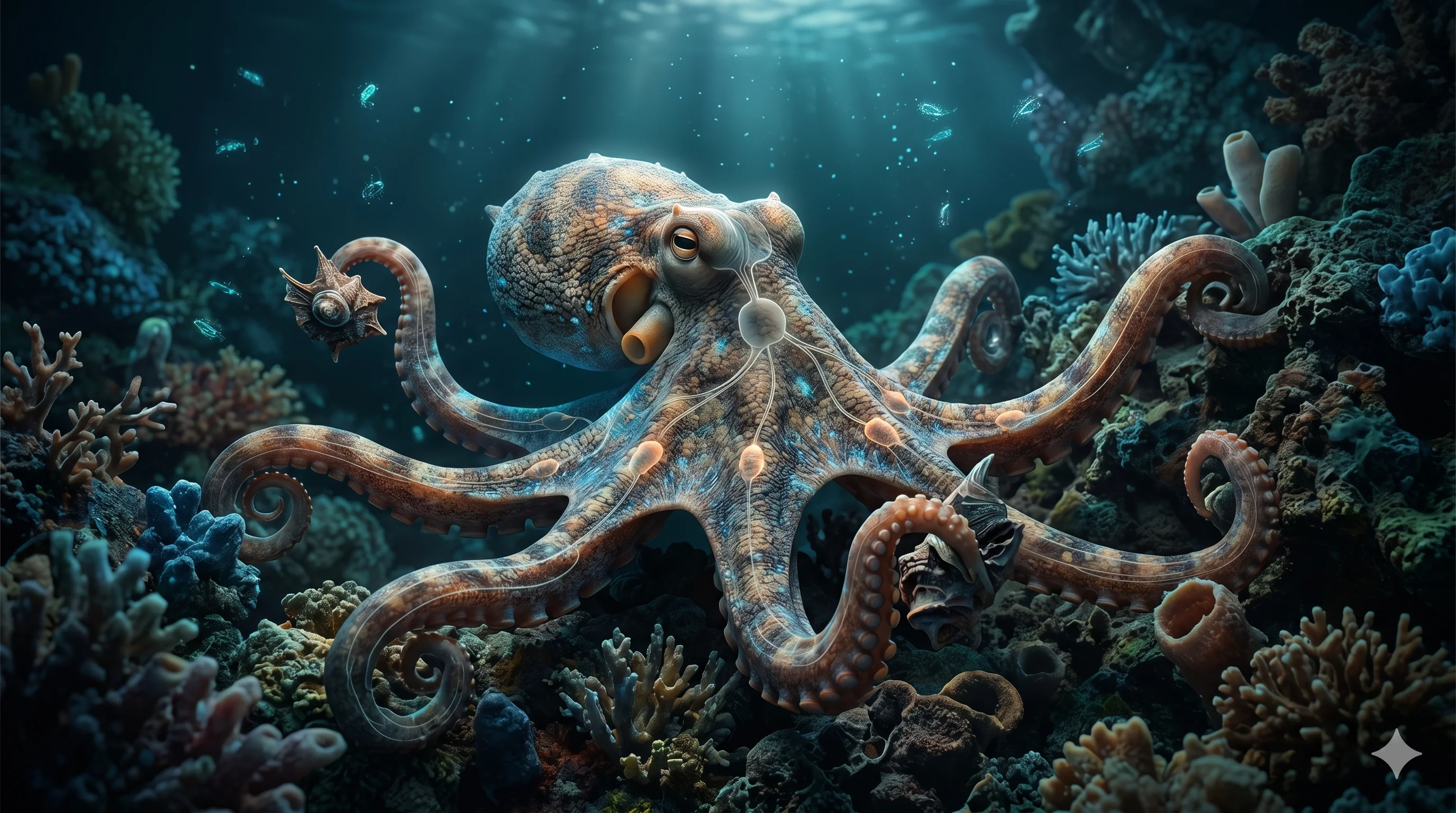
Imagine an animal whose very sense of self is distributed across its body, challenging our brain-centric understanding of consciousness. The octopus nervous system contains approximately 500 million neurons, which are the basic building blocks of the brain and nervous system. Roughly two-thirds of these—around 350 million—are located in its arms, rather than its central brain, which holds only about 50 million neurons. This central brain, or supraesophageal mass, is roughly the size of a walnut and sits between the octopus's eyes. This unique architecture embodies a form of distributed cognition, meaning intelligence is spread out, defying the typical idea that a single brain controls everything, as discussed by Carls-Diamante in Frontiers in Systems Neuroscience (2022, DOI: 10.3389/fnsys.2022.840022).
The Autonomous Arms
Each arm possesses its own neural circuitry, a network of nerves that allows it to perceive, make decisions, and control movement semi-autonomously. This means the arms can act with significant independence, without constant direction from the central brain. This distributed processing allows the arms to taste, touch, and independently solve localized problems through peripheral ganglia, which are nerve clusters that act like local processing stations. Carls-Diamante (2022) introduces the "octo-munculus" concept to describe how tactile (touch) and chemical (taste/smell) perception is mapped across these semi-autonomous arm circuits. This is similar to the "cortical homunculus" in mammals, which maps body sensations to the brain, but the octopus's version is structurally different and spread across its arms. This raises profound questions about where "experience" is localized within the organism.
A decentralized nervous system alters our understanding of animal intelligence and selfhood.
The Weight of Experience: Evaluating Affective Pain in Cephalopods
Do octopuses truly feel pain, or do they merely react to harmful stimuli? Behavioral and neurophysiological evidence suggests octopuses possess an affective pain experience, meaning they feel pain as an unpleasant emotional state, moving beyond simple nociceptive reflexes. Nociceptors are damage-detecting nerve endings that sense potential harm.
Evidence of Pain Aversion
In a study published in iScience, Crook (2021, DOI: 10.1016/j.isci.2021.102229) used a conditioned place preference assay, a test where animals learn to associate a location with a specific experience. Octopuses injected with acetic acid (a painful substance) in a specific chamber later avoided that environment. This indicates a learned aversion to pain-associated locations, as octopuses without the painful injection showed no such preference. The study further demonstrated that octopuses could associate a spatial context with a noxious experience and modify their behavior. When given access to a locally anesthetized area—an area numbed to pain—octopuses showed a significant preference for that location, suggesting they actively sought relief from ongoing pain. These findings suggest octopuses experience pain as an aversive emotional state, not just an unconscious reflex.
Understanding octopus pain reshapes our ethical considerations for their welfare.
Puzzles, Play, and Positive Valence: What Enrichment Reveals
Can octopuses experience rewarding states, not just avoid unpleasant ones? The emergence of play-like behavior suggests they can, indicating a capacity for positive valence, which refers to pleasant or rewarding emotional states.
Observing Play Behavior
Kuba et al. investigated this question in Journal of Comparative Psychology (2006, DOI: 10.1037/0735-7036.120.3.424). Their study showed that when octopuses were presented with novel objects across repeated testing sessions, their manipulation of these objects shifted. Initially, they might investigate the objects, but over time, they engaged in sustained, repetitious interactions. This behavior lacked immediate functional goals, consistent with diversive exploration and play. For example, an octopus might repeatedly push a floating bottle or squirt water at a toy without any obvious benefit like food or shelter. The emergence of this play-like behavior was modulated by object novelty and repeated exposure, suggesting that octopuses possess motivational systems for non-utilitarian engagement with their environment. This evidence for play indicates a capacity for positive valence, complementing findings on pain and suggesting a full affective spectrum, meaning they can experience a range of emotions.
Understanding octopus play changes our perception of their intelligence.
The Imminent Threat: The Ethical Crisis of Commercial Octopus Farming
The increasing recognition of cephalopod sentience, particularly their complex nervous systems and capacity for learning, presents a profound ethical crisis as commercial octopus farming looms. The European Parliament and Council of the European Union (2010) and the EFSA Panel on Animal Health and Welfare (2005) include hatched juveniles and adults in legislation covering experimental procedures likely to cause pain, suffering, distress, or lasting harm. This legal framework, as discussed by Fiorito et al. in Reviews in Fish Biology and Fisheries (2014, DOI: 10.1007/s10158-013-0165-x), requires harm-benefit assessments and adherence to the 3Rs principles (Replacement, Reduction, Refinement) in neuroscience research. The more evidence we gather on their complex cognitive abilities, the more urgent it becomes to prevent industrial-scale suffering in farming operations, which inherently challenge the application of these 3Rs principles. The development of commercial octopus farming poses a significant threat to the welfare of these intelligent creatures.
Our understanding of cephalopod sentience must influence future aquaculture practices.
The Legislative Tipping Point: Rewriting Animal Welfare Law
Scientific understanding is now outpacing existing legal frameworks, leading to significant changes in animal welfare law. The UK Animal Welfare Act 2022, enacted in April 2022, now explicitly recognizes octopuses and decapod crustaceans (like crabs and lobsters) as sentient beings, marking a significant shift in British legislation. This landmark decision was directly informed by an independent review commissioned by the UK government, as detailed by Birch, Burn, Schnell, Browning, & Crump (2021). Their review, which developed an eight-criterion framework for evaluating sentience, concluded there is strong evidence for sentience in octopuses and probable evidence in decapod crustaceans. These findings directly led to the amendment of the UK Animal Welfare Bill to include these taxa. Furthermore, the federal OCTOPUS Act, introduced in the United States in 2024/2025, cites this LSE sentience review as its scientific foundation to prohibit commercial octopus farming. These legislative changes reflect a growing global recognition of cephalopod sentience.
Evolving scientific understanding continues to reshape our legal and ethical obligations to other species.
Science-Backed Kindness: Protecting the Ocean's Most Complex Invertebrates
The octopus doesn't just challenge our conclusions about consciousness; it challenges our very questions. Understanding octopus consciousness requires theoretical frameworks that can accommodate multiple concurrent fields of awareness within a single organism, as Carls-Diamante argues in Frontiers in Systems Neuroscience (2022, DOI: 10.3389/fnsys.2022.840022). This shift from reactive welfare measures to proactive sentience-based protections is crucial. Mather concludes in Comparative Cognition & Behavior Reviews (2008, DOI: 10.1016/j.concog.2006.11.006) that cephalopod behavioral evidence satisfies multiple independent criteria for primary consciousness, a basic form of awareness. We must invent new research methodologies to study distributed consciousness, moving beyond assumptions of a single executive self. This fundamental change demands we block commercial octopus farming, support ethical research protocols, and protect benthic habitats, which are the seafloor communities where octopuses live.
We must redefine consciousness to include distributed minds.
Frequently Asked Questions
Q: How does an octopus's distributed nervous system work?
Imagine an animal whose very sense of self is distributed across its body, challenging our brain-centric understanding of consciousness. The octopus nervous system contains approximately 500 million neurons, with roughly two-thirds of these located in its arms rather than its central brain, or supraesophageal mass, which is roughly the size of a walnut. This decentralized architecture means each arm can perceive and act with significant independence from the central brain, with nerve clusters called distributed ganglia acting like local processing stations.
Q: Do octopuses experience affective pain?
Behavioral and neurophysiological evidence suggests octopuses possess an affective pain experience, meaning they feel pain as an unpleasant emotional state, moving beyond simple nociceptive reflexes (automatic reactions to damage-detecting nerve endings). Research, such as that by Crook (2021), indicates that cephalopods process noxious stimuli with more than simple reflexes, suggesting a genuine affective state, or emotional experience.
Q: What legal protections exist for octopuses?
The UK Animal Welfare Act 2022, enacted in April 2022, now explicitly recognizes octopuses and decapod crustaceans as sentient beings, marking a significant shift in British legislation. These findings directly led to the amendment of the UK Animal Welfare Bill to include these taxa. These legal developments reflect growing scientific consensus on cephalopod sentience and aim to prevent commercial exploitation, such as commercial octopus farming.
Sources
- Fiorito, G., et al. (2014). Cephalopods in neuroscience: regulations, research and the 3Rs. Reviews in Fish Biology and Fisheries. DOI: 10.1007/s10158-013-0165-x
- Mather, J. A. (2008). Cephalopod consciousness: behavioural evidence. Comparative Cognition & Behavior Reviews. DOI: 10.1016/j.concog.2006.11.006
- Crook, R. J. (2021). Behavioral and neurophysiological evidence suggests affective pain experience in octopus. iScience. DOI: 10.1016/j.isci.2021.102229
- Kuba, M. J., Byrne, R. A., Meisel, D. V., & Mather, J. A. (2006). When do octopuses play? Effects of repeated testing and object age on the emergence of play-like behaviour. Journal of Comparative Psychology. DOI: 10.1037/0735-7036.120.3.424
- Carls-Diamante, S. (2022). Where Is It Like to Be an Octopus?. Frontiers in Systems Neuroscience. DOI: 10.3389/fnsys.2022.840022