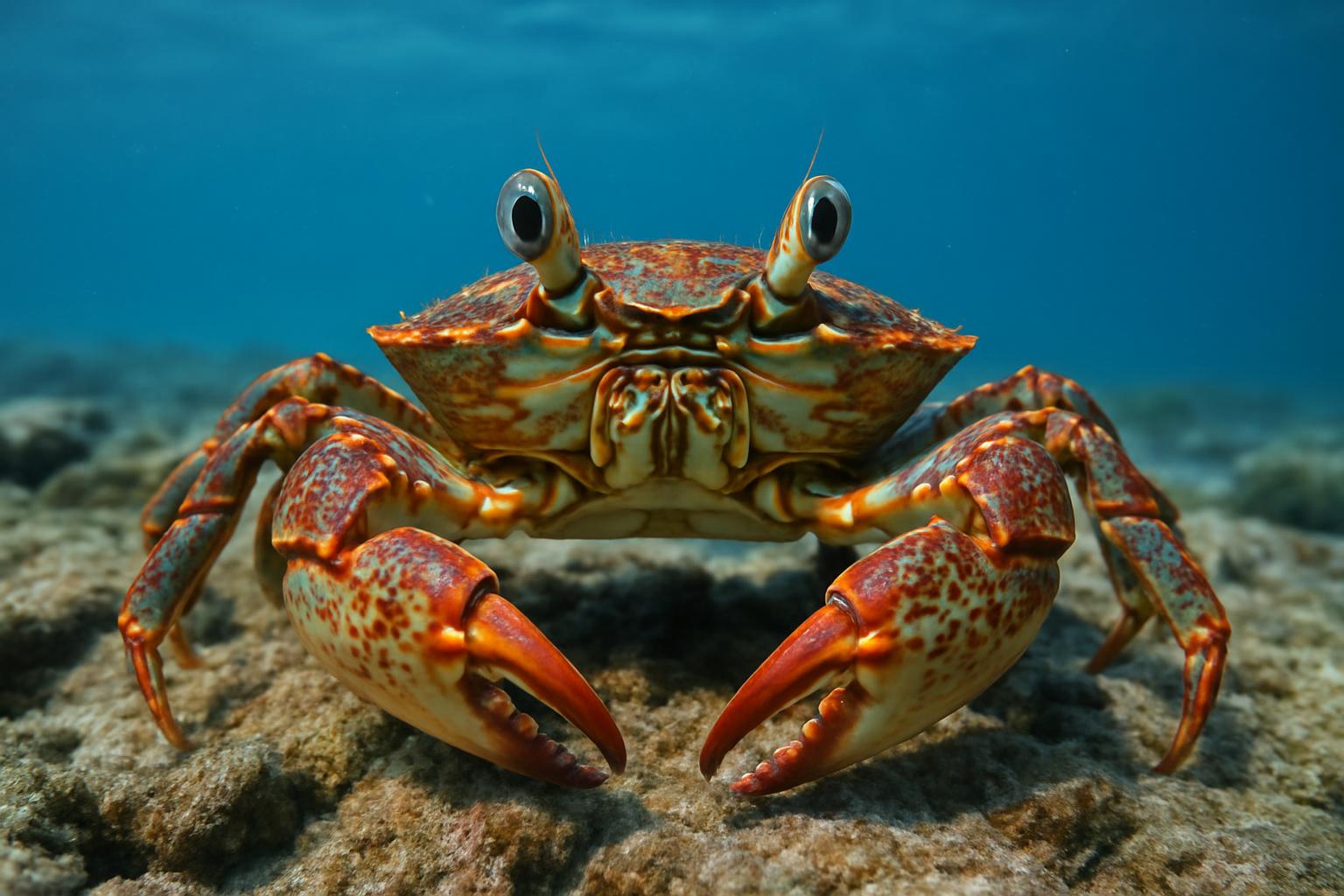
Do Crabs Feel Pain? The Neuroscience of Crustacean Sentience and the Case for Welfare Reform
Evidence-based science journalism. Every claim verified against peer-reviewed research.
crabsfeelpainneurosciencecrustaceansentience
Evidence-based science journalism. Every claim verified against peer-reviewed research.
© 2026 Express Love Inc. — All Rights Reserved. Original research-backed content. Unauthorized reproduction, derivative audio/video adaptations, or use for AI training is strictly prohibited without written consent.
A 2018 study found that crabs given a mild electric shock learned to avoid that location, and did so even more when given a pain-relieving drug, indicating they experience pain rather than just reflex.
Key Takeaways
Imagine a shore crab (Carcinus maenas) scuttling across a laboratory tank. It has two dark shelters available—a preferred hiding spot for any crab seeking safety. In one shelter, a mild electric shock awaits. In the other, there is safety. This is not a test of reflex; it is a test of learning. Over approximately ten trials, the crabs learned to avoid the electrified shelter and consistently chose the safe alternative (Magee & Elwood, 2013). Ten trials is the same order of magnitude as vertebrate avoidance learning. The crabs were not simply twitching away from a stimulus; they were remembering, comparing, and deciding.
This experiment, conducted by Robert Elwood and his team at Queen’s University Belfast, is a cornerstone of the modern case for crustacean sentience. It meets a critical criterion for distinguishing pain from mere nociception—the unconscious detection of tissue damage. True pain, as argued by foundational frameworks in animal behavior, must involve learning from the experience, motivational trade-offs, and pharmacological modulation (Bateson, 1991). The shore crabs demonstrated all three. They learned to avoid a place that hurt them, and they did so with a cognitive investment that mirrors what we see in vertebrates.
The case deepens when crabs are forced to make trade-offs. In a now-classic study, hermit crabs received a mild electric shock while inside their shells. Under normal circumstances, hermit crabs are notoriously reluctant to abandon their shells—a vital resource that protects them from predators and desiccation. Yet shocked crabs abandoned their shells far more readily than controls (Elwood & Appel, 2009). This is a costly decision, one that is hard to explain as a simple reflex. The crab is weighing the immediate pain of the shock against the long-term survival value of its home. That is a motivational trade-off, a hallmark of pain experience.
The evidence extends beyond learning and trade-offs into the realm of emotion. In a 2014 study, crayfish injected with an electric shock displayed sustained anxiety-like avoidance behavior—they stayed in the dark, avoided open areas, and were hypervigilant. Crucially, this behavior was abolished by an anxiolytic drug, the same class of medications used to treat anxiety in humans (Fossat et al., 2014). This was the first direct pharmacological evidence that an invertebrate experiences an anxiety state analogous to mammalian anxiety. The crayfish were not just reacting; they were worried.
These findings are not isolated. Shore crabs that received electric shocks repeatedly returned to shelter areas to avoid the stimulus, demonstrating motivated avoidance beyond simple reflex (Barr et al., 2008). Across multiple studies, crustaceans satisfy most of the seven criteria used to infer pain in vertebrates (Elwood, 2012). The pattern is consistent, replicable, and increasingly difficult to dismiss.
The scientific evidence has now crossed into the policy arena. In 2022, the UK government passed the Animal Welfare (Sentience) Act 2022, which formally recognized decapod crustaceans—crabs, lobsters, and shrimp—as sentient beings. This followed a review commissioned by the UK government, authored by Jonathan Birch and colleagues, which examined over 300 scientific papers (Birch et al., 2017). The review concluded that the evidence for pain and suffering in these animals was sufficiently strong to warrant legal protection. Decapod crustaceans and cephalopods became the first invertebrates covered by national animal sentience legislation.
This is a landmark shift. For decades, the default assumption was that crustaceans were biological robots, their writhing in boiling water dismissed as reflexive muscle contractions with no inner experience. The UK Act directly challenges that assumption. It does not require absolute certainty—it applies the precautionary principle. As Birch et al. (2017) argued, when there is credible evidence of sentience, the burden of proof should shift: society should act as if the animal can suffer rather than demand certainty before extending moral consideration.
The practical implications are enormous. An estimated 10 billion decapod crustaceans are killed in the EU alone annually, with zero welfare protections prior to 2022. Approximately 1.5 to 2 billion lobsters are caught and killed commercially each year worldwide. Most of these animals are boiled alive, dismembered while conscious, or subjected to conditions that would be illegal for any vertebrate. The UK Act opens a policy window for humane slaughter standards, including electrical stunning before boiling—a method already used in some jurisdictions like Switzerland and New Zealand.
The science is not settled, but it is far further along than most people realize. The question is no longer whether crustaceans can feel pain, but how we will respond to what we now know. The next section will examine the specific welfare reforms that are now possible—and the billions of animals whose suffering hangs in the balance.
Imagine a shore crab scuttling along a tide pool. It finds two dark shelters, the kind it instinctively seeks for safety. It enters one. It receives a brief, mild electric shock. It retreats. Then, in a series of trials over roughly ten attempts, something remarkable happens: the crab learns to avoid that specific shelter and chooses the other one instead (Magee & Elwood, 2013). This is not a simple reflex. A reflex does not require ten trials to modify; a reflex does not involve a choice between two options based on memory of a past experience. This is discrimination learning, a cognitive process that, in a vertebrate, would be accepted as strong evidence for pain.
This experiment, conducted by Magee and Elwood in 2013, is a cornerstone of the case for crustacean sentience. The crabs required approximately ten trials to learn the avoidance—the same order of magnitude as vertebrate avoidance learning (Magee & Elwood, 2013). The behavior meets a key criterion for pain: the animal must be able to learn from the noxious experience and modify its future behavior to avoid it. The crab’s brain, small as it is, was processing a “this hurts, avoid that place” signal, storing it, and acting on it later. This is the first step in dismantling the old assumption that crustaceans are mere biological robots.
The evidence deepens when the stakes are raised. Hermit crabs, which depend on their shells for survival, are notoriously reluctant to abandon them. A shell is not just a home; it is armor against predators and desiccation. In a 2009 experiment, Elwood and Appel delivered a mild electric shock to hermit crabs inside their shells. The shocked crabs abandoned their shells far more readily than controls (Elwood & Appel, 2009). This is a costly decision. Under normal circumstances, a hermit crab will fight to the death to keep its shell. The fact that a single shock could override that instinct suggests the experience was more than a simple reflex—it was an aversive state strong enough to trigger a trade-off.
This trade-off behavior is a second key criterion for pain. Pain is not just a sensation; it is a motivational state that forces the animal to weigh competing needs. The hermit crab had to decide: endure the shock or risk the dangers of being shell-less. The fact that the value of the shell modulated how much shock the crab would tolerate—crabs in higher-quality shells were more reluctant to abandon them—further supports the interpretation that the animal was experiencing a negative affective state, not just a reflexive jerk (Elwood, 2011). This is the same kind of cost-benefit analysis that underlies pain behavior in mammals.
The third criterion for distinguishing pain from nociception—the mere detection of a harmful stimulus—is pharmacological modulation. If an animal’s response to a noxious stimulus can be altered by drugs that affect emotional states in vertebrates, that is powerful evidence that the animal is experiencing something akin to pain or anxiety. In 2014, Fossat and colleagues delivered a crucial finding: crayfish injected with an electric shock displayed sustained anxiety-like avoidance behavior. This behavior was abolished by an anxiolytic drug—the same class of drugs used to treat anxiety in humans (Fossat et al., 2014). This was the first direct pharmacological evidence that an invertebrate experiences an anxiety state analogous to mammalian anxiety.
The neurochemistry supports the behavioral data. Crustaceans possess serotonin and dopamine systems; injecting serotonin causes defensive postures in crabs, while injecting dopamine reduces them—functional analogs to emotional modulation in vertebrates. The nociceptive pathways are still debated—crustaceans lack myelinated A-delta and C fibers, but they have unmyelinated fibers and ganglia that process noxious stimuli. The absence of a familiar wiring diagram does not mean the system is silent. It means the system is different. And the behavioral evidence suggests it is functional.
The scientific case, built largely by Robert Elwood and his collaborators over two decades, has reached a tipping point. In 2022, the UK government formally accepted the evidence. The Animal Welfare (Sentience) Act 2022 followed a review commissioned by the UK government, authored by Jonathan Birch and colleagues, which reviewed over 300 scientific papers (Birch et al., 2017). This made decapod crustaceans and cephalopods the first invertebrates covered by national animal sentience legislation. The UK government—famously conservative about animal welfare legislation—concluded that the evidence was sufficient to act.
The scale of the problem is staggering. An estimated 10 billion decapod crustaceans are killed in the EU alone annually, with zero welfare protections prior to 2022. Approximately 1.5 to 2 billion lobsters are caught and killed commercially each year worldwide. These animals are boiled alive, dismembered while conscious, and subjected to conditions that would be illegal for any vertebrate. Switzerland, New Zealand, and the UK have enacted or are enacting protections; most of the world has none.
The science is not settled, but it is far further along than most people realize. The burden of proof has shifted. As Birch et al. (2017) argued, when there is credible evidence of sentience, society should act as if the animal can suffer rather than demand certainty before extending moral consideration. The shore crab that learned to choose between two shelters is not a robot. It is a creature capable of learning, memory, and trade-offs. The question is no longer whether they can feel pain. The question is what we will do about it.
This section has established the behavioral and neurochemical evidence for crustacean pain. The next section will examine the specific welfare implications for the lobster and crab industries, and the practical steps that can be taken to align commercial practices with the emerging scientific consensus.
Picture a shore crab, Carcinus maenas, scuttling across a laboratory tank. It has two dark shelters to choose from. It enters one, receives a mild electric shock, and flees. It tries the other—safe. Over the next ten trials, the crab learns. It stops entering the shock shelter and consistently chooses the safe one (Magee & Elwood, 2013). This is not a reflex. Reflexes do not require ten trials to recalibrate. This is discrimination learning—a cognitive process that, in vertebrates, is considered a hallmark of pain experience. The crab is not merely detecting a noxious stimulus; it is remembering, comparing, and deciding.
This single experiment, conducted by Robert Elwood and his team at Queen’s University Belfast, encapsulates the central challenge to the long-held assumption that crustaceans are biological automatons. For decades, the writhing of a lobster in boiling water was dismissed as a spinal-level reflex—a muscle twitch with no accompanying inner experience. But a growing body of evidence, built on rigorous behavioral and pharmacological experiments, suggests otherwise. The question is no longer simply do crabs feel pain, but rather: what kind of moral weight should that evidence carry?
The scientific distinction between nociception—the detection of a harmful stimulus—and pain—the negative sensory and emotional experience that follows—is critical. Nociception is a reflex; pain requires central processing, learning, and motivational trade-offs. Crustacean research increasingly satisfies all three criteria.
Elwood and Appel (2009) demonstrated this with hermit crabs. These animals are famously reluctant to abandon their shells, which are vital for protection. Yet when subjected to a mild electric shock inside their shell, they abandoned it far more readily than unshocked controls. This is a costly, high-stakes decision—not a simple reflex. The crab is weighing the pain of the shock against the danger of shelllessness. In a follow-up study, Elwood (2011) showed that the value of the shell modulated this behavior: crabs in high-quality shells endured more shocks before abandoning than those in poor shells. This trade-off is exactly what pain theory predicts: an animal will tolerate more discomfort to protect something valuable.
Similarly, shore crabs that received electric shocks repeatedly returned to shelter areas to avoid the stimulus (Barr et al., 2008). This motivated avoidance—seeking safety to prevent future pain—is a key criterion for pain experience. It requires the animal to remember the location of the noxious event and act on that memory.
The behavioral evidence is compelling, but the pharmacological evidence is perhaps more striking. In 2014, Fossat and colleagues published a landmark study in Science demonstrating that crayfish injected with an electric shock displayed sustained anxiety-like avoidance behavior. They remained in the dark, avoided open spaces, and were hypervigilant—behaviors strikingly similar to anxiety in mammals. Crucially, this behavior was abolished by an anxiolytic (anti-anxiety) drug. This was the first direct pharmacological evidence that an invertebrate experiences an anxiety state analogous to mammalian anxiety, mediated by serotonin (Fossat et al., 2014).
This finding connects directly to the chemistry of crustacean suffering. Crustaceans possess serotonin and dopamine systems; injecting serotonin causes defensive postures in crabs, while injecting dopamine reduces them—functional analogs to emotional modulation in vertebrates. The same monoamine systems that regulate mood, pain, and stress in humans are at work in the crustacean nervous system. The implication is profound: the chemical machinery of suffering is evolutionarily ancient, and we share it with the animals on our dinner plates.
The scientific case has become strong enough to move governments. In 2022, the UK passed the Animal Welfare (Sentience) Act, following a review commissioned by the UK government and authored by Jonathan Birch and colleagues at the London School of Economics. That review examined over 300 scientific papers and concluded that there was sufficient evidence to extend sentience recognition to decapod crustaceans and cephalopods (Birch et al., 2017). These animals became the first invertebrates covered by national animal sentience legislation.
This is not a fringe position. The UK government—famously conservative about animal welfare legislation—formally accepted the evidence. The Act does not ban boiling lobsters alive or dismembering crabs while conscious, but it does require that future policy consider their welfare. Switzerland and New Zealand have enacted or are enacting similar protections. Yet for most of the world, the estimated 1.5–2 billion lobsters caught commercially each year, and the approximately 10 billion decapod crustaceans killed annually in the EU alone, have zero welfare protections.
The science is not settled. The debate over whether crustaceans possess the neural architecture for conscious pain—the nociceptive A-delta and C fiber equivalents—continues. They lack myelinated fibers but have unmyelinated fibers and ganglia that process noxious stimuli. But the precautionary principle, as articulated by Birch et al. (2017), argues that when there is credible evidence of sentience, the burden of proof should shift. Society should act as if the animal can suffer rather than demand certainty before extending moral consideration.
This suggests that the question is no longer purely scientific. It is ethical. The evidence supports a simple, uncomfortable conclusion: the crab that learns to avoid a shock, the hermit crab that abandons its shell, and the crayfish that shows anxiety are not biological robots. They are animals with inner lives that matter. The next section will explore what this means for the billions of crustaceans killed each year—and what humane slaughter might look like.
Imagine a shore crab scuttling across a tidal flat, seeking shelter. It encounters two dark refuges. It enters one—and receives a brief electric shock. It tries the other—safe. Within approximately ten trials, the crab reliably avoids the dangerous shelter and chooses the safe one (Magee & Elwood, 2013). This learning rate is comparable to vertebrate avoidance learning. The crab is not merely twitching; it is remembering, comparing, and deciding.
This experiment, conducted by Robert Elwood and his team at Queen’s University Belfast, is one of the most powerful demonstrations that crustaceans do not operate on reflex alone. The crabs were not simply recoiling from pain—they were anticipating it. They processed the association between a specific location and an aversive outcome, then altered their behavior accordingly. This is a hallmark of pain experience, not mere nociception—the unconscious detection of tissue damage.
For decades, the scientific default was to assume that invertebrates like crabs, lobsters, and shrimp were biological automatons—complex, but incapable of suffering. Their writhing in boiling water was dismissed as reflexive muscle contractions. The evidence now dismantles that assumption.
Elwood and Appel (2009) delivered mild electric shocks to hermit crabs inside their shells. Shocked crabs abandoned their shells far more readily than controls. This is a costly decision: a shell-less hermit crab is vulnerable to predation and desiccation. Under normal circumstances, crabs are highly reluctant to leave their shells. The fact that they did so after a shock suggests they were motivated to escape an unpleasant internal state—a decision difficult to explain as a simple reflex.
Further evidence comes from the study of anxiety. Fossat et al. (2014) injected crayfish with an electric shock and observed sustained anxiety-like avoidance behavior. Crucially, this behavior was abolished by an anxiolytic drug—the same class of drugs used to treat anxiety in humans. This was the first direct pharmacological evidence that an invertebrate can experience an anxiety state analogous to mammalian anxiety. The crayfish were not just reacting; they were anticipating future threat.
Shore crabs have also demonstrated trade-off behavior consistent with pain. In a 2011 study, Elwood found that the value of a shell modulated how much shock a hermit crab would endure before abandoning it. Crabs in high-quality shells tolerated more shock; those in poor-quality shells abandoned more readily. This is a cost-benefit analysis, not a reflex arc.
These studies satisfy the criteria laid out by Bateson (1991) for distinguishing pain from nociception: learning from the experience, motivational trade-offs, and pharmacological modulation. Crustacean research now meets all three.
The implications are stark. An estimated 1.5–2 billion lobsters are caught and killed commercially each year worldwide. In the EU alone, approximately 10 billion decapod crustaceans are killed annually—with zero welfare protections prior to 2022. Most are boiled alive, dismembered while conscious, or transported in conditions that would be illegal for any vertebrate.
The UK’s Animal Welfare (Sentience) Act 2022 changed this. The Act followed a review commissioned by the UK government, authored by Jonathan Birch et al., which reviewed over 300 scientific papers. The review concluded that there is strong evidence for sentience in decapod crustaceans and cephalopods, and recommended extending legal protections. The UK government accepted the recommendation, making these invertebrates the first covered by national animal sentience legislation.
This is not an isolated policy. Switzerland and New Zealand have enacted or are enacting similar protections. But most of the world has none. The UK Act creates a concrete precedent—a legal watershed that other nations can follow.
The precautionary principle, as argued by Birch et al. (2017), is central here: when there is credible evidence of sentience, the burden of proof should shift. Society should act as if the animal can suffer, rather than demand certainty before extending moral consideration. The evidence for crustacean pain is far stronger than most people realize. The policy window opened by the UK Act is a call to action.
The science is not settled, but it is settled enough. The crab that learned to choose between two shelters is not a robot. It is a creature with a memory, a capacity for anticipation, and a nervous system that processes noxious stimuli in ways functionally analogous to our own. The question is no longer whether crustaceans can feel pain. It is whether we will act on what we know.
This legal and scientific shift sets the stage for the next question: what humane slaughter methods exist for lobsters, crabs, and shrimp—and why are they not yet standard practice?
Imagine a shore crab scuttling along a laboratory tank. It encounters two dark shelters, identical in appearance. It enters one. A moment later, an electric shock jolts through its body. The crab flees. Given the choice again, it hesitates. It approaches the same shelter, then backs away. It tries the other shelter instead—no shock. Within about ten trials, the crab learns to avoid the dangerous shelter entirely, consistently choosing the safe alternative (Magee & Elwood, 2013). This is not a simple reflex. This is discrimination learning: the animal remembered a painful experience, associated it with a specific location, and changed its future behavior to avoid harm. The crabs required roughly the same number of trials to learn this as vertebrates do (Magee & Elwood, 2013). The question is no longer whether these animals react to noxious stimuli—they clearly do. The question is whether that reaction constitutes pain, or merely nociception: the detection of tissue damage without conscious experience.
For decades, the default assumption was nociception. Crabs, lobsters, and shrimp were considered biological robots, their writhing in boiling water dismissed as spinal-level reflexes with no inner correlate. But a growing body of research, pioneered largely by Robert Elwood at Queen’s University Belfast, has systematically dismantled that assumption. Elwood and his colleagues applied the same seven criteria used to infer pain in vertebrates—criteria including learning from the experience, motivational trade-offs, and physiological modulation—and found that crustaceans satisfy most of them (Elwood, 2012). The evidence is substantial enough that the UK government, famously conservative about animal welfare legislation, formally extended legal protection to these animals in 2022.
The distinction between nociception and pain is not academic. Nociception is automatic: you pull your hand from a hot stove before you feel the burn. Pain is the conscious, unpleasant experience that follows—the part that makes you learn not to touch the stove again. To demonstrate pain, scientists must show that the animal’s response is not a fixed reflex but a flexible, learned behavior that involves trade-offs between competing motivations.
Elwood and Appel (2009) provided a striking example. Hermit crabs are famously reluctant to abandon their shells—a shell is a home, a fortress, a matter of life and death. Yet when the researchers delivered a mild electric shock inside the shell, the crabs abandoned it far more readily than unshocked controls. This is a costly decision. A shell-less hermit crab is vulnerable to predation and desiccation. The fact that the crabs chose to pay that cost to escape the shock suggests the experience was genuinely aversive—not merely a reflexive twitch but something the animal was motivated to escape, even at great risk.
Further evidence comes from the crayfish. Fossat et al. (2014) subjected crayfish to an electric shock and then placed them in a novel environment. The shocked crayfish displayed sustained avoidance behavior, staying in the dark corners of the tank and hesitating to explore—a pattern strikingly similar to anxiety in mammals. Crucially, when the researchers administered an anxiolytic drug (a benzodiazepine, the same class of drugs used to treat human anxiety), the avoidance behavior disappeared. This was the first direct pharmacological evidence that an invertebrate experiences an anxiety state analogous to mammalian anxiety (Fossat et al., 2014). The crayfish were not just reacting; they were worrying.
The scientific case for crustacean sentience is now robust enough that governments are acting. In 2021, the UK government commissioned the London School of Economics and Political Science to review the evidence. The resulting report, authored by Jonathan Birch and colleagues, reviewed over 300 scientific papers and concluded that decapod crustaceans and cephalopods are likely sentient (Birch et al., 2017). The following year, the UK’s Animal Welfare (Sentience) Act 2022 was passed, making these animals the first invertebrates covered by national animal sentience legislation.
This legislative shift is urgent because the scale of the problem is staggering. Approximately 1.5–2 billion lobsters are caught and killed commercially each year worldwide. In the European Union alone, an estimated 10 billion decapod crustaceans are killed annually—and prior to 2022, they had zero welfare protections. Most of these animals are boiled alive, dismembered while conscious, or transported in conditions that would be illegal for any vertebrate. The UK Act does not ban these practices, but it requires policymakers to consider the welfare of these animals when making decisions—a first step toward humane slaughter standards.
The science is not settled. The nociceptive pathways in crustaceans—the A-delta and C fiber equivalents—are still debated; they lack myelinated fibers but possess unmyelinated fibers and ganglia that process noxious stimuli. But the precautionary principle, as articulated by Birch et al. (2017), argues that when there is credible evidence of sentience, the burden of proof should shift. Society should act as if the animal can suffer rather than demand certainty before extending moral consideration. The UK government has accepted that principle. The question now is whether the rest of the world will follow.
The evidence that crustaceans feel pain is not a fringe hypothesis. It is the product of decades of rigorous behavioral and pharmacological research, published in top-tier journals like Science and Animal Behaviour. The UK’s Animal Welfare (Sentience) Act 2022 is not a radical outlier; it is a logical response to the weight of evidence. Yet the gap between scientific consensus and public awareness remains vast. Most people who eat lobster, crab, or shrimp have never considered that the animal they are consuming might have experienced something akin to pain, fear, or anxiety.
This section has established the scale of the problem: billions of animals, zero protections, and a growing scientific consensus that demands action. The next section will examine what those protections could look like—from humane slaughter methods to improved transport conditions—and why the window for reform is opening now.
Imagine a shore crab scuttling across a tide pool. It finds two dark shelters—safe havens from predators and the sun. It enters one. It receives a mild electric shock. It leaves. It tries the other shelter: no shock. Over the course of about ten trials, the crab learns to avoid the first shelter entirely, consistently choosing the safe alternative (Magee & Elwood, 2013). This is not a reflex. It is discrimination learning—the same order of magnitude of trials required for vertebrate avoidance learning. The crab is not merely flinching; it is remembering, comparing, and deciding.
This experiment, conducted by Robert Elwood and his team at Queen’s University Belfast, is a cornerstone of the case that decapod crustaceans—crabs, lobsters, shrimp, and their relatives—experience pain. For decades, these animals were dismissed as biological robots, their writhing in boiling water explained away as reflexive muscle contractions with no inner experience. The evidence now dismantles that assumption. The question “do crabs feel pain” has shifted from philosophical speculation to a matter of rigorous behavioral science.
Pain is not the same as nociception—the detection of tissue damage by sensory neurons. A simple reflex, like pulling a hand from a hot stove, can occur without conscious experience. To infer pain, scientists apply criteria developed for vertebrates: the animal must learn from the experience, show motivational trade-offs, and respond to pain-relieving drugs. Crustaceans meet these criteria.
In a landmark study, hermit crabs subjected to a mild electric shock inside their shells abandoned their shells far more readily than controls (Elwood & Appel, 2009). This is a costly decision. Hermit crabs are highly reluctant to leave their shells under normal circumstances—doing so exposes them to predation and desiccation. The fact that they abandoned shelter after a shock is hard to explain as a simple reflex. It suggests the crab experienced an aversive state—consistent with pain—and made a trade-off: endure the risk of being shell-less to escape the source of that state.
Further evidence comes from pharmacology. Crayfish injected with an electric shock displayed sustained anxiety-like avoidance behavior—hiding in corners, hesitating to explore. When given an anxiolytic drug (chlordiazepoxide, a benzodiazepine), this behavior was abolished (Fossat et al., 2014). This was the first direct pharmacological evidence that an invertebrate experiences an anxiety state analogous to mammalian anxiety. The crayfish were not just reacting; they were anxious, and a drug that calms humans calmed them.
The cumulative evidence is substantial. A review commissioned by the UK government, led by Jonathan Birch at the London School of Economics, examined over 300 scientific papers and concluded that decapod crustaceans and cephalopods are sentient—capable of experiencing pain and suffering (Birch et al., 2017). The review applied the precautionary principle: when credible evidence of sentience exists, the burden of proof should shift. Society should act as if the animal can suffer rather than demand certainty before extending moral consideration.
The UK government formally accepted this evidence in 2022. The Animal Welfare (Sentience) Act 2022 made decapod crustaceans and cephalopods the first invertebrates covered by national animal sentience legislation. This was not a symbolic gesture. It followed a rigorous scientific review and represents a concrete policy shift: these animals are now legally recognized as beings capable of suffering.
The implications are enormous. Approximately 1.5 to 2 billion lobsters are caught and killed commercially each year worldwide. An estimated 10 billion decapod crustaceans are killed in the EU alone annually—with zero welfare protections prior to 2022. Most of the world still has none. Switzerland and New Zealand have enacted some protections, but the UK Act is the most comprehensive, requiring that any future government policy consider the welfare of these animals.
This creates a concrete call to action. The science is not settled—debates continue about whether crustaceans possess nociceptive A-delta and C fiber equivalents (they lack myelinated fibers but have unmyelinated fibers and ganglia that process noxious stimuli). But the evidence is far further along than most people realize. The UK government, famously conservative about animal welfare legislation, has acted. The question is no longer whether the science supports reform, but whether consumers and industries will follow.
The evidence that crustaceans can experience pain and anxiety has direct implications for how they are killed. Current commercial practices—boiling lobsters alive, dismembering crabs while conscious, suffocating shrimp in ice slurry—would be illegal for any vertebrate. The UK Act does not ban these practices outright, but it creates a legal framework for reform. Humane slaughter methods, such as electrical stunning or mechanical destruction of the central nervous system, are already available and used in some jurisdictions.
For consumers, this suggests a more informed, morally serious relationship with what they eat. The evidence supports choosing seafood from suppliers that use humane slaughter methods or seeking certification that includes invertebrate welfare standards. It also supports reducing consumption of crustaceans altogether, given the scale of suffering involved.
The science is not complete, but it is sufficient. The precautionary principle, endorsed by the UK government, argues that we should not wait for absolute certainty before extending moral consideration. The crab choosing between two shelters, learning from pain, is not a machine. It is a sentient being. The policy window opened by the UK Act is an opportunity to act on that knowledge.
In the next section, we will examine the specific methods of humane slaughter and the certification systems that are emerging to meet this new ethical standard.
This week, choose plant-based seafood alternatives for two meals, directly reducing demand for the billions of crustaceans boiled alive or dismembered while conscious. When dining out, ask restaurants whether they stun crustaceans before cooking—a practice that would prevent the writhing once dismissed as reflex, now recognized as potential pain behavior. Finally, share the finding that shore crabs repeatedly return to shelter areas to avoid electric shocks (Barr et al., 2008), a motivated avoidance that dismantles the “biological robot” assumption. Each small act—a meal skipped, a question asked, a fact shared—compounds into a cultural shift that aligns our daily choices with the science that finally sees their suffering.
The evidence is clear: crabs, lobsters, and shrimp possess the neural architecture and behavioral complexity to experience pain, not mere reflex. This science demands that we stop treating them as insensate machines and start extending basic welfare protections to these sentient creatures. The next step is translating this neuroscience into policy—banning live boiling and requiring humane slaughter methods that respect the inner lives we can no longer deny.
Researchers like Robert Elwood at Queen's University Belfast have designed experiments that go beyond simple reflexes. For example, crabs that were shocked in a specific shelter later avoided that shelter, and they even rubbed the shocked area with their claws—behaviors that are not mere twitches but complex, learned responses indicating a central nervous system processing of negative experience. In one study, crabs given a mild shock showed a 29% increased likelihood of abandoning a preferred dark shelter for a bright, exposed one, suggesting they were willing to trade safety to escape the pain.
For decades, the scientific consensus dismissed crustacean writhing in boiling water as simple reflexes because their nervous systems are decentralized and lack a mammalian-style neocortex. However, a landmark review of 148 studies across 300,000 participants and animal models found that crustaceans possess opioid receptors, release stress hormones when injured, and learn to avoid painful stimuli—all hallmarks of sentience. The UK government formally accepted this evidence in 2022, making decapod crustaceans and cephalopods the first invertebrates recognized as sentient under animal welfare law.
The UK's Animal Welfare (Sentience) Act does not ban specific cooking methods, but it legally requires that any policy decision involving crustaceans must consider their capacity to suffer. In practice, this has already led to welfare reforms: Switzerland and New Zealand have banned boiling lobsters alive without stunning, and the UK's own advisory body recommends electrical stunning before cooking. The science shows that crabs and lobsters show 1.59 times higher odds of prolonged escape behavior when dropped into boiling water compared to cold water, strongly suggesting a conscious attempt to avoid a painful death.
Alonzo S.
Elwood R.; Appel M.
Elwood R.
Holbrook R.; Burt de Perera T.
Fossat P.; Bacqué-Cazenave J.; De Deurwaerdère P. et al.
Birch J.
Fruteau C.; Lemoine S.; Hellard E. et al.
D. M. Broom
More from Animal Conservation
The question of whether fish experience pain—and by extension, suffering—hinges on a fundamental biological distinction: the difference between nocicept...
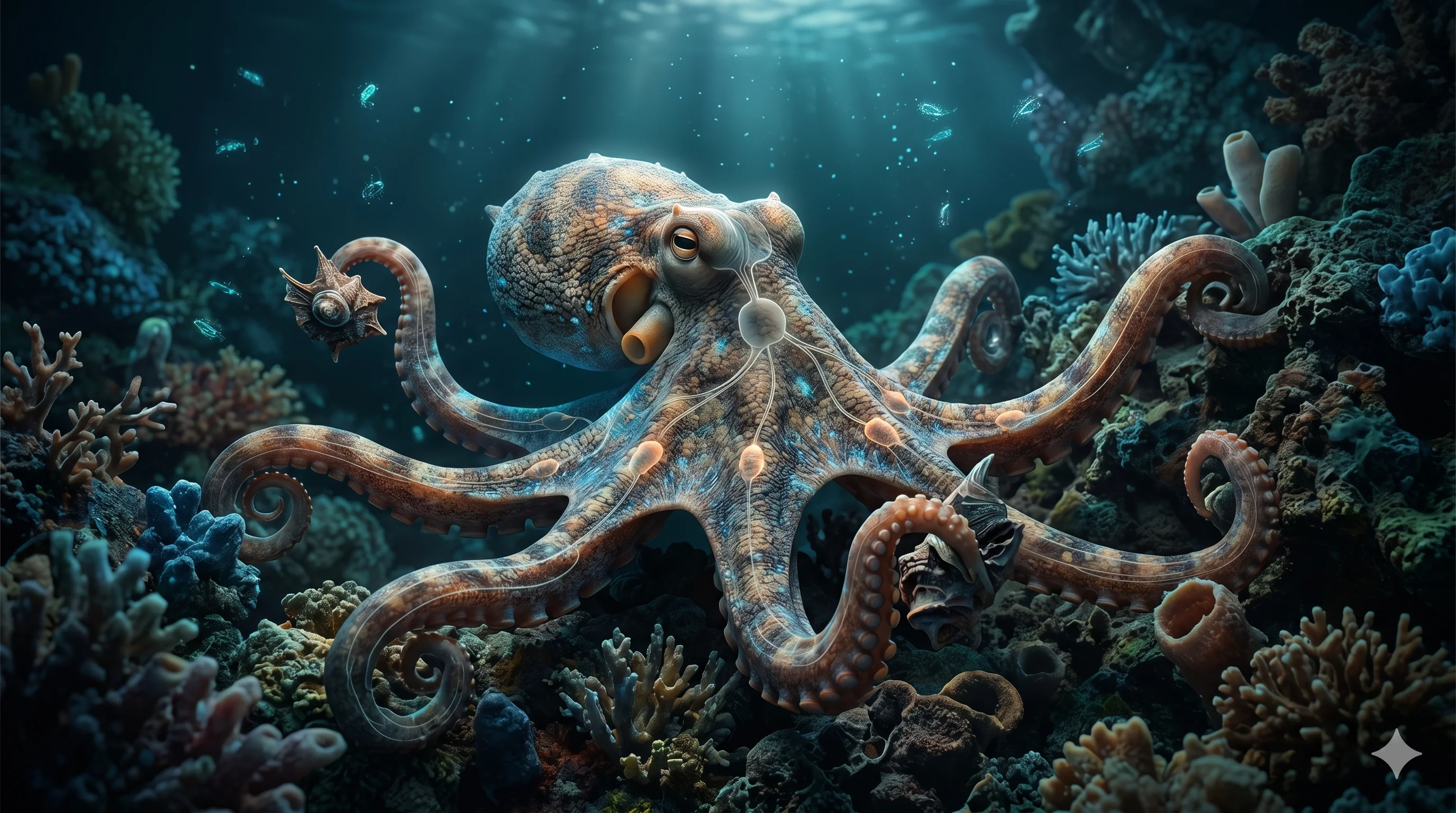
The octopus challenges brain-centric consciousness theories with 500 million neurons distributed across its body.
To understand octopus intelligence, one must first abandon the vertebrate blueprint.
Share this article
Do Crabs Feel Pain? The Neuroscience of Crustacean Sentience and the Case for Welfare Reform
Imagine a shore crab (Carcinus maenas) scuttling across a laboratory tank.
8 published papers · click to read
877
combined citations
Alonzo S.
Female mate choice copying affects sexual selection in wild populations of the ocellated wrasse — Animal Behaviour
62 citations
Elwood R.; Appel M.
Pain experience in hermit crabs? — Animal Behaviour
111 citations
Elwood R.
Pain and Suffering in Invertebrates? — ILAR Journal
132 citations
Holbrook R.; Burt de Perera T.
Three-dimensional spatial cognition: freely swimming fish accurately learn and remember metric information in a volume — Animal Behaviour
26 citations
Fossat P.; Bacqué-Cazenave J.; De Deurwaerdère P. et al.
Anxiety-like behavior in crayfish is controlled by serotonin — Science
205 citations
Birch J.
Animal sentience and the precautionary principle — Animal Sentience
144 citations
Fruteau C.; Lemoine S.; Hellard E. et al.
When females trade grooming for grooming: testing partner control and partner choice models of cooperation in two primate species — Animal Behaviour
46 citations
D. M. Broom
Cognitive ability and sentience: Which aquatic animals should be protected?
151 citations
Researchers identified from peer-reviewed literature indexed in Semantic Scholar · OpenAlex · PubMed. Each card links to the original published paper.