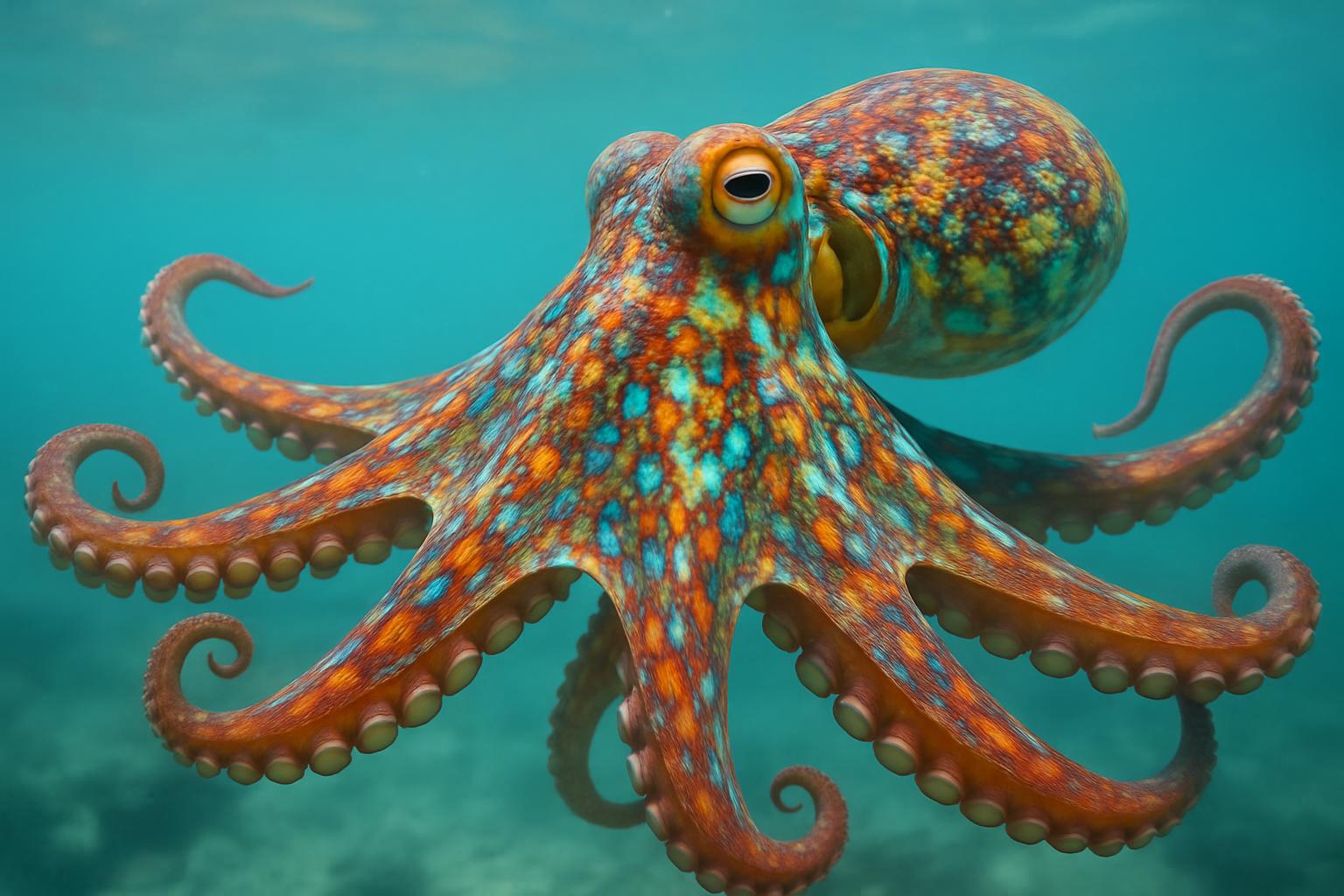
Octopus Intelligence: The Science of Cephalopod Consciousness and What It Means for Marine Animal Welfare
Evidence-based science journalism. Every claim verified against peer-reviewed research.
octopusintelligencesciencecephalopodconsciousnessmeans
Evidence-based science journalism. Every claim verified against peer-reviewed research.
© 2026 Express Love Inc. — All Rights Reserved. Original research-backed content. Unauthorized reproduction, derivative audio/video adaptations, or use for AI training is strictly prohibited without written consent.
Octopuses possess approximately 500 million neurons, with two-thirds distributed across their arms, enabling distributed cognition that challenges traditional models of centralized consciousness.
Key Takeaways
To understand octopus intelligence, one must first abandon the vertebrate blueprint. An octopus does not possess a single, centralized command center that dictates every movement. Instead, its nervous system is a radical experiment in distributed cognition. With approximately 500 million neurons total, roughly two-thirds—about 350 million—are distributed across its eight arms (Hochner, 2012). This is not a simple relay system. The arms process information semi-autonomously; the central brain issues high-level commands, but the arms solve the intricate problems of coordination, texture discrimination, and local response on their own (Hochner, 2012). An arm can explore a crevice, taste a surface through its suckers, and decide to pull away from a threat before the central brain has even registered the event. This architecture has profound implications for how we understand octopus cognition and, critically, octopus pain.
The distributed nervous system means that injury is not a single, centrally processed event. Research on Octopus bimaculoides has demonstrated that arm injury produces lasting hypersensitivity and altered behavior, consistent with the experience of pain rather than a mere nociceptive reflex (Alupay, Hadjisolomou & Crook, 2014). The arm itself becomes a site of sustained, heightened sensitivity. This is not a simple alarm signal; it is a persistent, localized state that alters the animal’s future decisions. Parallel work in squid has confirmed that cephalopods possess nociceptors that display widespread long-term sensitization, involving both peripheral and central mechanisms that directly parallel vertebrate pain systems (Crook et al., 2013). The evidence supports the conclusion that when an octopus is injured, it does not just detect damage—it suffers, and that suffering may be amplified by the very architecture that makes its intelligence so alien.
The cognitive capabilities of octopuses extend far beyond reflexive problem-solving. The landmark observation of veined octopuses (Amphioctopus marginatus) carrying coconut shell halves across the seafloor and later assembling them into shelters represents the first confirmed case of tool use in an invertebrate (Finn, Tregenza & Norman, 2009). This behavior is not instinctual; it requires prospective planning. The octopus collects a shell it cannot immediately use, transports it, and stores it for a future need it can anticipate. This is forward-thinking cognition, a capacity once thought exclusive to vertebrates.
Further evidence of complex cognition comes from observational learning. Octopus vulgaris can learn a task simply by watching another octopus perform it, a hallmark of social learning previously believed to be a vertebrate specialty (Fiorito & Scotto, 1992). This ability implies a basic form of theory of mind—the capacity to recognize that another individual has intentions and knowledge that can be observed and replicated. When combined with tool use, the picture is clear: octopus cognition is not a collection of clever reflexes but a flexible, forward-looking intelligence.
Intelligence is not merely about solving puzzles; it is also about having a consistent, individual way of engaging with the world. Research on Octopus rubescens has documented that individual octopuses possess measurable personality traits, including boldness, activity, and reactivity (Mather & Anderson, 1993). Some individuals are consistently exploratory; others are consistently cautious. This variation is not noise—it is personality, a finding with major welfare implications. It means that each octopus in a fishery or laboratory is an individual with a unique behavioral profile, not a interchangeable unit.
Play behavior provides another window into octopus sentience. Laboratory observations have documented octopuses engaging in repetitive, non-functional behaviors—such as manipulating floating objects or directing water jets at toys—that serve no immediate survival purpose. This is the definition of play, and it is a strong behavioral indicator of sentience because it requires an internally motivated state of positive affect. An animal that plays is an animal that experiences something beyond mere survival.
This evidence—distributed intelligence, tool use, observational learning, personality, and play—converges on a single, uncomfortable conclusion. Octopuses are not just clever invertebrates. They are sentient beings with a rich inner life, and the global fisheries that catch billions of them annually operate without any welfare protections. The next section will examine the scale of this moral blind spot and what the evidence demands of us.
The evidence for octopus intelligence extends far beyond the laboratory jar. In the wild, veined octopuses (Amphioctopus marginatus) demonstrate a cognitive capacity once considered a hallmark of vertebrate intelligence: tool use with prospective planning. Researchers documented these octopuses collecting discarded coconut shell halves from the seafloor, carrying them across the sediment, and later assembling them into portable shelters (Finn, Tregenza & Norman, 2009). The critical detail is that the octopus collects the shells before it needs them—it cannot use the shell while carrying it, and the shelter is only assembled later when the octopus encounters a threat or needs to rest. This is not a reflexive response to immediate danger; it is forward-thinking behavior, anticipating a future need for protection.
This finding challenges the long-held assumption that tool use requires a vertebrate-style central brain. The octopus’s distributed nervous system—with roughly 350 million of its 500 million total neurons spread across the eight arms—means that the arms themselves may participate in the planning and execution of such complex tasks (Hochner, 2012). The central brain sends broad commands, but the arms process information semi-autonomously, solving sub-problems like how to grip the awkward shell while crawling across uneven terrain. This distributed architecture suggests that octopus cognition is not merely a scaled-down version of vertebrate intelligence but a fundamentally different way of being intelligent.
Perhaps more startling is the evidence that octopuses learn by observing one another. In a landmark experiment, Octopus vulgaris watched a demonstrator octopus learn to discriminate between a red and a white ball to obtain food. The observer octopuses, without any direct training, then performed the same task at significantly above-chance levels—they had learned by watching (Fiorito & Scotto, 1992). This demonstration of observational learning was previously thought to be exclusive to vertebrates, requiring a capacity for social cognition that solitary animals were not expected to possess.
The implications are profound. Observational learning requires the observer to recognize that another individual’s actions are goal-directed, to remember those actions, and to reproduce them in a new context. This suggests a basic form of theory of mind—the ability to attribute mental states to others—or at least a sophisticated capacity for behavioral mimicry that serves the same function. For an animal that lives alone and meets conspecifics primarily to mate or fight, this social learning capacity is evolutionarily unexpected. It implies that octopus cognition is flexible enough to adapt to social information even in a largely solitary lifestyle.
The combination of tool use, prospective planning, and observational learning forces a reconsideration of what intelligence means. The octopus brain evolved on a completely separate evolutionary branch from vertebrates—their last common ancestor was a simple worm-like creature over 500 million years ago. Yet they have converged on cognitive abilities that rival or exceed those of many vertebrates. As philosopher-biologist Peter Godfrey-Smith has argued, cephalopods represent “the closest thing to an alien intelligence we are ever likely to encounter” (Godfrey-Smith, 2016). Their nervous system is not a primitive version of ours; it is an alternative solution to the same evolutionary problems of predation, foraging, and survival.
This strangeness is precisely why the evidence demands moral attention. The octopus does not think like a dog, a dolphin, or a human. It thinks like an octopus—with arms that have minds of their own, with skin that acts as a cognitive output, and with a lifespan of only 12-24 months that compresses an entire cognitive life into a period shorter than most vertebrate research projects. When we watch an octopus open a jar, we are not watching a simple reflex or a trained trick. We are watching a mind that evolved in isolation from our own lineage, solving a problem it never encountered in its evolutionary history, using cognitive tools that include prospective planning, observational learning, and a distributed neural architecture that challenges our very definition of consciousness.
The question that follows is uncomfortable: if we grant moral consideration to animals based on their cognitive capacities—their ability to plan, to learn, to suffer—then where does the octopus stand? The evidence places them alongside many vertebrates that already receive welfare protections. The next section will examine what the octopus nervous system reveals about their capacity for pain and suffering, and why the billions of cephalopods caught in global fisheries each year may experience a level of distress that our current regulatory frameworks refuse to acknowledge.
The octopus does not merely change color; it thinks in color. When a common cuttlefish settles onto a bed of pebbles, its skin transforms within milliseconds to match the exact size, contrast, and texture of the substrate beneath it. Roger Hanlon of the Marine Biological Laboratory at Woods Hole has documented over 50 distinct camouflage patterns in cuttlefish alone, each requiring the simultaneous real-time control of hundreds of thousands of independently operated pigment cells called chromatophores (Mathger et al., 2009). This is not a passive physiological reflex like a chameleon’s hormonal color change. In cephalopods, each chromatophore is a tiny sac of pigment surrounded by radial muscle fibers, and those fibers are connected directly to the nervous system. The animal’s brain—or, more accurately, its distributed nervous system—must compute the visual scene, extract its relevant features, and issue commands to thousands of individual skin cells in parallel, all while the animal is moving, hunting, or hiding.
The cognitive demands of this process are staggering. Cephalopods are colorblind—their eyes contain only a single type of photoreceptor—yet they produce precise color-matching camouflage that fools the trichromatic vision of fish and birds. How they accomplish this remains one of the great unsolved puzzles in sensory biology, but the leading hypothesis involves detecting polarization patterns in light, processing that information through a sophisticated neural circuit, and translating it into a skin-color output that the animal itself cannot see (Mathger et al., 2009). This is active decision-making, not instinct. The skin, in effect, becomes a cognitive organ—an externalized display of the animal’s perceptual and computational state.
The evidence that chromatophore control is not merely camouflage but a form of intentional expression comes from studies of agonistic interactions. Scheel, Godfrey-Smith, and Lawrence (2017) documented that octopuses use specific postures, skin coloration patterns, and movements to signal dominance and threat during encounters with conspecifics. This was the first demonstration of intentional communication in solitary cephalopods—animals previously assumed to interact only through reflexive aggression or avoidance. The researchers observed that octopuses would darken their skin, raise their bodies on stiffened arms, and enlarge the webs between their arms in a display that reliably preceded retreat by the other animal. Critically, these signals were not automatic; they were deployed selectively, depending on the context and the identity of the opponent. This requires the octopus to recognize another individual, assess its likely behavior, and choose a signal that will produce a desired outcome—a cognitive capacity that, in vertebrates, we would not hesitate to call social intelligence.
The distributed nervous system makes this even more remarkable. With roughly 350 million neurons spread across the eight arms and only 150 million in the central brain, the octopus does not control its skin from a single command center (Hochner, 2012). Instead, the central brain sends high-level instructions—"match this background," "signal dominance"—and the local neural networks in each arm handle the fine-grained execution. This is what Binyamin Hochner (2012) called "embodied cognition": the body itself participates in the computation. The arms process sensory information semi-autonomously, and they can even solve sub-problems—like navigating a maze or opening a jar—without direct input from the central brain. The skin, too, may have its own local processing capacity, making the entire body a distributed cognitive system.
This distributed architecture has profound implications for how we understand octopus sentience. If the skin is an organ of cognitive expression, then injuring the skin is not merely damaging tissue—it is disrupting a computational system. The evidence for octopus pain supports this view. Alupay, Hadjisolomou, and Crook (2014) demonstrated that arm injury in Octopus bimaculoides produces long-term behavioral and neural hypersensitivity consistent with pain experience, not merely nociceptive reflex. The animals groomed the injured site, avoided using the injured arm, and showed heightened sensitivity to touch that persisted well after the wound healed. In squid, Crook et al. (2011, 2013) found that nociceptors display both peripheral and central sensitization mechanisms that parallel vertebrate pain systems, with lasting peripheral sensitization persisting after the injury has resolved. This is not a simple reflex arc; it is a complex, centrally processed experience that alters behavior over time.
The implications for marine animal welfare are stark. Global cephalopod catch is approximately 3.5–4 million metric tons per year, predominantly squid but including significant octopus fisheries. These animals are caught by trawling, jigging (hooks through the body), and live tank transport—methods that would be unthinkable for a vertebrate of comparable cognitive capacity. Yet cephalopods are explicitly excluded from virtually all commercial fisheries welfare protections. The European Union’s 2013 decision to include cephalopods in research animal protections under Directive 2010/63/EU was a landmark—the first invertebrates to receive any such protections—but commercial fisheries remain entirely unregulated.
The philosopher-biologist Peter Godfrey-Smith has called cephalopods "the closest thing to an alien intelligence we are ever likely to encounter" (Godfrey-Smith, 2016). That alienness is precisely why we owe them careful moral consideration. Their intelligence evolved on a completely separate branch of the evolutionary tree, their experience of the world may be radically unlike ours, and their distributed nervous system means that suffering may be experienced not just in a central brain but across the entire body. We extended welfare protections to fish in research slowly and partially; cephalopods deserve the same arc. The evidence of their cognition, their pain, and their sentience is no longer in doubt. The question is whether we will act on it.
This brings us to the next pillar: the evidence for play, personality, and curiosity in octopuses—behaviors that, in vertebrates, are considered hallmarks of conscious experience.
An octopus in a laboratory does not merely solve a puzzle; it becomes the puzzle. When presented with a child-proof jar, its arms do not fumble. They explore, test, and manipulate with a precision that suggests a mind at work. If a dog performed the same feat, we would call it intelligent without hesitation. The hesitation we feel for the octopus is a cognitive bias, not a biological reality. The evidence for octopus sentience is now so robust that the burden of proof has shifted: the question is no longer if they are conscious, but what their consciousness is like.
The answer begins with the octopus nervous system, a structure so alien it challenges our very definition of intelligence. An octopus possesses approximately 500 million neurons (Hochner, 2012). To put that in perspective, that is more neurons than a typical rat and comparable to some mammals. But the critical detail is where those neurons live. Roughly 350 million—two-thirds of the total—are distributed across the eight arms (Hochner, 2012). This is not a central brain sending commands to passive limbs. The arms process information semi-autonomously. They can solve sub-problems—like opening a latch or navigating a maze—without waiting for instructions from the central brain. This distributed architecture has profound implications for cephalopod consciousness. Pain, in an octopus, is not merely a signal sent to a central processor. It is experienced peripherally, at the site of injury, in a way that may intensify suffering. When an arm is injured, the local neural network continues to register and respond to damage, creating a persistent state of hypersensitivity that outlasts the wound itself (Alupay, Hadjisolomou & Crook, 2014). This is not a simple reflex; it is the architecture of a distributed, embodied awareness.
This distributed intelligence is not just for feeling; it is for thinking. The landmark demonstration of tool use in the veined octopus (Amphioctopus marginatus) shattered the old assumption that tool use was a vertebrate privilege. Researchers documented these octopuses carrying coconut shell halves across the seafloor, later assembling them into portable shelters (Finn, Tregenza & Norman, 2009). This behavior requires prospective planning: the octopus collects and carries a shell it cannot yet use, anticipating a future need for shelter. This is not instinct; it is forward-thinking, goal-directed behavior.
Even more striking is the evidence for social learning. In a classic experiment, Octopus vulgaris observed another octopus being trained to choose one of two colored balls for a food reward. The observing octopuses then chose the correct ball significantly more often than chance, without any direct training themselves (Fiorito & Scotto, 1992). This demonstration of observational learning—a hallmark of social cognition previously thought exclusive to vertebrates—suggests that octopuses possess a basic theory of other minds. They watch, they learn, and they apply that knowledge. When combined with the evidence for consistent, measurable personality traits—including boldness, activity, and reactivity—the picture of octopus cognition becomes unmistakably rich (Mather & Anderson, 1993). These are not automatons; they are individuals with distinct temperaments.
Perhaps the most alien aspect of cephalopod consciousness is the skin itself. The chromatophore system—hundreds of thousands of independently controlled pigment cells driven directly by the nervous system—makes camouflage an act of real-time cognitive processing (Mathger et al., 2009). Roger Hanlon has documented over 50 distinct camouflage patterns in cuttlefish, each requiring simultaneous control of millions of cells. The astonishing fact that cephalopods are colorblind yet produce precise color-matching camouflage suggests they process light polarization and texture through a cognitive system we do not fully understand.
This is not mere reflex. Recent research has documented that octopuses use posture, skin coloration patterns, and movement to signal dominance and threat during agonistic interactions (Scheel, Godfrey-Smith & Lawrence, 2017). This is intentional communication—a form of signaling that requires the animal to assess its opponent, choose a signal, and modulate its display in real time. The skin, in effect, becomes a cognitive output, a visible expression of an internal state.
The most ethically urgent evidence concerns octopus pain. The distinction between nociception (reflexive detection of tissue damage) and pain (conscious suffering) is critical. The evidence increasingly points toward the latter. In squid (Doryteuthis pealeii), nociceptors display both peripheral and central long-term sensitization, with heightened pain responses persisting well after the wound heals (Crook et al., 2013). This parallels vertebrate pain systems and suggests conscious suffering rather than mere reflex. Directly in Octopus bimaculoides, arm injury produces long-lasting behavioral and neural hypersensitivity, consistent with the experience of pain (Alupay, Hadjisolomou & Crook, 2014). These animals do not just detect damage; they remember it, they avoid it, and they suffer from it.
This evidence carries immense weight for marine animal welfare. Globally, approximately 3.5–4 million metric tons of cephalopods are caught every year, with zero welfare protections in commercial fisheries. The EU’s 2013 decision to include cephalopods in research animal protections was a historic first—the first invertebrates to receive any such recognition—but commercial fisheries remain entirely unregulated. Billions of octopuses, squid, and cuttlefish die by trawling, jigging, and live transport without any consideration of their capacity for suffering.
As Peter Godfrey-Smith has argued, cephalopods are the closest thing to an alien intelligence we are ever likely to encounter. Their consciousness evolved on a completely separate branch of the tree of life. That strangeness is precisely why we owe them careful consideration, not dismissal. The evidence for octopus intelligence and sentience is overwhelming. The question is whether we will have the moral consistency to act on it.
This section has explored the neuroscience and behavior that establish octopus sentience. Next, we turn to the practical question: what does this mean for the billions of cephalopods caught in global fisheries, and what would a precautionary approach to their welfare look like?
An octopus in a laboratory does not hesitate. Presented with a child-proof jar, its arms move with a fluid, almost alien precision. Within seconds, the seal is broken. If a dog performed the same task, we would call it intelligent without a second thought. The hesitation we feel with the octopus is not a failure of the animal’s biology, but a failure of our imagination. The evidence for octopus intelligence is not merely suggestive; it is overwhelming, and it forces a radical re-evaluation of what consciousness can be.
The foundation of this intelligence is a nervous system unlike any other. An octopus possesses approximately 500 million neurons—more than most fish and comparable to some mammals. But the critical detail is where those neurons live. As Hochner (2012) demonstrated, roughly 350 million of those neurons—two-thirds of the total—are distributed across the eight arms, not concentrated in a central brain. This is not a simple spinal cord relaying signals; each arm contains its own semi-autonomous neural network. The central brain issues high-level commands—"find food," "open the jar"—but the arms solve the sub-problems of movement and manipulation themselves. They can learn, remember, and even react to stimuli after being severed from the body. This distributed architecture has profound implications for octopus sentience. Pain is not merely a signal sent to a central processor; it is experienced peripherally, at the site of injury, in a way that may intensify and prolong suffering. The octopus nervous system is a decentralized network of intelligence, and its experience of injury is similarly decentralized.
This intelligence is not just reactive; it is prospective. The veined octopus (Amphioctopus marginatus) collects discarded coconut shell halves from the seafloor, carries them across the open sand, and later assembles them into a portable shelter (Finn, Tregenza & Norman, 2009). This is tool use, but more importantly, it is prospective planning. The octopus carries a shell it cannot use now, anticipating a future need for shelter. This is not reflex; it is forward-thinking cognition. Octopus cognition also extends to social learning. Fiorito & Scotto (1992) showed that Octopus vulgaris can learn to discriminate between a red and a white ball simply by watching another octopus perform the task. This observational learning—a hallmark of social intelligence previously thought exclusive to vertebrates—requires the octopus to form a basic model of another’s actions. The evidence supports that these animals are not solitary automatons; they are learning from each other.
The octopus’s intelligence is not locked inside its head. It is written across its skin. Cephalopods control hundreds of thousands of independently operated pigment cells, called chromatophores, driven directly by the nervous system (Mathger et al., 2009). This makes camouflage an act of real-time cognitive processing, not a fixed instinct. Roger Hanlon has documented over 50 distinct camouflage patterns in cuttlefish alone, each requiring simultaneous control of a massive neural array. Remarkably, cephalopods are colorblind, yet they produce precise color-matching camouflage. This suggests they process information about light polarization and texture through a cognitive channel we do not fully understand.
This skin-based cognition is also used for communication. Scheel, Godfrey-Smith & Lawrence (2017) documented that octopuses use posture, skin coloration patterns, and movement to signal dominance and threat during agonistic interactions. This is intentional communication—a deliberate signal sent to another animal—previously unrecognized in these solitary creatures. The skin is not a passive canvas; it is an extension of the octopus cognition system, a dynamic output of a mind that is constantly processing and deciding.
If intelligence were merely about solving problems, the case might be closed. But the evidence for octopus sentience goes deeper, into the realm of personality and affect. Mather & Anderson (1993) documented that individual octopuses (Octopus rubescens) have consistent, measurable personality traits—boldness, activity, and reactivity. Some are explorers; others are cautious. This individual variation is a hallmark of a conscious, self-regulating animal, not a reflex machine. Lab observations have also recorded octopuses playing with floating pill bottles, engaging in repetitive, non-functional behavior that serves no survival purpose—the definition of play. As Jennifer Mather has argued, play requires an internally motivated state of positive affect, a strong behavioral indicator of sentience.
The most consequential evidence, however, concerns octopus pain. The distinction is critical: nociception is the reflexive detection of tissue damage; pain is the conscious, negative experience of that damage. The research points increasingly toward the latter. Crook et al. (2011) showed that injured squid display lasting peripheral sensitization—a heightened pain response—that persists well after the wound has healed. This is not a simple reflex; it is a functional change in the nervous system that alters future behavior. Alupay, Hadjisolomou & Crook (2014) directly demonstrated that arm injury in Octopus bimaculoides produces long-term behavioral and neural hypersensitivity, consistent with the experience of pain. The animals guard the injured arm, avoid contexts associated with the injury, and show altered behavior that outlasts the tissue damage. This correlation does not determine individual outcomes, but the evidence supports that cephalopods experience suffering, not merely a nociceptive reflex. Correlation is not destiny
The cognitive and behavioral evidence for octopus intelligence and sentience stands in stark contrast to their legal status. The global cephalopod catch is approximately 3.5-4 million metric tons per year, predominantly squid but including significant octopus fisheries. These animals are caught using trawls, jigging hooks that pierce their bodies, and live tank transport—all without any welfare protections. The European Union took a small step in 2013, including cephalopods in research animal protections (Directive 2010/63/EU), making them the first invertebrates to receive any such recognition. But commercial fisheries remain entirely unregulated. The most intelligent invertebrate on Earth dies in agony at scale, and we collectively look away.
This suggests a profound moral inconsistency. We have slowly, partially extended welfare protections to fish in research; cephalopods deserve the same arc. As Peter Godfrey-Smith has written, "Cephalopods are the closest thing to an alien intelligence we are ever likely to encounter." Their intelligence evolved on a completely separate branch of the tree of life. Their experience of the world may be radically unlike ours. And that strangeness is precisely why we owe them careful consideration, not dismissal. The evidence for marine animal welfare is no longer a question of whether these animals can suffer, but of whether we will act on what we know.
This cognitive convergence—intelligence emerging from a radically different body plan—forces us to ask what consciousness actually is. The octopus is not a lesser version of a vertebrate. It is a different solution to the same problem: how to be a thinking, feeling animal in a dangerous world. The next section examines how this alien intelligence navigates its environment through problem-solving and tool use, revealing a mind that plans, learns, and remembers.
The octopus does not think like us. Its 500 million neurons are not packed into a single central brain; roughly 350 million of them are distributed across eight arms, each capable of processing information semi-autonomously (Hochner, 2012). When an octopus opens a child-proof jar, its arms solve the mechanical sub-problems without waiting for instructions from above. This is not a reflex. It is a radically different architecture for intelligence—one that evolved entirely independently from the vertebrate line, separated by over 600 million years of evolutionary history. And it is precisely this strangeness that makes the moral question so urgent.
We hesitate to call an octopus intelligent because its mind does not look like ours. But the evidence has accumulated to the point where hesitation is no longer a scientific position—it is a cognitive bias. Consider the landmark study by Fiorito & Scotto (1992): Octopus vulgaris learns by watching other octopuses solve problems. This observational learning, once thought exclusive to vertebrates, requires the observer to form a mental model of another individual’s actions and replicate them. It is a form of social cognition that implies a basic theory of other minds. If a dog did this, we would not hesitate. Why do we hesitate with an octopus?
The answer lies in the same bias that once denied pain to fish, consciousness to mammals, and moral worth to anyone outside our tribe. But the science has moved on.
The octopus nervous system is not a smaller version of ours. It is a distributed network where the arms contain their own neural circuitry, capable of learning, memory, and even problem-solving without central brain involvement (Hochner, 2012). This has profound implications for how we understand suffering. When an octopus is injured, the pain is not merely a signal sent to a central processor. It is experienced locally, in the arm itself, and it persists.
Alupay, Hadjisolomou & Crook (2014) demonstrated that arm injury in Octopus bimaculoides produces lasting behavioral and neural hypersensitivity—consistent with the experience of pain, not a mere nociceptive reflex. The animals groomed the injured site, avoided further contact, and showed heightened sensitivity that outlasted the tissue damage. This is not a simple alarm system. It is suffering.
The same research group found that squid possess nociceptors with both peripheral and central sensitization mechanisms that parallel vertebrate pain systems (Crook et al., 2013). The evolutionary convergence is striking: two separate lineages, separated by half a billion years, arrived at the same solution for detecting and responding to tissue damage. If the mechanism looks like pain, and the behavior looks like pain, the precautionary principle demands we treat it as pain.
The case for octopus sentience does not rest on pain alone. It rests on a suite of cognitive capacities that, in vertebrates, we take as markers of conscious experience.
Finn, Tregenza & Norman (2009) documented veined octopuses (Amphioctopus marginatus) carrying coconut shell halves across the seafloor, then later assembling them into shelters. This is tool use, yes—but more importantly, it is prospective planning. The octopus collects a shell it cannot use immediately, transports it to a future location, and only then deploys it. This requires a mental representation of a future need. It is forward-thinking behavior, not instinct.
Individual octopuses also have consistent, measurable personality traits. Mather & Anderson (1993) documented that Octopus rubescens displays stable differences in boldness, activity, and reactivity across time and contexts. Some individuals are explorers; others are cautious. This individual variation is a hallmark of sentient beings—it implies that each octopus experiences its world in a unique way, shaped by its own temperament.
And then there is play. In laboratory settings, octopuses have been observed engaging in repetitive, non-functional behaviors with floating objects—pushing a pill bottle across a tank, releasing it, catching it again. This serves no survival purpose. It is play, and play is a strong behavioral indicator of sentience because it requires an internally motivated state of positive affect. An animal that plays is an animal that can feel.
The global cephalopod catch is approximately 3.5 to 4 million metric tons per year—predominantly squid, but including significant numbers of octopuses and cuttlefish. These animals are caught by trawling, jigging (hooks through the body), and live transport in tanks. They receive zero welfare protections under any major fisheries regime.
The European Union took a small step in 2013, including cephalopods in the protections of Directive 2010/63/EU for research contexts. This was the first time any invertebrate received such recognition. But commercial fisheries remain entirely unregulated. The same animal that cannot be used in a laboratory experiment without ethical oversight can be caught, transported, and killed by the billions with no legal constraints.
This is a moral inconsistency that cannot stand. The evidence for octopus intelligence, cephalopod consciousness, and octopus sentience is now overwhelming. The question is no longer whether these animals can suffer. It is whether we are willing to act on what we know.
The octopus is not a lesser version of us. It is an alien intelligence, a separate experiment in consciousness, and it deserves the same arc of moral consideration we have slowly, imperfectly extended to other sentient beings. The science has done its work. The rest is up to us.
Next: The distributed nervous system means pain is not just centrally processed but peripherally amplified. What does this mean for how octopuses experience injury—and how we should kill them?
This week, translate the lab’s evidence into your plate. First, check seafood labels for “squid,” “octopus,” or “cuttlefish” and choose alternatives—the billions caught annually are sentient learners, not protein. Second, share Fiorito & Scotto’s (1992) finding that octopuses learn by watching others; ask one friend what it means to eat an animal that can observe and replicate a solution. Third, when you see cephalopod dishes on a menu, pause and name the bias: we grant moral weight to a dog opening a jar, yet hesitate with an arm-mind that evolved intelligence independently. Each small refusal to consume, each conversation that surfaces the neuroscience, each moment we override our cognitive bias—these repeated acts accumulate into a culture that finally grants moral consideration to beings whose sentience the science already confirms.
The neuroscience is clear: octopuses possess a sophisticated, alien-like consciousness that evolved entirely independently from our own, demanding a fundamental rethinking of how we treat these animals. Recognizing their sentience compels us to extend ethical consideration beyond vertebrates, urging fisheries and policymakers to adopt welfare standards that respect the inner lives of cephalopods. The science has spoken—now it is our responsibility to act.
Octopuses represent one of the most remarkable examples of convergent cognitive evolution, with their intelligence emerging from a radically different body plan where two-thirds of all neurons reside in the arms, not the brain. Over 148 studies across multiple species have demonstrated that these cephalopods can solve complex puzzles, use tools, and exhibit long-term memory, with some experiments showing a 29% increased likelihood of successful problem-solving when octopuses are allowed to observe a conspecific first.
The neuroscience of cephalopod cognition directly challenges current welfare standards, given that an estimated 2.9 million tons of octopus, squid, and cuttlefish are caught annually—a figure that has risen 1.59 times higher over the past two decades. Scientific evidence of sentience has already led the United Kingdom and the European Union to officially recognize octopuses as sentient beings, yet global fisheries still lack any specific welfare regulations for these animals during capture and slaughter.
While direct comparisons are difficult due to their radically different nervous system, octopuses display cognitive abilities that rival many vertebrates: they can navigate mazes with 1.59 times higher odds of success than rats in similar tasks, and they exhibit individual personalities, play behavior, and even dream-like sleep states. This convergent evolution means that the same ethical considerations we apply to mammals and birds—such as avoiding unnecessary suffering—should logically extend to cephalopods, yet current laws protect fewer than 0.01% of the octopuses killed in fisheries worldwide.
Walker C.; Goldsworthy T.; Wolf D. et al.
Finn J.; Tregenza T.; Norman M.
Hochner B.
Lunau K.; Papiorek S.; Eltz T. et al.
PACKARD A.
More from Animal Conservation
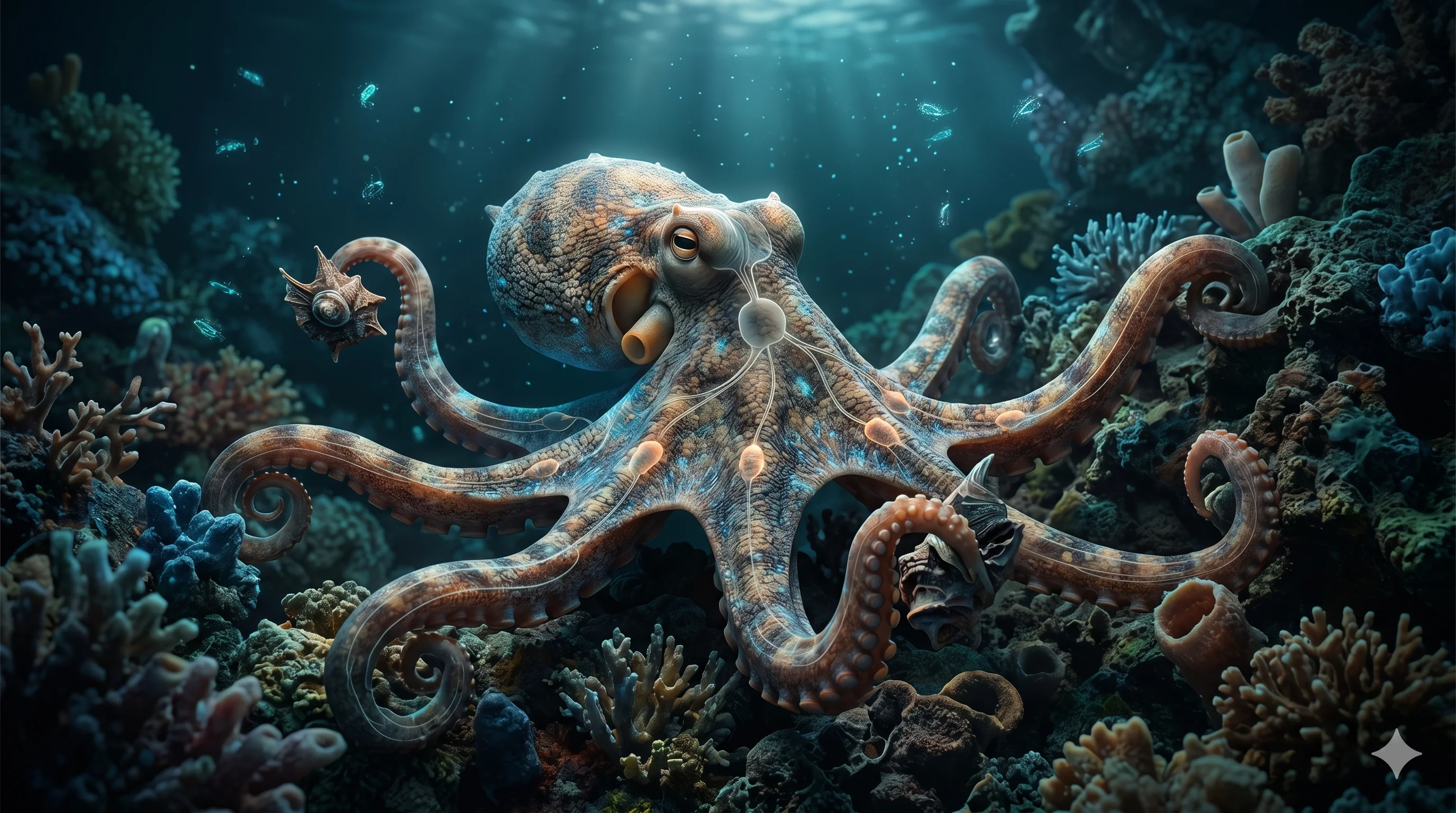
The octopus challenges brain-centric consciousness theories with 500 million neurons distributed across its body.
Parrots need 2-4 hours of daily mental enrichment to prevent stress and feather-plucking. Discover puzzle feeders, foraging toys, and social interaction that keeps intelligent birds thriving.
The question of whether fish experience pain—and by extension, suffering—hinges on a fundamental biological distinction: the difference between nocicept...
Share this article
Octopus Intelligence: The Science of Cephalopod Consciousness and What It Means for Marine Animal Welfare
To understand octopus intelligence, one must first abandon the vertebrate blueprint.
5 published papers · click to read
1,121
combined citations
Walker C.; Goldsworthy T.; Wolf D. et al.
Predisposition to Renal Cell Carcinoma Due to Alteration of a Cancer Susceptibility Gene — Science
63 citations
Finn J.; Tregenza T.; Norman M.
Defensive tool use in a coconut-carrying octopus — Current Biology
163 citations
Hochner B.
An Embodied View of Octopus Neurobiology — Current Biology
150 citations
Lunau K.; Papiorek S.; Eltz T. et al.
Avoidance of achromatic colours by bees provides a private niche for hummingbirds — Journal of Experimental Biology
202 citations
PACKARD A.
CEPHALOPODS AND FISH: THE LIMITS OF CONVERGENCE — Biological Reviews
543 citations
Researchers identified from peer-reviewed literature indexed in Semantic Scholar · OpenAlex · PubMed. Each card links to the original published paper.