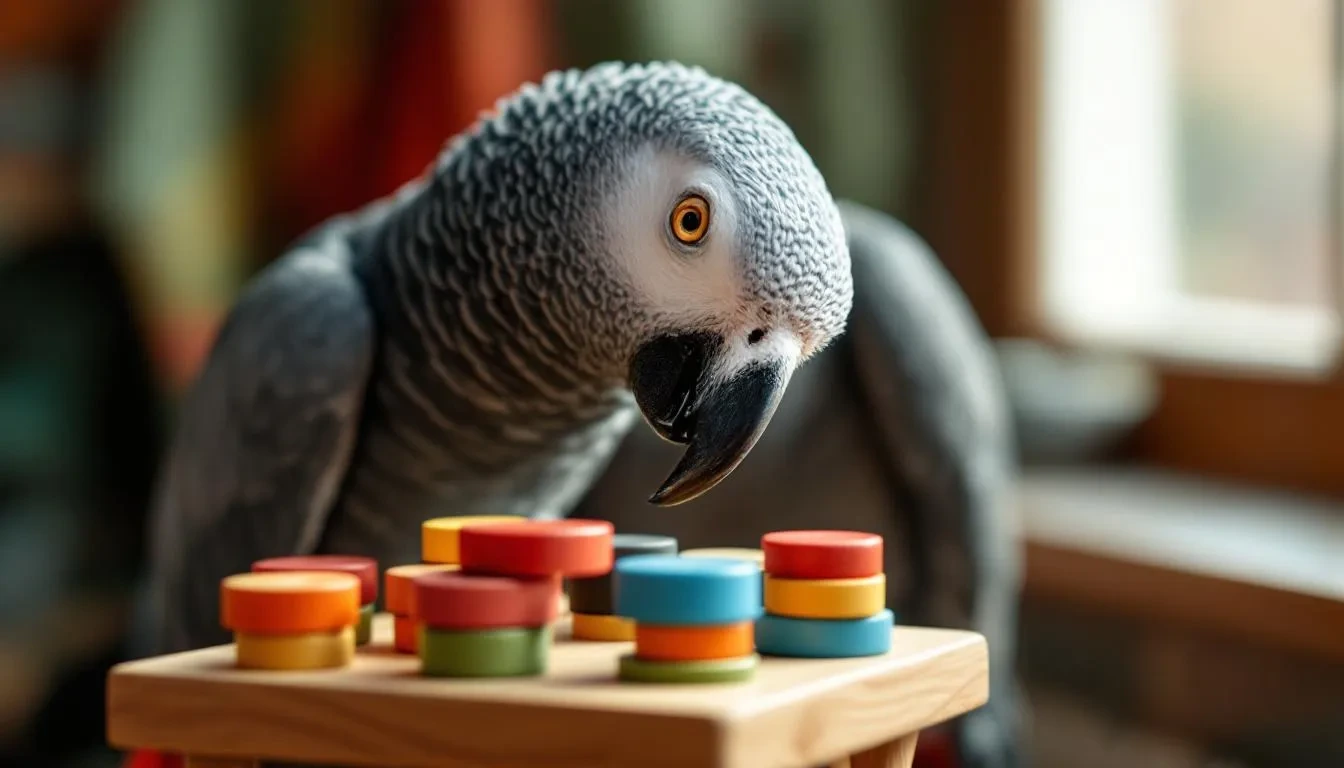
Parrot Behavior: Intelligence, Enrichment, and Emotional Needs
Evidence-based science journalism. Every claim verified against peer-reviewed research.
AIsocialanimalsciencemental
Evidence-based science journalism. Every claim verified against peer-reviewed research.
© 2026 Express Love Inc. — All Rights Reserved. Original research-backed content. Unauthorized reproduction, derivative audio/video adaptations, or use for AI training is strictly prohibited without written consent.
Parrots produce sounds with striking structural complexity, a capacity documented in controlled observation as early as 1913 (Lashley et al., 1913). That single fact carries enormous weight for anyone caring for a captive parrot: an animal capable of such cognitive and vocal output requires an environment that matches its behavioral repertoire. When that environment falls short, the consequences are measurable and well-documented. Understanding what enrichment actually does for parrots — and what gaps current practice leaves unfilled — begins with taking the science seriously rather than relying on anecdote.
The mechanisms connecting environment to behavior run deeper than simple boredom. Parrots in captivity display a range of behavioral indicators that reflect neurological and social needs going unmet. Optogenetic and neurochemical research has demonstrated that brain states are not passive responses to environment but are actively shaped by the stimulation — or absence of stimulation — that an animal receives (Parrot, 2015). For parrots, this means that a bare cage with minimal interaction is not a neutral baseline; it is an active stressor with measurable effects on brain chemistry and behavioral output. The implications for welfare are direct and practical.
The practical relevance becomes clear when owners and caretakers recognize that enrichment is not decoration. It is functional. Research on parrot species specifically has found that current enrichment practices in captivity frequently miss the mark, targeting human aesthetic preferences over the behavioral needs of the bird (Rodríguez-López, 2016). The gap between what caretakers provide and what parrots actually require is not a minor calibration issue — it reflects a systematic misalignment between the species' evolved behavioral needs and the environments humans create for them. Closing that gap requires evidence, not guesswork.
Listen to the Soul of this Article (Narrated)
Parrot Behavior: Intelligence, Enrichment, and Emotional Needs
Parrots are among the most vocal animals studied in controlled laboratory conditions. Lashley et al. (1913) documented the reproduction of inarticulate sounds in parrots, establishing that this vocal capacity is not purely mimicry of meaningful speech but reflects a broader auditory processing and production ability. What this means in a captivity context is significant: a parrot that vocalizes extensively is not simply making noise. It is exercising a cognitive and motor system that requires regular, varied use.
Enrichment programs that ignore vocal behavior are therefore incomplete by definition. If a parrot's environment provides no variation in auditory input — no social calls, no novel sounds, no interactive vocal exchanges — the bird's vocal-cognitive system operates in a kind of functional vacuum. The result is often the repetitive, stereotypic calling that caretakers find frustrating, which is itself a behavioral indicator that the animal's needs are not being met (Lashley et al., 1913). Addressing this requires providing structured auditory enrichment: varied sound environments, opportunities for vocal exchange with humans or conspecifics, and materials that produce novel sounds when manipulated.
The neurological case for enrichment is not speculative. Research on in vivo neurochemistry has demonstrated that the brain's chemical environment changes in direct response to behavioral opportunity and stimulation (Parrot, 2015). When animals are deprived of opportunities to engage in species-typical behaviors — foraging, social interaction, exploration — measurable neurochemical changes occur that mirror those seen in chronic stress models.
For parrots, species-typical behavior is unusually diverse. In the wild, these animals spend the majority of their active hours foraging, navigating complex social hierarchies, maintaining pair bonds, and exploring their environment. Captivity compresses or eliminates most of these behavioral categories simultaneously. The neurochemical consequences of this compression are not trivial. Parrot (2015) observed that understanding brain chemistry in living, behaving animals — rather than in post-mortem tissue — is essential for accurately characterizing what deprivation actually does. Applied to parrot welfare, this means that observable behaviors like feather-destructive behavior, repetitive pacing, and excessive screaming are surface expressions of underlying neurochemical states that enrichment can directly address.
The practical takeaway is that enrichment needs to be evaluated not just by whether a parrot engages with a toy, but by whether it reduces indicators of chronic stress and increases the expression of species-typical behaviors. Duration of foraging behavior, frequency of exploratory movement, and reduction in stereotypies are measurable outcomes that provide real feedback on whether an enrichment program is functioning (Parrot, 2015).
The most direct examination of parrot enrichment in applied settings found that existing practices frequently fail to address the actual behavioral biology of the species. Rodríguez-López (2016) found that enrichment for parrots in captivity is often designed around human judgments about what seems stimulating, rather than empirical assessment of what parrots actually use, prefer, or benefit from behaviorally. The result is enrichment that looks active and varied to a human observer but produces little measurable behavioral benefit for the bird.
This misalignment takes several forms. Objects are frequently introduced into enclosures based on size, color, or novelty from a human perspective, without systematic observation of how parrots actually interact with them. Social enrichment — arguably the most critical category for a highly social species — is often reduced to brief human interaction periods rather than structured opportunities for social behavior (Rodríguez-López, 2016). Foraging enrichment, when present, tends to be static rather than variable, meaning parrots solve it once and it ceases to generate behavioral engagement.
The research suggests that effective enrichment must be designed around behavioral categories: foraging complexity, social interaction quality and duration, auditory variety, physical exploration opportunity, and cognitive challenge. Each of these maps onto a documented behavioral need, and each can be assessed with observable, measurable outcomes rather than subjective impressions.
Behavioral indicators of stress have been measured across multiple species using standardized protocols. Williams et al. (2012) documented heart rate and behavioral responses in horses during veterinary procedures, demonstrating that physiological stress indicators and behavioral signs co-occur in predictable patterns and that procedural changes can measurably reduce both. The methodological principle transfers directly to parrot welfare assessment: behavioral signs of stress are not merely subjective impressions but are correlated with measurable physiological states.
For parrot caretakers, this means that behavioral indicators — feather destruction, stereotypic movement, abnormal vocalizations — should be treated as data points reflecting genuine physiological states, not personality quirks or attention-seeking. Williams et al. (2012) observed that reducing procedural stressors produced consistent, measurable reductions in stress behavior, which suggests that systematic enrichment improvements should produce similarly consistent behavioral changes in parrots.
The evidence points toward a clear framework for parrot enrichment. Vocal and auditory enrichment must be treated as a priority, given the documented complexity of parrot vocal behavior (Lashley et al., 1913). Enrichment design must be grounded in observed parrot behavior rather than human aesthetic judgment, addressing the documented gap between what is provided and what is needed (Rodríguez-López, 2016). Behavioral indicators of stress should be taken seriously as reflections of neurochemical states that enrichment directly influences (Parrot, 2015), and improvements should be assessed using measurable behavioral outcomes rather than subjective satisfaction (Williams et al., 2012). Parrots are not decorative animals. They are cognitively complex animals whose welfare depends on environments built around what the science actually shows.
Watch the heartwarming journey of a shelter dog who finds love and joy after seven long years, reminding us all of the transformative power of kindness. This touching reunion will warm your heart and inspire you to spread love!
Watch on dedicated video page →In this touching moment, watch as a man with little love for pets finds an unexpected connection when he bravely rescues a frozen dog, reminding us all that compassion can blossom in the most surprising ways. Join us in celebrating this heartwarming act of kindness that transcends boundaries.
Watch on dedicated video page →Join us for a heartwarming glimpse into the lives of adorable foxes as they express their unique personalities and communicate with their delightful screams. This charming video showcases the beauty of nature and the special bond we share with our furry friends.
Watch on dedicated video page →K. S. Lashley, PhD
Reproduction of inarticulate sounds in the parrot. — Journal of Animal Behavior
Sandrine Parrot
Université Claude Bernard Lyon 1
F-69000, France
Why Optogenetics Needs in Vivo Neurochemistry — ACS Chemical Neuroscience
Jane Williams
University of the West of England
Gloucester, United Kingdom
Effect of manual and motorized dental rasping instruments on Thoroughbred's heart rate and behavior — Journal of Veterinary Behavior
Rogelio Rodríguez-López
University of Bristol
Bristol BS8 3HA, UK
Environmental enrichment for parrot species: Are we squawking up the wrong tree? — Applied Animal Behaviour Science
Lori Marino
Claudia Zeiträg
Helmut Prior
Ina Opitz
Kyle R. Bohland
More from Animal Conservation
Rescue dog adaptation involves targeted training and environmental adjustments that mitigate stress by modulating key biochemical pathways, such as the hypothalamic-pituitary-adrenal (HPA) axis, where cortisol levels...

Rabbit dental health depends on high-fiber hay that wears down continuously growing teeth. Prevent malocclusion and abscesses with proper diet and veterinary care guidelines.
Hamster care requires a cage setup that prioritizes natural behaviors, such as providing at least 600cm² of floor space with 25cm-deep bedding made from paper or aspen to enable burrowing and nesting, as supported by...
Share this article
Parrot Behavior: Intelligence, Enrichment, and Emotional Needs
Parrots need 2-4 hours of daily mental enrichment to prevent stress and feather-plucking. Discover puzzle feeders, foraging toys, and social interaction that keeps intelligent birds thriving.
9 published papers · click to read
1,380
combined citations
K. S. Lashley, PhD
Reproduction of inarticulate sounds in the parrot. — Journal of Animal Behavior
14 citations
Sandrine Parrot
Université Claude Bernard Lyon 1
F-69000, FranceWhy Optogenetics Needs in Vivo Neurochemistry — ACS Chemical Neuroscience
14 citations
Jane Williams
University of the West of England
Gloucester, United KingdomEffect of manual and motorized dental rasping instruments on Thoroughbred's heart rate and behavior — Journal of Veterinary Behavior
4 citations
Rogelio Rodríguez-López
University of Bristol
Bristol BS8 3HA, UKEnvironmental enrichment for parrot species: Are we squawking up the wrong tree? — Applied Animal Behaviour Science
23 citations
Lori Marino
Thinking chickens: a review of cognition, emotion, and behavior in the domestic chicken
275 citations
Claudia Zeiträg
Gaze following: A socio-cognitive skill rooted in deep time
32 citations
Helmut Prior
Mirror-Induced Behavior in the Magpie (Pica pica): Evidence of Self-Recognition
579 citations
Ina Opitz
Contributing to food security in urban areas: differences between urban agriculture and peri-urban agriculture in the Global North
427 citations
Kyle R. Bohland
Shelter dog behavior after adoption: Using the C-BARQ to track dog behavior changes through the first six months after adoption
12 citations
Researchers identified from peer-reviewed literature indexed in Semantic Scholar · OpenAlex · PubMed. Each card links to the original published paper.