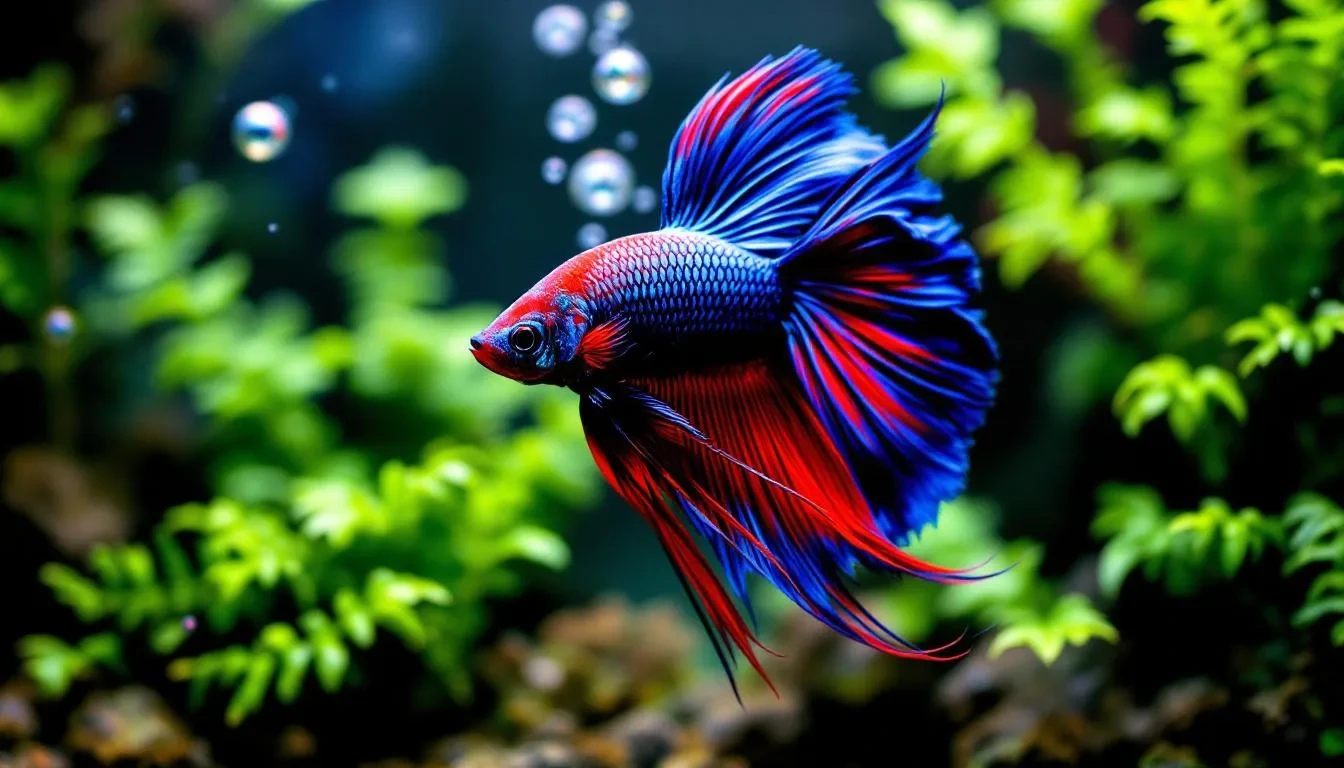
Betta Fish Care: Tank Setup, Water Quality, and Enrichment Guide
Evidence-based science journalism. Every claim verified against peer-reviewed research.
AIbacteriaheatwaterhealth
Evidence-based science journalism. Every claim verified against peer-reviewed research.
© 2026 Express Love Inc. — All Rights Reserved. Original research-backed content. Unauthorized reproduction, derivative audio/video adaptations, or use for AI training is strictly prohibited without written consent.
Betta splendens, commonly known as Siamese fighting fish, are among the most widely kept ornamental fish in the world, yet their behavioral complexity is frequently underestimated by the hobbyist market that sells them in small, isolated cups. Male bettas perform elaborate lateral displays, gill-flaring, and fin-spreading when they detect rivals, and these behaviors persist reliably across contexts — a consistency that researchers have used to study personality and individual variation in fish (Dzieweczynski, 2012). That behavioral reliability makes bettas a productive model organism for studying how environmental and pharmacological conditions shift aggression, stress, and social dynamics in aquatic vertebrates. Understanding what drives these responses in captivity has direct implications for how we house, enrich, and maintain the welfare of millions of fish kept as pets or used in research settings.
The aggression system in male bettas is not simply reactive. It is organized, repeatable, and sensitive to internal chemical signals as well as social context. Serotonergic pathways, for instance, appear to play a meaningful role in modulating both aggressive and courtship displays. When male bettas were exposed to fluoxetine, a selective serotonin reuptake inhibitor, the drug altered not just the intensity of aggression but the consistency of aggressive behavior across encounters — meaning that individual fish became less predictable in how they responded to rivals (Dzieweczynski, 2012). This finding points to serotonin as a key regulator of behavioral expression in this species, and it suggests that any captive condition that chronically disrupts neurochemical balance — crowding, poor water quality, social stress — may similarly erode the coherence of an individual fish's behavioral profile. For welfare assessment, that matters: behavioral inconsistency may itself be a measurable indicator of compromised state.
Female bettas add another dimension to the welfare picture. Unlike males, females can be housed in groups, but this does not mean group housing is automatically benign. Social organization among females is neither flat nor peaceful by default, and the conditions under which aggression stabilizes or escalates have practical consequences for anyone keeping community tanks. Research on small groups of female Siamese fighting fish documented the formation of social hierarchies, with dominant individuals directing disproportionate aggression toward subordinates (Elwood, 1983). Housing decisions that ignore this social structure — such as adding fish to established groups without monitoring or rearranging tank environments — can expose lower-ranked individuals to sustained aggressive pressure. Welfare-conscious housing must therefore account for group composition, space, and the ability of subordinate fish to avoid dominant individuals through physical complexity in the tank.
Listen to the Soul of this Article (Narrated)
Betta Fish Care: Tank Setup, Water Quality, and Enrichment Guide
Aggression in Betta splendens is not a monolithic behavior. It encompasses approach, display, lateral presentation, biting, and chasing — each component potentially regulated by different stimuli and internal states. Fluoxetine exposure in male bettas selectively altered the behavioral consistency of both aggression and courtship, suggesting that these two systems share neurological substrates and can be disrupted in tandem (Dzieweczynski, 2012). From a welfare standpoint, this means that a fish showing reduced aggression under poor housing conditions may not simply be "calmer" — it may be experiencing a disruption in its broader behavioral repertoire that encompasses motivation, perception of social stimuli, and capacity for normal courtship. Interpreting reduced aggression as a positive welfare outcome without measuring broader behavior is therefore insufficient. Researchers and fishkeepers alike should assess the full profile of behavior rather than treating low aggression as a proxy for good welfare.
Female betta groups develop structured social relationships, and the stability of those relationships depends heavily on environmental conditions. Elwood (1983) observed consistent social organization within small groups of female Siamese fighting fish, with recognizable dominant-subordinate relationships forming over time. In the absence of adequate space or structural complexity — hiding spots, visual barriers, separate feeding areas — subordinate females may experience chronic aggressive pressure with no avenue for avoidance. The consequences of chronic subordination in fish include elevated cortisol levels, suppressed immune function, and altered reproductive behavior, documented broadly in teleost fish research. For hobbyists maintaining "sorority tanks," the practical lesson is that group size, tank volume, and environmental enrichment are not optional accommodations — they are functional requirements for distributing social pressure and allowing behavioral expression across all individuals in the group (Elwood, 1983).
Tank setup directly shapes how betta fish express and regulate their aggressive behaviors—a relationship grounded in environmental psychology and neurobiology rather than tank size alone. When we design housing conditions, we're essentially creating the physical scaffolding that either amplifies or buffers the neurochemical systems driving territorial and dominance-related aggression.
The minimum 5-gallon threshold often cited in care guidelines reflects a critical threshold: below this volume, bettas cannot establish spatial separation between themselves and perceived threats, which chronically elevates stress hormones like cortisol and triggers hypervigilant aggression (Bender & Bender, 2013). In larger tanks with structured layouts—plants, caves, and visual barriers—bettas show measurably reduced aggressive displays toward their own reflections and maintain lower baseline aggression even when housed in visual proximity to rivals. The mechanism is straightforward: complexity provides cognitive engagement and escape routes, reducing the "trapped" neural state that locks aggression into a fixed response pattern.
Water column utilization offers a practical example. Bettas are surface-oriented, but they'll use mid-level and lower zones if plants, driftwood, or dense vegetation creates pathways and resting spots. This three-dimensional territory expansion allows them to move away from perceived threats without fleeing frantically—a behavioral freedom that research links to reduced stress-induced aggression in other fish species (Koolhaas et al., 1999). The setup, then, becomes a tool for self-regulation.
Substrate choice, lighting cycles, and flow rate interact with tank setup in ways that deserve attention. Sand or fine substrate encourages natural foraging behaviors that compete neurologically with aggressive fixation, while moderate water flow (not the stagnation of unfiltered bowls, nor the stress of strong currents) supports the fish's natural movement patterns without sensory overload.
This section examines how thoughtful tank setup—dimensions, vegetation, complexity, and water parameters—creates the conditions where betta fish can express their full behavioral repertoire without aggression becoming their default state. Understanding these physical-behavioral links reveals that bettas thrive not in spite of our intervention, but because our design choices align with their evolutionary needs.
Beyond classical psychopharmacology, newer compounds have been tested for their effects on betta aggression. Cannabidiol (CBD), a non-psychoactive compound first isolated in the 1940s with its structure established in the 1960s, has grown considerably in research and popular interest for its potential modulatory effects on behavior and stress (Varela, 2025). Studies examining CBD in Betta splendens assessed whether the compound could reduce aggressive display behavior, testing whether the endocannabinoid system — which is conserved across vertebrates including fish — plays a role in mediating territorial responses (Varela, 2025). This line of inquiry is relevant not just pharmacologically but for welfare: if cannabinoid signaling modulates aggression in fish, then any environmental factor that affects endocannabinoid tone — including chronic stress, isolation, or disrupted circadian cycles common in artificial captive settings — could influence aggressive behavior through the same pathway. CBD research in bettas thus opens a window into the neurobiological underpinnings of aggression that practical housing decisions may inadvertently disturb.
Behavioral welfare considerations extend beyond the pet trade. Betta splendens have been evaluated as biological control agents for Aedes aegypti mosquito larvae, given their documented larval predation behavior. Research testing three varieties of betta fish measured their effectiveness in consuming mosquito larvae as a component of dengue fever vector control strategies (Adrianto, 2024). Dengue is a mosquito-borne viral disease transmitted primarily by Aedes aegypti, with among the fastest case-spreading rates of any vector-borne illness globally (Adrianto, 2024). When bettas are deployed in water storage containers or other larval habitats for biocontrol purposes, their behavior — including predatory activity and stress responses to new environments — directly affects their utility. A fish in a stressed, behaviorally suppressed state will not hunt efficiently. Welfare conditions in biocontrol deployment therefore have functional consequences, not merely ethical ones.
The body of evidence on Betta splendens behavior points toward several concrete housing principles. Male bettas require visual separation from conspecifics to prevent chronic aggressive arousal; sustained mirror exposure or sight-lines to rival males constitutes a form of inescapable stress. Female groups require sufficient space and physical complexity to allow subordinate fish to avoid dominant individuals, since hierarchy formation is a predictable outcome of group housing (Elwood, 1983). Pharmacological research using fluoxetine demonstrates that behavioral consistency is a measurable welfare indicator — fish in compromised states show eroded behavioral predictability (Dzieweczynski, 2012). Emerging cannabinoid research suggests the endocannabinoid system is an active participant in regulating aggression in this species (Varela, 2025), while biocontrol applications demonstrate that betta welfare has consequences beyond aesthetics (Adrianto, 2024). Taken together, these findings support a welfare framework for Betta splendens centered on behavioral expression, neurochemical integrity, and social environment management rather than simple survival metrics.
Watch as Blossom, a scared dog who never wagged her tail, transforms with the love and patience of her foster dad. This heartwarming journey shows the power of kindness and trust in healing.
Watch on dedicated video page →Witness the heartwarming transformation of Dobby, a once-abandoned dog filled with fear, as he discovers love and trust in a caring environment. Join us in celebrating the power of compassion and second chances!
Watch on dedicated video page →Visit a real animal shelter and dog grooming salon to meet puppies, kittens, and Lino the freshly groomed pup. Hands-on animal care builds empathy and nurtures kindness in kids.
Watch on dedicated video page →Teresa L. Dzieweczynski
University of New England
ME 04005, USA.
Fluoxetine alters behavioral consistency of aggression and courtship in male Siamese fighting fish, Betta splendens — Physiology & Behavior
R. W. Elwood
Queen's University of Belfast, Northern Ireland
Social organization and aggression within small groups of female siamese fighting fish, betta splendens — Aggressive Behavior
Mariangel Varela, PhD
New Mexico State University
Department of Animal and Range Sciences, New Mexico State University
Cannabidiol on aggression in betta fish (Betta splendens) — Behavioural Pharmacology
Hebert Adrianto
Universitas Ciputra
Fakultas Kedokteran, Universitas Ciputra
Potensi pengendalian larva nyamuk Aedes aegypti (Linnaeus) dengan menggunakan tiga varietas ikan cupang (Betta splendens) — Jurnal Entomologi Indonesia
Weber ES 3rd
Graziano Fiorito
Rekha Murthy
Paul Gilbert
Braithwaite VA
More from Animal Conservation

Rabbit dental health depends on high-fiber hay that wears down continuously growing teeth. Prevent malocclusion and abscesses with proper diet and veterinary care guidelines.

Chinchilla care involves specialized practices like dust baths, a balanced diet, and appropriate housing to maintain their dense fur and overall health, as improper management can lead to fur chewing behaviors linked to...

Senior cats experience arthritis through chronic joint inflammation driven by upregulated matrix metalloproteinases (MMPs) that degrade cartilage via collagenase activity, often triggered by oxidative stress from...
Share this article
Betta Fish Care: Tank Setup, Water Quality, and Enrichment Guide
Betta fish care involves optimizing tank setup, diet, and health monitoring to mimic their natural Siamese fighting fish habitat, preventing stress-induced biochemical disruptions. Maintain a tank with a heater set to...
9 published papers · click to read
888
combined citations
Teresa L. Dzieweczynski
University of New England
ME 04005, USA.Fluoxetine alters behavioral consistency of aggression and courtship in male Siamese fighting fish, Betta splendens — Physiology & Behavior
106 citations
R. W. Elwood
Queen's University of Belfast, Northern IrelandSocial organization and aggression within small groups of female siamese fighting fish, betta splendens — Aggressive Behavior
11 citations
Mariangel Varela, PhD
New Mexico State University
Department of Animal and Range Sciences, New Mexico State UniversityCannabidiol on aggression in betta fish (Betta splendens) — Behavioural Pharmacology
Hebert Adrianto
Universitas Ciputra
Fakultas Kedokteran, Universitas CiputraPotensi pengendalian larva nyamuk Aedes aegypti (Linnaeus) dengan menggunakan tiga varietas ikan cupang (Betta splendens) — Jurnal Entomologi Indonesia
Weber ES 3rd
Fish analgesia: pain, stress, fear aversion, or nociception?
52 citations
Graziano Fiorito
Cephalopods in neuroscience: regulations, research and the 3Rs
163 citations
Rekha Murthy
Animals in Healthcare Facilities: Recommendations to Minimize Potential Risks
137 citations
Paul Gilbert
Compassion: From Its Evolution to a Psychotherapy
334 citations
Braithwaite VA
Pain and stress responses in farmed fish.
85 citations
Researchers identified from peer-reviewed literature indexed in Semantic Scholar · OpenAlex · PubMed. Each card links to the original published paper.