Chinchilla Care: Dust Baths, Diet, and Enrichment Needs
Evidence-based science journalism. Every claim verified against peer-reviewed research.
AIstresscarehealth
Evidence-based science journalism. Every claim verified against peer-reviewed research.
© 2026 Express Love Inc. — All Rights Reserved. Original research-backed content. Unauthorized reproduction, derivative audio/video adaptations, or use for AI training is strictly prohibited without written consent.
Chinchillas produce lanolin-like oils from specialized sebaceous glands distributed across their exceptionally dense fur — fur so thick that a single follicle can produce more than 60 individual hairs. This biological reality means that conventional water bathing strips protective compounds from the coat and skin, creating conditions for fungal overgrowth and dermatitis. Understanding how dust baths and dietary choices interact with chinchilla physiology is not simply a matter of husbandry preference; it is a question with measurable health consequences. Owners who treat these two pillars of care as optional or interchangeable with practices used for other small mammals routinely observe animals in poor condition, even when basic housing needs are met.
The relationship between nutrition and metabolic health in small mammals has been documented across several species that share physiological characteristics with chinchillas. Research on nutritional medicine and diet care has demonstrated that the composition of an animal's diet directly influences lipid metabolism, immune competence, and tissue repair capacity (Grant et al., 2015). For chinchilla owners, this means that commercial pelleted foods marketed as "complete" diets may still fall short when they are not supplemented or balanced against the animal's actual caloric needs and fiber requirements. The chinchilla's digestive system, adapted to the sparse, high-fiber vegetation of the Andean plateau, demands a diet architecture that many domestic feeding regimens do not replicate.
Practically speaking, dust baths and diet interact in ways that owners rarely anticipate. A chinchilla maintained on a diet that produces metabolic stress will often display coat deterioration — dullness, thinning, or fur slip — that no amount of dust bathing will correct. Conversely, an animal on an excellent diet but denied regular dust bath access will develop oily, matted fur that becomes a substrate for microbial colonization. Both inputs must be managed consistently and correctly. The pages that follow examine what peer-reviewed research documents about each of these care domains and how they combine to support or undermine chinchilla health.
Listen to the Soul of this Article (Narrated)
Chinchilla Care: Dust Baths, Diet, and Enrichment Needs
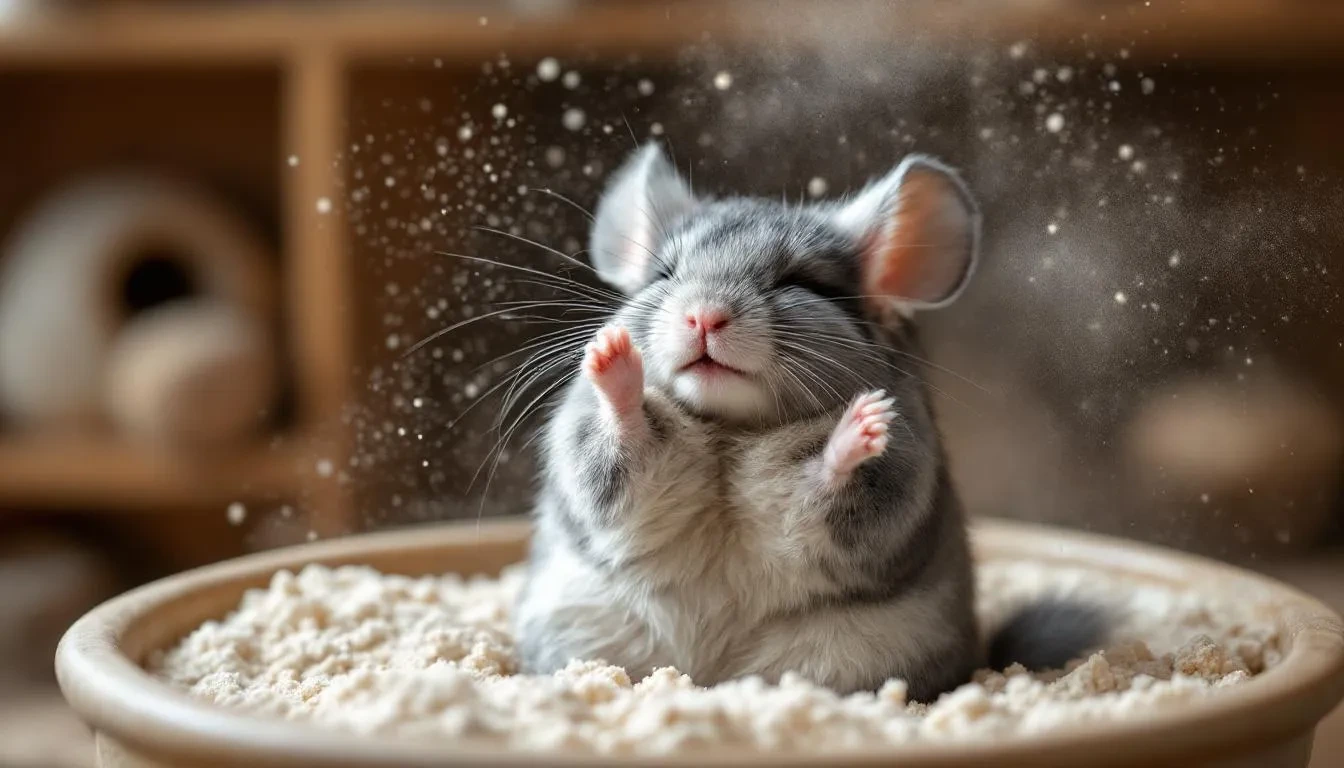
The dust bath is not a behavioral luxury. It is the primary mechanism by which a chinchilla regulates the moisture and lipid content of its coat. In arid environments, fine volcanic ash or mineral dust particles mechanically absorb excess sebum and moisture, then fall free from the fur as the animal rolls and rotates. Research documented in clinical contexts has confirmed that respiratory and integumentary conditions in small exotic mammals are frequently traceable to inadequate environmental hygiene practices, including the substitution of inappropriate bathing media (Christman et al., 2018). When owners use sand that is too coarse, or skip dust baths entirely in humid climates, the fur becomes a reservoir for moisture-dependent pathogens.
Frequency recommendations in the husbandry literature generally converge on two to three dust bath sessions per week, with each session lasting approximately ten to fifteen minutes. In high-humidity environments — those above 50% relative humidity — daily access may be warranted because ambient moisture accelerates sebum accumulation. Chinchilla-specific volcanic pumice dust, milled to a particle size of roughly 0.1 to 0.3 millimeters, is the medium most consistently associated with coat health. Coarser particles do not penetrate the fur column effectively; finer particles raise inhalation risk. The container used for bathing should be wide enough for the animal to roll completely without striking the sides, as incomplete rolling leaves dorsal and lateral coat regions unaddressed (Christman et al., 2018).
One common owner error is leaving the dust bath container in the enclosure continuously. Overexposure dries the skin excessively, producing flaking and pruritis that owners sometimes misidentify as a fungal infection. The correct approach is timed access — bath provided, observed briefly, then removed. This preserves the coat's natural moisture balance rather than stripping it entirely.
The chinchilla's natural diet consists predominantly of coarse grasses, dried herbs, bark, and sparse leafy matter — all materials defined by high fiber content, low fat, and low simple-sugar concentration. Research on insulin resistance and diet care has demonstrated that diets characterized by elevated simple carbohydrate loads produce measurable disruptions in glucose metabolism and lipid handling in small mammals (Kobayashi, 2015). For chinchillas, whose pancreatic and hepatic systems did not evolve to process grain-dense or sugar-supplemented foods, this metabolic vulnerability translates directly into conditions like hepatic lipidosis, obesity, and diabetes when inappropriate foods are fed consistently.
Quality timothy hay should constitute at minimum 70% of the daily dietary volume. This is not a general guideline — it is a structural requirement dictated by the chinchilla's hindgut fermentation physiology. Without adequate long-stem fiber, cecal motility slows, fermentation balance shifts toward dysbiotic populations, and gas accumulation creates gastrointestinal distress. Pellets, when offered, should be timothy-based rather than alfalfa-based for adult animals, because alfalfa's elevated calcium and protein content is appropriate only for growing juveniles and lactating females. Fruit, corn-based treats, and nut-based treats should be withheld entirely; their sugar and fat densities exceed what the chinchilla's metabolic machinery can safely process (Kobayashi, 2015).
Research on diet-induced hypercholesterolemia in small mammals has demonstrated that even moderate sustained elevations in dietary fat intake produce measurable arterial and hepatic lipid deposition in species with compact body sizes and rapid metabolic rates (Henderson et al., 1970). Chinchillas share several of the physiological parameters — including body mass, basal metabolic rate scaling, and hepatic fat-processing capacity — that make this finding directly applicable to their care. Owners who supplement chinchilla diets with sunflower seeds, peanuts, or commercially prepared "treat sticks" containing mixed grains and sugars are introducing fat and cholesterol loads that the chinchilla's liver was not designed to clear efficiently.
The clinical presentation of dietary fat excess in chinchillas includes lethargy, progressive weight gain concentrated in the abdominal region, coat deterioration at the dorsal midline, and eventual reduction in reproductive performance in breeding animals. These signs develop gradually over months, which is why the connection to diet is frequently missed. By the time a veterinarian documents hepatic changes, the dietary pattern responsible has often been in place for a year or more. Documented research on nutritional medicine and diet care confirms that early dietary intervention — reducing fat and simple sugar intake before clinical signs appear — produces measurably better metabolic outcomes than intervention initiated after organ-level changes have developed (Grant et al., 2015).
The evidence drawn from nutritional and clinical research converges on a straightforward set of daily practices. Timothy hay in unlimited quantities forms the dietary foundation. Timothy-based pellets are offered in measured portions — approximately one to two tablespoons per adult animal per day. Treats derived from fruit, seed, or grain are removed from the feeding routine entirely. Dust bath access is provided two to three times weekly in a correctly sized container using fine volcanic pumice dust, with each session lasting ten to fifteen minutes before the container is removed.
Humidity in the environment is monitored and maintained below 50%, both to preserve coat condition between dust baths and to limit respiratory stress from airborne dust particles during bathing sessions (Christman et al., 2018). Diet and dust bath practices are not independent variables; metabolic health influences coat quality, and coat hygiene influences the skin barrier that underlies immune competence. Owners who treat both domains with equal consistency produce animals that demonstrate the dense, uniform coat condition and stable body weight that are reliable external indicators of underlying health (Henderson et al., 1970).
Watch as Blossom, a scared dog who never wagged her tail, transforms with the love and patience of her foster dad. This heartwarming journey shows the power of kindness and trust in healing.
Watch on dedicated video page →Witness the heartwarming transformation of Dobby, a once-abandoned dog filled with fear, as he discovers love and trust in a caring environment. Join us in celebrating the power of compassion and second chances!
Watch on dedicated video page →Visit a real animal shelter and dog grooming salon to meet puppies, kittens, and Lino the freshly groomed pup. Hands-on animal care builds empathy and nurtures kindness in kids.
Watch on dedicated video page →Ross Stewart Grant, MD
Nutritional Medicine and Diet Care — Journal of Nutritional Medicine and Diet Care
Brian W. Christman
Vanderbilt University
Vanderbilt University, Tennessee (B.W.C.)
Dust Bath — Annals of Internal Medicine
Jun Kobayashi
Josai University
Faculty of Pharmaceutical Science, Josai University
Insulin Resistance and Diet Care — Journal of Nutritional Medicine and Diet Care
J.D. Henderson
Wake Forest University
Winston-Salem, N.C. U.S.A
Diet-induced hypercholesterolemia in the chinchilla and rabbit — Atherosclerosis
Rachel Wood
Rekha Murthy
Alex Pollock
Miriam Ticktin
Jessica Wilson
Emily G. Lattie
Isabela Carvalho de Morais
Andrew Darley
Paul Gilbert
Emma K. Grigg
University of California, Davis
CA 95616, USA
Owners’ Attitudes, Knowledge, and Care Practices: Exploring the Implications for Domestic Cat Behavior and Welfare in the Home — Animals
Karen L. Overall
Graziano Fiorito
Mahan Mohammadi
David E. Bloom
Maartje M.A. de Graaf
More from Animal Conservation
Rabbit dental health depends on high-fiber hay that wears down continuously growing teeth. Prevent malocclusion and abscesses with proper diet and veterinary care guidelines.
Senior cats experience arthritis through chronic joint inflammation driven by upregulated matrix metalloproteinases (MMPs) that degrade cartilage via collagenase activity, often triggered by oxidative stress from...
Hamster care requires a cage setup that prioritizes natural behaviors, such as providing at least 600cm² of floor space with 25cm-deep bedding made from paper or aspen to enable burrowing and nesting, as supported by...
Share this article
Chinchilla Care: Dust Baths, Diet, and Enrichment Needs
Chinchilla care involves specialized practices like dust baths, a balanced diet, and appropriate housing to maintain their dense fur and overall health, as improper management can lead to fur chewing behaviors linked to...
19 published papers · click to read
3,534
combined citations
Ross Stewart Grant, MD
Nutritional Medicine and Diet Care — Journal of Nutritional Medicine and Diet Care
1 citations
Brian W. Christman
Vanderbilt University
Vanderbilt University, Tennessee (B.W.C.)Dust Bath — Annals of Internal Medicine
Jun Kobayashi
Josai University
Faculty of Pharmaceutical Science, Josai UniversityInsulin Resistance and Diet Care — Journal of Nutritional Medicine and Diet Care
J.D. Henderson
Wake Forest University
Winston-Salem, N.C. U.S.ADiet-induced hypercholesterolemia in the chinchilla and rabbit — Atherosclerosis
2 citations
Rachel Wood
From aesthetic labour to affective labour: feminine beauty and body work as self-care in UK ‘lockdown’
10 citations
Rekha Murthy
Animals in Healthcare Facilities: Recommendations to Minimize Potential Risks
137 citations
Alex Pollock
Interventions to support the resilience and mental health of frontline health and social care professionals during and after a disease outbreak, epidemic or pandemic: a mixed methods systematic review
645 citations
Miriam Ticktin
From the human to the planetary
30 citations
Jessica Wilson
Barriers and facilitators to the use of e-health by older adults: a scoping review
686 citations
Emily G. Lattie
An overview of and recommendations for more accessible digital mental health services
426 citations
Isabela Carvalho de Morais
Reimagining Beauty: Digital Consumption Practices in a Disrupted World
5 citations
Andrew Darley
Conducting Co-Design with Older People in a Digital Setting: Methodological Reflections and Recommendations
43 citations
Paul Gilbert
Compassion: From Its Evolution to a Psychotherapy
334 citations
Emma K. Grigg
University of California, Davis
CA 95616, USAOwners’ Attitudes, Knowledge, and Care Practices: Exploring the Implications for Domestic Cat Behavior and Welfare in the Home — Animals
100 citations
Karen L. Overall
Feline behavior guidelines from the American Association of Feline Practitioners
97 citations
Graziano Fiorito
Cephalopods in neuroscience: regulations, research and the 3Rs
163 citations
Mahan Mohammadi
Health Problems of Increasing Man-Made and Climate-Related Disasters on Forcibly Displaced populations: A Scoping Review on Global Evidence
21 citations
David E. Bloom
The Demographic Dividend: A New Perspective on the Economic Consequences of Population Change
655 citations
Maartje M.A. de Graaf
An Ethical Evaluation of Human–Robot Relationships
179 citations
Researchers identified from peer-reviewed literature indexed in Semantic Scholar · OpenAlex · PubMed. Each card links to the original published paper.