Rabbit Dental Health: Diet, Malocclusion, and Preventive Care
Evidence-based science journalism. Every claim verified against peer-reviewed research.
AIhealththroughmatrixcatcare
Evidence-based science journalism. Every claim verified against peer-reviewed research.
© 2026 Express Love Inc. — All Rights Reserved. Original research-backed content. Unauthorized reproduction, derivative audio/video adaptations, or use for AI training is strictly prohibited without written consent.
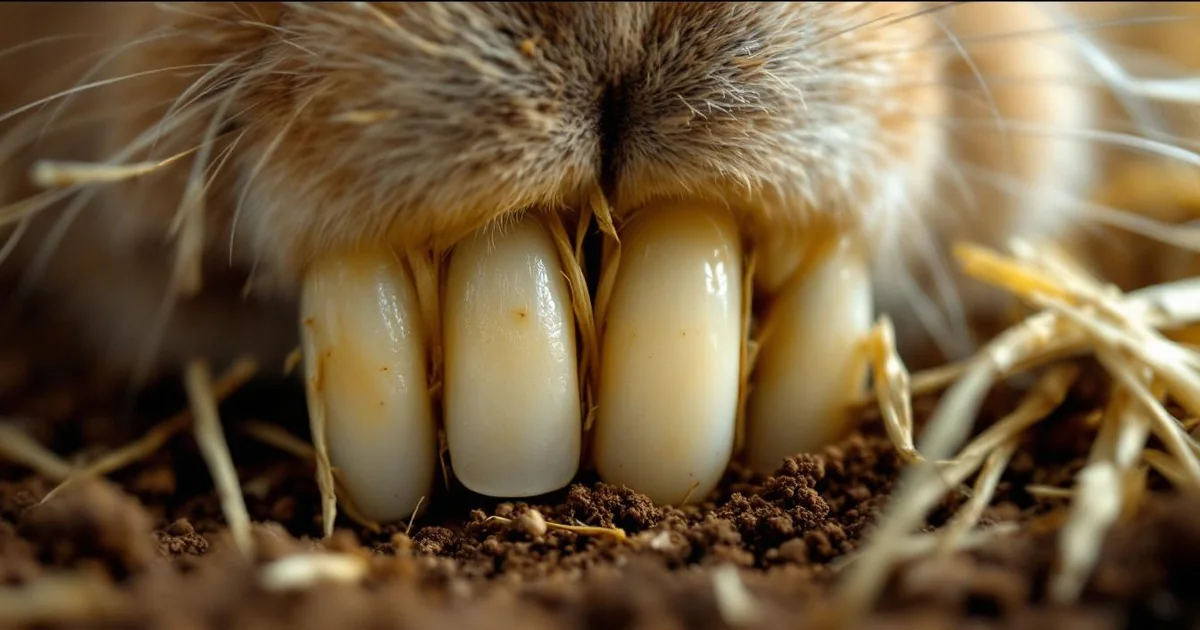
Rabbits have teeth that never stop growing. Unlike human molars that reach a fixed length and stay there, rabbit incisors and cheek teeth grow continuously throughout the animal's life — a biological design that requires constant mechanical wear to stay functional. When that wear fails to keep pace with growth, the result is malocclusion: a misalignment of the dental arches that can progress from a minor cosmetic irregularity to a life-threatening inability to eat. The primary driver of adequate wear in domestic rabbits is a single dietary staple — hay — and understanding why that fiber matters means understanding how teeth actually move against each other during chewing.
The mechanics of rabbit mastication differ meaningfully from human chewing. Rabbits move their jaws in a lateral, grinding motion rather than a purely vertical crushing motion, and this side-to-side action is what produces the attrition that keeps tooth surfaces level. Coarse, long-stem hay demands sustained lateral jaw movement, generating the friction and pressure that grinds down enamel at a controlled rate. Soft foods — pellets, fruit, cooked vegetables — require far less lateral excursion, reducing the grinding stimulus. Over time, reduced grinding stimulus allows teeth to overgrow, sharp spurs to form on molar edges, and the skeletal and soft-tissue relationships between the upper and lower arches to drift out of alignment. Research on skeletal malocclusion across species has documented how jaw-bone morphology and tooth position interact in ways that are rarely reversible without active clinical management (Meng et al., 2025).
For rabbit owners, this biology carries a clear practical message: hay is not a supplementary food item but the structural foundation of dental health. Veterinary guidance consistently places long-stem grass hay — timothy, orchard grass, meadow hay — at sixty to eighty percent of the daily diet, with the remainder composed of leafy greens and a strictly limited quantity of pellets. When owners substitute convenience foods for hay, they are not simply changing flavor preferences; they are removing the mechanical stimulus that the rabbit's dental anatomy depends on to function correctly.
Listen to the Soul of this Article (Narrated)
Rabbit Dental Health: Diet, Malocclusion, and Preventive Care
Malocclusion is not a single event but a cascade. In rabbits, the process typically begins with insufficient attrition of the cheek teeth, which allows the occlusal surfaces to develop uneven wear patterns. As surfaces become uneven, the jaw closes differently on each side, generating asymmetric loading forces on the temporomandibular joint and the surrounding bone. Bone remodels in response to load, meaning that sustained asymmetric forces gradually reshape the skeletal architecture of the jaw. Once skeletal changes occur, the positional relationship between upper and lower dental arches shifts, and malocclusion that began as a soft-tissue or dental problem acquires a hard-tissue, structural component that dietary correction alone cannot resolve. Clinical case documentation has shown that skeletal Class III malocclusion — where the lower jaw protrudes relative to the upper — can develop alongside impacted teeth, demonstrating how positional misalignment and tooth eruption problems compound each other (Meng et al., 2025).
The presence of missing teeth adds another layer of complexity. When a tooth is absent, the opposing tooth loses its wear partner and overgrows into the gap. Neighboring teeth drift toward the space, altering the spacing geometry of the entire arch. In rabbits, where the dental arcade is compact and all teeth contribute to the grinding surface, even a single missing or non-functional tooth can disrupt occlusal contact across multiple tooth pairs. Multidisciplinary approaches to skeletal Class III cases with missing teeth have demonstrated that correcting both the positional and spatial components of malocclusion requires coordinated planning across diagnostic and treatment phases (Yu et al., 2025). For rabbit medicine, this research context reinforces the veterinary principle that early intervention — before skeletal remodeling becomes established — produces substantially better outcomes than late-stage management.
Not all hay is equal in its mechanical effect, and the physical characteristics of fiber matter as much as the fact of feeding hay at all. Long-stem hay requires the rabbit to grip, tear, and grind repeatedly before swallowing, generating a prolonged chewing episode that exercises the full lateral range of jaw motion. Chopped or pelleted hay — where fiber has been mechanically shortened or compressed — reduces both the grip-and-tear phase and the duration of lateral grinding, diminishing the attrition stimulus even when the nutritional fiber content appears similar on a feed label.
The structural demand that coarse fiber places on the dentition is also relevant to impacted tooth risk. When eruption pathways are kept clear by normal occlusal pressure and wear, teeth track their intended path through the alveolar bone. When wear is insufficient and teeth overgrow, they can deflect from their eruption axis and become impacted — trapped within the jaw before completing their emergence. Orthodontic research has documented the management complexity that Angle Class II malocclusion with impacted teeth creates, illustrating how impaction and arch misalignment interact in ways that require sequential, carefully staged treatment (Fan et al., 2025). In rabbit patients, impacted cheek teeth and molar spurs are among the most common findings in animals presenting with reduced food intake and weight loss, and hay-deficient diets are consistently identified as a contributing history factor.
A rabbit's diet directly influences whether their teeth develop and wear properly—or drift into misalignment that causes lifelong pain. When rabbits consume low-quality hay or pelleted diets lacking adequate fiber length, their teeth don't experience the grinding friction needed for natural wear, but their bodies also miss critical minerals like calcium and phosphorus that govern jaw bone density and dental structure.
Research on rodent models shows that calcium-deficient diets reduce jaw bone mineral density within weeks, altering the mechanical forces that guide tooth eruption (Navia & Harris, 1980). While rabbits' continuously growing teeth are an evolutionary adaptation to wear, that system only works when the diet provides both the physical abrasion and nutritional building blocks for healthy bone remodeling. Without them, teeth erupt at irregular angles, the jaw joint experiences abnormal loading, and malocclusion becomes almost inevitable.
High-quality timothy or orchard grass hay—where fiber length exceeds 2 centimeters—creates the repetitive chewing cycles that rabbits need: roughly 120 jaw movements per minute during grazing. These movements generate the compression and tension forces that keep the jaw joint stable and teeth aligned. Simultaneously, the mineral content in mature grass (approximately 0.4–0.8% calcium depending on growth stage) supports the constant bone remodeling that accommodates erupting teeth.
Rabbits fed primarily soft pellets or alfalfa-dominant diets face a double deficit: reduced mechanical stimulation and an imbalance of calcium to phosphorus ratios that favors hypercalcemia and bone resorption. This metabolic state weakens the supporting structures that hold teeth in their proper position.
Understanding the diet-dental health connection means recognizing that preventing malocclusion isn't only about correcting skeletal geometry—it's about ensuring that a rabbit's daily food choices literally build the jaw architecture their teeth depend on. The choices you make at feeding time shape whether your rabbit's teeth stay functional or drift toward the misalignment and pain that malocclusion brings.
The technical literature on correcting established dental malocclusion in humans provides a conceptual framework that veterinary practitioners increasingly draw on. Temporary anchorage devices — small titanium fixtures placed in bone to provide a stable force anchor for tooth movement — have been documented as effective tools in managing malocclusion cases where teeth need repositioning without unwanted movement of adjacent anchor teeth (Chuan, 2017). The underlying biomechanical principle — controlled, sustained force applied to a tooth produces predictable movement through the alveolar bone — is species-general, even though the clinical techniques differ between human orthodontics and exotic animal dentistry.
For rabbit owners, the relevance is indirect but important: it establishes that correcting established malocclusion is a technically demanding, multi-step clinical process. It is far less resource-intensive to maintain normal occlusal wear through appropriate diet than to attempt correction after skeletal changes have set in. Prevention, in this case, has a measurable biomechanical basis, not just a general wellness rationale.
The evidence across clinical case reports and multidisciplinary dental research consistently points to the same conclusion: jaw-bone morphology, tooth position, and occlusal wear are interdependent systems, and disruption in one domain propagates through the others (Meng et al., 2025; Yu et al., 2025). For rabbit owners, this means that hay provision is a medical intervention as much as a feeding choice. Offering unlimited access to long-stem grass hay, monitoring chewing behavior for signs of reduced lateral jaw movement, and scheduling regular veterinary dental examinations — where cheek teeth can be assessed with an otoscope or under sedation — represent the core preventive strategy. When weight loss, drooling, or food dropping is observed, early imaging and dental assessment are warranted before spurs and positional changes compound into a problem requiring the kind of staged, multidisciplinary management that established malocclusion demands (Fan et al., 2025; Chuan, 2017).
In this touching moment, watch as a man with little love for pets finds an unexpected connection when he bravely rescues a frozen dog, reminding us all that compassion can blossom in the most surprising ways. Join us in celebrating this heartwarming act of kindness that transcends boundaries.
Watch on dedicated video page →Join us for a heartwarming glimpse into the lives of adorable foxes as they express their unique personalities and communicate with their delightful screams. This charming video showcases the beauty of nature and the special bond we share with our furry friends.
Watch on dedicated video page →Join us for a heartwarming adventure as a charming hairless rabbit showcases its collection of cozy sweaters! This delightful video is sure to bring smiles and warmth to your day.
Watch on dedicated video page →Mingmei Meng
Sichuan University
West China Hospital of Stomatology, Sichuan University
Skeletal Class Iii Malocclusion With Impacted Teeth: A Case Report — International Dental Journal
Han Yu
Nanyang Technological University
Singapore
Building Ethics into Artificial Intelligence
Fiona C. Rioja-Lang
University of Edinburgh
Jeanne Marchig International Centre for Animal Welfare Education The University of Edinburgh Royal Dick School of Veterinary Studies Edinburgh UK
Rabbit welfare: determining priority welfare issues for pet rabbits using a modified Delphi method — Veterinary Record Open
Xuemin Fan
Guangxi Medical University
Guangxi Medical University
Angle Class II Malocclusion & Impacted Teeth: Orthodontic Management — International Dental Journal
Christine Böhmer
Centre National de la Recherche Scientifique
57 rue Cuvier, 75231 Paris Cedex 05
Shape Variation in the Craniomandibular System and Prevalence of Dental Problems in Domestic Rabbits: A Case Study in Evolutionary Veterinary Science — Veterinary Sciences
Weiqiang Yu, MD
Shanghai Ninth People's Hospital
Shanghai Jiao Tong University School of Medicine; College of Stomatology, Shanghai Jiao Tong University
Multidisciplinary Management Of Skeletal Class Iii Malocclusion With Missing Teeth — International Dental Journal
Naomi D. Harvey
University of Nottingham
The University of Nottingham, Sutton Bonington Campus Leicestershire LE12 5RD
What Makes a Rabbit Cute? Preference for Rabbit Faces Differs according to Skull Morphology and Demographic Factors — Animals
How Kim Chuan, DDS
The use of TAD and osseointegrated implant in the management of malocclusion with missing teeth synopsis — Oral Health and Dental Management
Tyler Stewart
Anne Schienle
Ahmad Maqboul
Barry Bogin
Hironori Matsuura
More from Animal Conservation
Chinchilla care involves specialized practices like dust baths, a balanced diet, and appropriate housing to maintain their dense fur and overall health, as improper management can lead to fur chewing behaviors linked to...
Senior cats experience arthritis through chronic joint inflammation driven by upregulated matrix metalloproteinases (MMPs) that degrade cartilage via collagenase activity, often triggered by oxidative stress from...

Dog arthritis, or osteoarthritis, involves joint degeneration that causes pain and mobility issues in dogs. Management strategies include the use of glucosamine and chondroitin supplements, which have shown efficacy in...
Share this article
Rabbit Dental Health: Diet, Malocclusion, and Preventive Care
Rabbit dental health depends on high-fiber hay that wears down continuously growing teeth. Prevent malocclusion and abscesses with proper diet and veterinary care guidelines.
13 published papers · click to read
1,069
combined citations
Mingmei Meng
Sichuan University
West China Hospital of Stomatology, Sichuan UniversitySkeletal Class Iii Malocclusion With Impacted Teeth: A Case Report — International Dental Journal
Han Yu
Nanyang Technological University
SingaporeBuilding Ethics into Artificial Intelligence
192 citations
Fiona C. Rioja-Lang
University of Edinburgh
Jeanne Marchig International Centre for Animal Welfare Education The University of Edinburgh Royal Dick School of Veterinary Studies Edinburgh UKRabbit welfare: determining priority welfare issues for pet rabbits using a modified Delphi method — Veterinary Record Open
62 citations
Xuemin Fan
Guangxi Medical University
Guangxi Medical UniversityAngle Class II Malocclusion & Impacted Teeth: Orthodontic Management — International Dental Journal
Christine Böhmer
Centre National de la Recherche Scientifique
57 rue Cuvier, 75231 Paris Cedex 05Shape Variation in the Craniomandibular System and Prevalence of Dental Problems in Domestic Rabbits: A Case Study in Evolutionary Veterinary Science — Veterinary Sciences
39 citations
Weiqiang Yu, MD
Shanghai Ninth People's Hospital
Shanghai Jiao Tong University School of Medicine; College of Stomatology, Shanghai Jiao Tong UniversityMultidisciplinary Management Of Skeletal Class Iii Malocclusion With Missing Teeth — International Dental Journal
Naomi D. Harvey
University of Nottingham
The University of Nottingham, Sutton Bonington Campus Leicestershire LE12 5RDWhat Makes a Rabbit Cute? Preference for Rabbit Faces Differs according to Skull Morphology and Demographic Factors — Animals
34 citations
How Kim Chuan, DDS
The use of TAD and osseointegrated implant in the management of malocclusion with missing teeth synopsis — Oral Health and Dental Management
Tyler Stewart
Personal identification in mass disasters
481 citations
Anne Schienle
Frontal late positivity in dental phobia: A study on gender differences
35 citations
Ahmad Maqboul
A Novel Model of Cancer-Induced Peripheral Neuropathy and the Role of TRPA1 in Pain Transduction
8 citations
Barry Bogin
Human life course biology: A centennial perspective of scholarship on the human pattern of physical growth and its place in human biocultural evolution
60 citations
Hironori Matsuura
Evolutionary conservation and changes in insect TRP channels
158 citations
Researchers identified from peer-reviewed literature indexed in Semantic Scholar · OpenAlex · PubMed. Each card links to the original published paper.