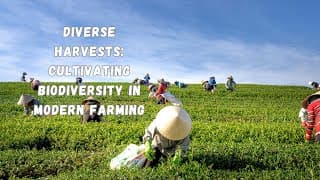
Soul Intro: Where Barren Earth Becomes Living Pantry
The first thing you notice is the quiet. Not the silence of abandonment, but a deep, humming quiet — the sound of soil breathing. Where once there was only cracked clay and wind-scoured dirt, now stands a layered community of life. Tall canopy trees filter the morning light onto a mid-story of fruit-laden shrubs, as ground-cover herbs and root vegetables weave a dense, living carpet beneath. This is a polyculture food forest, and it is performing a quiet miracle: turning degraded land back into a functioning ecosystem.
Across the globe, an estimated 2 billion hectares of land have been degraded — stripped of their fertility, biodiversity, and capacity to support life. Industrial agriculture, deforestation, and climate extremes have left vast stretches of earth unable to hold water, cycle nutrients, or sustain the web of organisms that make soil alive. The conventional response has been to inject synthetic fertilizers, irrigate with fossil water, and apply pesticides — a techno-fix that treats symptoms while ignoring the underlying biological collapse.
Polyculture food forests offer a different path. By mimicking the structure and function of natural forests — stacking plants in vertical layers, cultivating perennial species alongside annuals, and integrating animals and fungi — these systems rebuild ecosystem complexity from the ground up. They are not gardens in the traditional sense, nor are they wild forests. They are designed ecosystems, where every plant, insect, and microbe influences restoring what was lost.
The science is clear: biodiversity is not a luxury for healthy landscapes. It is the engine that powers them. As we explore the mechanisms behind food forests, we will see how diversity drives function, how life restores life, and why this ancient practice may be one of our most powerful tools for healing a wounded planet.
Mechanism Deep Dive: How Biodiversity Powers Ecosystem Function
Ecosystems are not static collections of species. They are dynamic systems whose properties — productivity, stability, nutrient cycling — emerge directly from the diversity of organisms that inhabit them. Research demonstrates that changes in biodiversity alter ecosystem properties and the goods and services they provide to humanity (10.1890/04-0922). This is not a subtle correlation; it is a mechanistic relationship. When species are lost, functions are lost. When diversity is restored, functions return.
The key lies in functional characteristics — the traits that determine how organisms interact with their environment and with each other. As the same research establishes, ecosystem properties depend on the functional characteristics of organisms and their distribution and abundance over space and time (10.1890/04-0922). A forest with deep-rooted trees, nitrogen-fixing legumes, and sprawling ground covers processes water, carbon, and nutrients differently than a monoculture of shallow-rooted annuals. In a polyculture food forest, functional diversity ensures that every ecological niche is filled, every resource captured, every waste product recycled.
Nowhere is this more visible than in the soil. Earthworms, as ecosystem engineers, contribute to soil function and ecosystem services including pedogenesis, soil structure, water regulation, nutrient cycling, primary production, climate regulation, and pollution remediation (10.1111/ejss.12025). Their burrows create macropores that channel water deep into the profile, reducing runoff and erosion. Their castings stabilize soil aggregates and make nutrients available to plants. In a degraded landscape, earthworms are often absent — the soil is too compacted, too hot, too dry for them to survive. A food forest changes that. The mulch layer moderates temperature and moisture. The diverse root systems create channels and food sources. Within months, earthworm populations can rebound, and with them, the entire soil food web.
This is the fundamental insight: biodiversity is not decoration. It is infrastructure. When we plant a polyculture food forest, we are not just growing food. We are rebuilding the biological machinery that makes landscapes productive, resilient, and alive.
Mechanism Deep Dive: Agroecological Principles in Practice
The scientific literature on agroecology provides a clear framework for understanding why polyculture food forests work. Agroecologically based production systems enhance food security while conserving agrobiodiversity, soil, and water resources, particularly for smallholder farmers (10.1007/s13593-011-0065-6). This finding, drawn from case studies across Cuba, Brazil, the Philippines, and Africa, demonstrates that ecological intensification — using biodiversity to drive productivity — can outperform industrial approaches in the contexts where it matters most.
One of the most dramatic benefits is pest regulation. Introducing plant diversity in agroecosystems is an agroecological approach to drastically reduce pesticide use while controlling crop pests and diseases (10.1007/s13593-011-0022-4). In a monoculture, pests find an endless buffet of their preferred host plant. In a polyculture, they encounter a confusing mosaic of scents, textures, and chemical defenses. Beneficial insects — predators and parasitoids — find habitat and alternative prey. The system regulates itself. Farmers in the tropics have known this for millennia; now the data confirms it.
Water management is another critical dimension. Water availability is a major factor constraining humanity's ability to meet future food and energy needs, highlighting the interconnectedness of the food-energy-water nexus (10.1029/2017rg000591). Food forests address this by building soil organic matter, which acts like a sponge, absorbing rainfall and releasing it slowly during dry periods. The deep root systems of trees and perennial plants access water far below the reach of annual crops, making the system more resilient to drought. In degraded landscapes where water infiltration is near zero and evaporation is high, a food forest can transform the local hydrology within a few growing seasons.
These principles are not theoretical. They are being applied by farmers and restoration practitioners around the world, turning barren hillsides into productive, biodiverse landscapes that feed people while healing the earth.
Action-Encyclopedia Module: Carbon Sequestration as a Climate Solution
The urgency of climate action cannot be overstated. Achieving net-zero carbon emissions is an urgent necessity due to increasing greenhouse gas releases from industrialization and fossil fuel over-exploitation (10.1007/s10311-022-01435-8). The global community has set ambitious targets, yet progress remains uneven.
| Category | Percentage of Countries | Target Timeline |
|---|
| Achieved Carbon Neutrality | 4.5% | N/A |
| Planning Carbon Neutrality | Most countries | 2050-2070 |
Only 4.5 percent of countries have achieved carbon neutrality. Most are still in the planning phase, with target timelines stretching to 2050 or beyond. These numbers make clear that technological solutions alone — renewable energy, carbon capture, efficiency gains — will not be enough. We need biological solutions that can draw down atmospheric carbon while delivering co-benefits for biodiversity, water, and food security.
Polyculture food forests are precisely such a solution. By accumulating carbon in woody biomass, root systems, and soil organic matter, they can sequester significant amounts of carbon per hectare — often exceeding the rates of natural forest regeneration in the same climate. The deep, diverse root systems of a food forest deposit carbon deep in the soil profile, where it can remain for decades or centuries. The mulch layer, built from falling leaves and pruned branches, continues to build soil carbon year after year.
Integrating food forests into landscape restoration programs offers a pathway to carbon neutrality that also restores biodiversity, improves water cycles, and produces food. It is a climate solution that works with life, not against it.
Action-Encyclopedia Module: Diversified Farming as a Systems Alternative
The industrial agricultural model — large-scale monocultures dependent on synthetic inputs — has brought us to the brink of ecological collapse. Diversified farming systems offer an agroecological, systems-based alternative to modern industrial agriculture (10.5751/es-05103-170444). Polyculture food forests represent the fullest expression of this alternative: a system where diversity is not an afterthought but the organizing principle.
These systems work by mimicking natural ecosystems. In a food forest, plants are arranged in guilds — groups of species that support each other through complementary functions. Nitrogen-fixing trees feed their neighbors. Deep-rooted plants bring up minerals from the subsoil. Ground covers protect the soil surface and suppress weeds. The result is a system that requires minimal external inputs because it produces its own fertility, manages its own pests, and conserves its own water.
The evidence from developing regions is compelling. Agroecologically based production systems enhance food security while conserving agrobiodiversity, soil, and water resources (10.1007/s13593-011-0065-6). In Cuba, after the collapse of Soviet-era industrial inputs, farmers who adopted diversified agroecological systems saw yields stabilize and even increase. In the Philippines, farmers practicing traditional polyculture maintained productivity through droughts that devastated neighboring monocultures.
For degraded landscapes, the implications are profound. A food forest can transform a plot of land that was losing soil, water, and biodiversity into a system that builds all three. It is restoration through production — healing the land by using it wisely.
Love In Action: Three Ways to Support Food Forest Restoration
Join a local food forest project. Many communities have established public food forests on parkland, school grounds, or reclaimed lots. Volunteers are needed for planting, mulching, weeding, and harvesting. Search for "community food forest" in your area, or check with local permaculture organizations. Your hands-on participation directly accelerates the restoration of degraded urban and peri-urban land.
Advocate for agroecological policies. Contact your local representatives and ask them to support funding for agroecological research, farmer training in diversified systems, and public land restoration programs that prioritize polyculture food forests. Policy shifts at the municipal and state level can unlock resources for large-scale restoration that individual efforts cannot achieve alone.
Plant a mini food forest at home. Even a small yard or a community garden plot can host a layered polyculture. Start with a fruit tree or nut tree as the canopy, add berry shrubs as the understory, and fill the ground layer with perennial vegetables, herbs, and nitrogen-fixing ground covers. Every square meter of food forest you create is a refuge for biodiversity and a demonstration that restoration is possible.
Conclusion: The Living Answer
Polyculture food forests are not a silver bullet, but they are a powerful tool in the restoration toolkit. The science demonstrates that biodiversity drives ecosystem function; that agroecological principles can enhance food security while conserving resources; and that diversified farming systems offer a viable alternative to industrial agriculture. In degraded landscapes, these forests rebuild soil, cycle water, sequester carbon, and support a web of life that was lost.
The data is clear. The mechanisms are understood. The application is within reach. What remains is the will to act. Every food forest planted is a statement that restoration is possible — that degraded land can become productive again, that biodiversity can be rebuilt, and that human communities can thrive in partnership with the living world.
Imagine a future where degraded landscapes are not abandoned but restored. Where food forests line the slopes of eroded hillsides, and their roots hold the soil, and their canopies cool the earth, and their fruits feed the people. That future is not a fantasy. It is a design. And we have the science to build it.