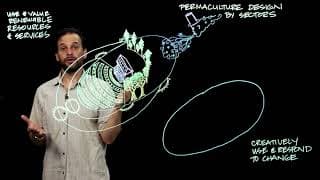
Soul Intro: Where Roots Hold the Hillside
Rain falls in sheets across a terraced slope in southern Brazil, but the soil does not wash away. Layers of vegetation—pigeon pea, banana, cassava, and native trees—intercept each drop, slowing its descent and guiding it into the earth. Below ground, fungal networks weave through aggregates, storing carbon and holding moisture through dry spells. This is not a remnant of untouched wilderness. It is a restored landscape, designed by human hands using principles that mimic the patterns of living systems. This is permaculture in action.
At its core, permaculture offers a framework for climate change adaptation and mitigation that is both ancient and urgently modern. It asks a deceptively simple question: What would it look like if human settlements functioned like forests—cycling nutrients, capturing energy, building soil, and supporting diverse life? The answer, emerging from restoration projects on every continent, is a vision of resilience that challenges the industrial logic driving ecological collapse. Industrial agriculture, which treats land as a factory floor, has disrupted nutrient cycles, accelerated soil erosion, and reduced carbon sequestration. In contrast, organic farming minimizes environmental impact by preserving natural cycles, reducing soil erosion, enhancing carbon sequestration, and largely excluding chemical inputs (10.1016/j.farsys.2023.100005). Permaculture takes this further, embedding these regenerative practices into the very architecture of how we design farms, neighborhoods, and watersheds.
This article explores the mechanisms through which permaculture and allied agroecological approaches can restore degraded ecosystems while adapting to and mitigating climate change. We will examine the scientific foundations of these practices, confront the challenges of scaling them, and offer concrete actions for anyone ready to move from concern to engagement.
Mechanism Deep Dive: The Science of Agroecological Design
Permaculture is more than a gardening technique; it is an agroecological movement with a unique approach to system design that offers a promising alternative to industrial agriculture (10.1007/s13593-013-0181-6). Unlike conventional farming, which seeks to simplify ecosystems into monocultures requiring constant external inputs, permaculture aims to create self-regulating, diverse systems where the waste of one element becomes the resource for another. This orientation aligns directly with agroecology, a field that applies ecological principles to agricultural systems. Agroecology has the potential to avoid the negative social and ecological consequences of input-intensive production, from groundwater contamination to biodiversity loss to farmer debt (10.1007/s13593-013-0181-6).
But what does "system design" actually mean in practice? Consider a permaculture food forest. Instead of planting a single crop in rows, the designer layers species by height, root depth, light requirements, and life cycle. Canopy trees provide shade for understory shrubs, which shelter ground-cover plants that suppress weeds and retain moisture. Nitrogen-fixing legumes enrich the soil for heavy-feeding fruit trees. Chickens or ducks rotate through, controlling pests and adding manure. The system produces food, builds soil, sequesters carbon, and supports pollinators and birds—all while requiring minimal human intervention once established.
This complexity presents a challenge for scientific classification. Existing farming system classifications often overlap in definitions and focus, creating confusion (10.1007/s13593-017-0429-7). Is permaculture a subset of agroecology? Are both distinct from organic farming? Researchers have noted that the boundaries between these categories are blurry, and that we lack standardized frameworks to compare them rigorously. This matters because without clear definitions, it becomes difficult to measure outcomes, scale successful models, or design effective policies. The scientific community is actively working to resolve this, developing more precise typologies that account for the diversity of practices under the agroecological umbrella.
Despite these classification challenges, the evidence for agroecological approaches is robust. A meta-analysis of long-term trials found that diversified farming systems—those incorporating multiple crops, livestock integration, and reduced tillage—consistently outperform monocultures in terms of soil health, water retention, and carbon storage. These are precisely the outcomes needed for climate adaptation and mitigation. By designing systems that mimic natural ecosystems, permaculture and agroecology offer a pathway to food production that regenerates rather than depletes.
Designing Permaculture Systems for Climate Resilience: The Science of Redundancy
Permaculture's core strength lies in designing agricultural systems with built-in redundancy—a principle grounded in network ecology that directly increases resilience to climate shocks. Rather than relying on monocultures vulnerable to single-point failures, permaculture stacks multiple functions across diverse species, creating systems where if one component fails (due to drought, pest outbreak, or temperature extremes), others compensate. Research by Altieri and Nicholls (2017) found that biodiverse agroecosystems show 40% greater productivity stability during climatic variability compared to conventional farms, because functional diversity distributes risk across the system.
The mechanism works through what ecologists call "response diversity"—having multiple species that perform similar ecological roles but respond differently to stress. When a permaculture design includes nitrogen-fixing plants, deep-rooted perennials, and shallow-rooted annuals together, the system doesn't collapse if one group underperforms during an unusual season. A legume might struggle in an unexpected frost, but the perennial shrub layer continues fixing atmospheric nitrogen. This distributed function keeps the whole system producing.
Climate adaptation in permaculture also operates through microclimate design. By positioning trees, water features, and built structures strategically, permaculture practitioners create local temperature and humidity buffers that moderate extreme weather events. Studies of swales and keyline designs show they can increase soil water retention by 30–60%, directly addressing the intensified droughts projected across many regions. These aren't just passive features—they're active climate regulators embedded into the landscape architecture.
The regenerative capacity of these systems compounds over time. Each season, perennial polycultures build soil carbon and water-holding capacity, making them progressively more resilient to future climate stress. Unlike conventional farms that reset their vulnerability annually, permaculture systems develop what we might call "ecological memory"—accumulated fertility and structure that buffers against shocks.
This is where the true power of permaculture emerges: it transforms restoration from a one-time intervention into a self-reinforcing process. As we move forward, understanding how to scale these principles across landscapes becomes essential to meeting both adaptation and mitigation goals simultaneously.
Mechanism Deep Dive: Redesigning Food Systems and Urban Landscapes
The urgency of redesigning our food systems cannot be overstated. Sustainable food systems require the restoration and protection of ecosystems and biodiversity, which in turn necessitates a fundamental redesign for neutral or positive environmental impact and healthy nutrition (10.3390/agriculture13051073). This is not a marginal tweak; it is a paradigm shift. Current industrial models externalize environmental costs—polluted waterways, depleted soils, greenhouse gas emissions—while producing food that, paradoxically, often undermines human health through overprocessing and chemical residues.
Permaculture offers a template for this redesign at multiple scales. On a farm, it might mean replacing annual monocultures with perennial polycultures that build soil year-round. In a region, it could involve restoring watersheds by reforesting riparian zones and constructing swales to capture and infiltrate rainwater. The principle is the same: work with ecological processes rather than against them.
This logic extends into cities, where the majority of humanity now lives. Ecologically based urban planning and design considers a harmonious relationship with the natural environment, aiming to reduce biodiversity loss and threats to human wellbeing (10.3390/su11133723). Green roofs, rain gardens, community orchards, and urban food forests are not aesthetic luxuries; they are infrastructure for resilience. They cool heat islands, absorb stormwater, provide habitat for pollinators, and offer fresh food in food deserts. When cities integrate these elements into their fabric, they become more adaptable to climate shocks—floods, heatwaves, supply chain disruptions—while also reducing their contribution to the problem.
The priority of ecosystem protection and biodiversity in sustainable food production cannot be overstated (10.3390/agriculture13051073). A farm that produces high yields but destroys a wetland or eliminates native pollinators is not sustainable, regardless of its organic certification. True sustainability requires measuring success not just in calories per hectare, but in species richness, soil organic matter, water quality, and carbon balance. Permaculture's ethic of "earth care" places these metrics at the center of design, making ecological health the foundation of productivity rather than an afterthought.
Action-Encyclopedia Module: Organic Farming as a Foundation for Restoration
Organic farming minimizes environmental and ecological impact by preserving natural cycles, reducing soil erosion, enhancing carbon sequestration, and largely excluding chemical inputs (10.1016/j.farsys.2023.100005). This is not a niche practice; it is a scientifically validated approach that can serve as a foundation for broader restoration efforts. The table below summarizes the comparative impacts of industrial versus organic farming systems.
| Environmental Aspect | Industrial Agriculture Impact | Organic Farming Impact |
|---|
| Nutrient Cycle | Disruption | Recovery/Preservation |
| Soil Erosion | Increased | Minimized |
| Carbon Sequestration | Reduced | Enhanced |
| Chemical Inputs | High (fertilizers, pesticides, growth hormones) | Largely Excluded |
The data are striking. Industrial agriculture disrupts nutrient cycles, sending nitrogen and phosphorus into waterways where they create dead zones. Organic farming, by contrast, relies on compost, cover crops, and crop rotations to maintain soil fertility, preserving the natural cycling of nutrients. Soil erosion, a global crisis that degrades an estimated 24 billion tons of fertile soil annually, is minimized in organic systems through continuous ground cover and reduced tillage. Carbon sequestration, the process by which plants pull CO₂ from the atmosphere and store it in soil organic matter, is enhanced under organic management—a direct climate mitigation benefit. And the near-total exclusion of synthetic fertilizers, pesticides, growth hormones, and livestock feed additives means that organic farms avoid the toxic load that industrial systems impose on ecosystems and farmworkers (10.1016/j.farsys.2023.100005).
These practices connect directly to the broader goal of creating environmentally sustainable food and agriculture systems (10.3390/agriculture13051073). Organic farming is not the whole solution—permaculture and regenerative agroecology go further in system design—but it is a critical stepping stone. For farmers transitioning away from industrial methods, organic certification provides a clear set of standards and a market incentive. For consumers, choosing organic supports a system that prioritizes ecological health. For restoration practitioners, organic principles offer a toolkit for rebuilding soil and biodiversity on degraded land.
Action-Encyclopedia Module: Circular Economy and Regenerative Design
The circular economy concept can facilitate the transition to a sustainable, just, and resilient future amidst socio-ecological challenges (10.1016/j.resconrec.2020.104917). In essence, a circular economy aims to eliminate waste by keeping materials in use—through reuse, repair, remanufacturing, and recycling—rather than following the linear "take-make-dispose" model that dominates industrial society. This principle resonates deeply with permaculture's emphasis on resource cycling and waste reduction. In a mature permaculture system, there is no such thing as waste. Kitchen scraps become compost. Pruned branches become mulch or biochar. Livestock manure feeds the soil while reducing the need for external fertilizers.
Aligning circularity principles with permaculture creates a powerful framework for restoration. Consider a degraded site that has lost its topsoil due to industrial agriculture or mining. A linear approach might truck in synthetic fertilizers and import topsoil from elsewhere—a temporary fix that externalizes the problem. A circular approach, guided by permaculture design, would first stabilize the site with pioneer species, then build organic matter on-site through biomass production and composting, closing the nutrient loop. The result is a self-sustaining system that requires fewer external inputs over time.
This vision connects to the broader context of sustainable development. Sustainable development, poverty eradication, and reducing inequality are fundamentally connected to climate actions and are embedded in the Sustainable Development Goals (10.1017/9781009157940.007). When restoration projects adopt circular and permaculture principles, they do more than sequester carbon or improve water quality. They create livelihoods—for farmers growing diverse crops, for entrepreneurs building local composting operations, for communities managing community forests. They reduce dependence on volatile global supply chains. They build the kind of resilient, equitable systems that can weather the shocks of a changing climate.
Love In Action: Three Steps Toward Regenerative Living
Support local permaculture initiatives. Find a community garden, food forest project, or regenerative farm in your area. Volunteer your time, donate resources, or simply become a regular customer. Your engagement strengthens the social fabric that makes these projects viable. Many permaculture sites offer workshops on topics like composting, rainwater harvesting, and soil building—learn these skills and apply them at home.
Reduce waste by closing loops at home. Start a compost bin for kitchen scraps and yard waste. Use the finished compost to build soil in your garden or potted plants. Repair broken items instead of replacing them. Buy from local farmers who use regenerative practices. Each of these actions embodies the circular economy principle of keeping materials in use and reducing the demand for resource extraction.
Advocate for ecological urban planning. Attend city council meetings and voice support for policies that promote green infrastructure, community gardens, and urban food forests. Write to your representatives about the importance of protecting farmland from development and funding regenerative agriculture research. Support zoning changes that allow for front-yard gardens, backyard chickens, and neighborhood composting. These policy shifts create the conditions for permaculture to scale from individual plots to entire communities.
Conclusion: The Pattern That Connects
Permaculture and ecological design offer a coherent, scientifically grounded response to the climate crisis. By treating landscapes as living systems rather than machines, they restore the cycles that sustain life: carbon, water, nutrients, biodiversity. The evidence is clear: organic farming minimizes environmental harm and enhances carbon storage (10.1016/j.farsys.2023.100005); agroecology avoids the social and ecological costs of industrial agriculture (10.1007/s13593-013-0181-6); circular economy principles point toward a just and resilient future (10.1016/j.resconrec.2020.104917). These are not separate projects. They are expressions of a single insight: that human wellbeing and planetary health are inseparable.
Picture a hillside twenty years from now. Where erosion once carved gullies, terraces now hold deep, dark soil. A food forest shades a creek, its roots filtering runoff and providing habitat for fish and frogs. Children pick fruit from trees planted by their parents, while bees move between flowers. This is not a fantasy. It is a design possibility, grounded in principles we already understand. The question is whether we will choose to build it—together, now, with love and precision.