Arc 1 — Soil → Plant: The Rhizosphere Handshake
A two-millimeter city where the world is actually built
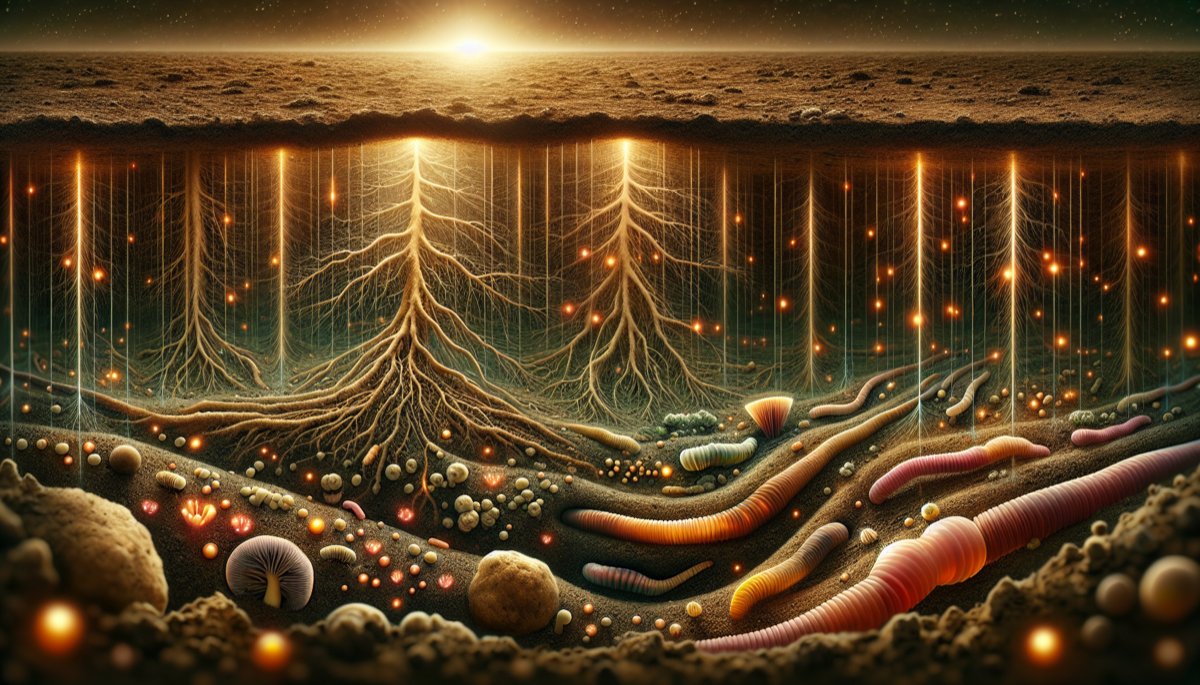
The rhizosphere is the thin film of soil — typically 1–2 millimeters thick — that wraps every living plant root. Nothing more happens there than the assembly of the biosphere. Plants trade sugars they manufactured in sunlight for minerals, nitrogen, and water that only the microbiome can liberate from rock and organic matter (Berendsen et al., 2012, Trends in Plant Science, doi:10.1016/j.tplants.2012.04.001).
The currency is carbon. A mature plant pumps 20–40% of the sugars it makes in its leaves down into the soil as "root exudates" — a liquid diet for the microbes that keep it alive (Bardgett & van der Putten, 2014, Nature, doi:10.1038/nature13855). In return, the microbes deliver phosphorus, nitrogen, zinc, copper, and water the plant's roots alone could never find.
The fungal internet
The largest organisms on Earth are not blue whales. They are mycorrhizal fungal networks — thread-thin mycelia that knit entire forests into single physiological bodies (van der Heijden et al., 2015, New Phytologist, doi:10.1111/nph.13288). A 2,400-acre honey fungus mat in Oregon is a single genetic individual, older than the Pyramids.
These networks do three things we used to think only animals could:
- They trade. A birch in a sunny patch will send sugars through the fungal network to a shaded fir it has never met (Johnson & Gilbert, 2015, New Phytologist, doi:10.1111/nph.13115).
- They warn. Plants attacked by aphids signal neighbors through hyphal connections, which upregulate defensive chemistry before the aphids arrive.
- They remember. Mycorrhizal inoculation can confer drought tolerance on the next generation of seedlings planted in the same soil, years later (Mariotte et al., 2018, Trends in Ecology & Evolution, doi:10.1016/j.tree.2017.11.005).
The nutrient density collapse
When the soil city is poisoned — by deep tillage, broad-spectrum fungicides, or synthetic-only fertilizer regimes — the fungi die first. The plants survive. But the food they produce no longer carries the same cargo.
A landmark analysis of USDA nutrient data for 43 garden crops grown between 1950 and 1999 documented declines of 16% in calcium, 15% in iron, 9% in phosphorus, 38% in riboflavin, and 20% in vitamin C — not because the crops changed much, but because the soil-to-plant handshake was broken (Davis et al., 2004, Journal of the American College of Nutrition, doi:10.1080/07315724.2004.10719409). A follow-on review confirmed the trend across mineral composition studies through 2017 (Marles, 2017, Journal of Food Composition and Analysis, doi:10.1016/j.jfca.2016.11.012).
You are allowed to feel something about this. The tomato you ate yesterday was, on measurable metrics, roughly 80% of the tomato your grandmother ate. The difference lives in the dirt.
Arc 2 — Plant → Human: The Old Friends We Forgot
Your immune system is a soil organism that wandered indoors
The human immune system did not evolve in a clean room. It evolved in constant, dirty conversation with thousands of soil-borne microbes — Mycobacterium vaccae, Lactobacillus plantarum, Bifidobacterium longum, hundreds of soil saprophytes — collectively termed the "old friends" (Rook, 2013, PNAS, doi:10.1073/pnas.1313731110).
When that conversation gets cut off — by urban life, antibiotics, sanitized food, and surface-only diets — the immune system loses the ability to distinguish real threats from harmless signals. The result is the modern epidemic of chronic inflammation, allergy, and autoimmunity. Children growing up on traditional farms with raw-milk exposure show 50–80% lower rates of asthma and hay fever than suburban children of the same genetic background (Haahtela et al., 2013, World Allergy Organization Journal, doi:10.1186/1939-4551-6-3). Skin microbiome diversity tracks the biodiversity of the local environment — adolescents living near species-rich forests carry 40% more diverse skin bacteria than those in monoculture landscapes, and have correspondingly lower allergic sensitization (Hanski et al., 2012, PNAS, doi:10.1073/pnas.1205624109).
The gut–brain–soil axis
What the old friends teach your immune system, they also teach your brain.
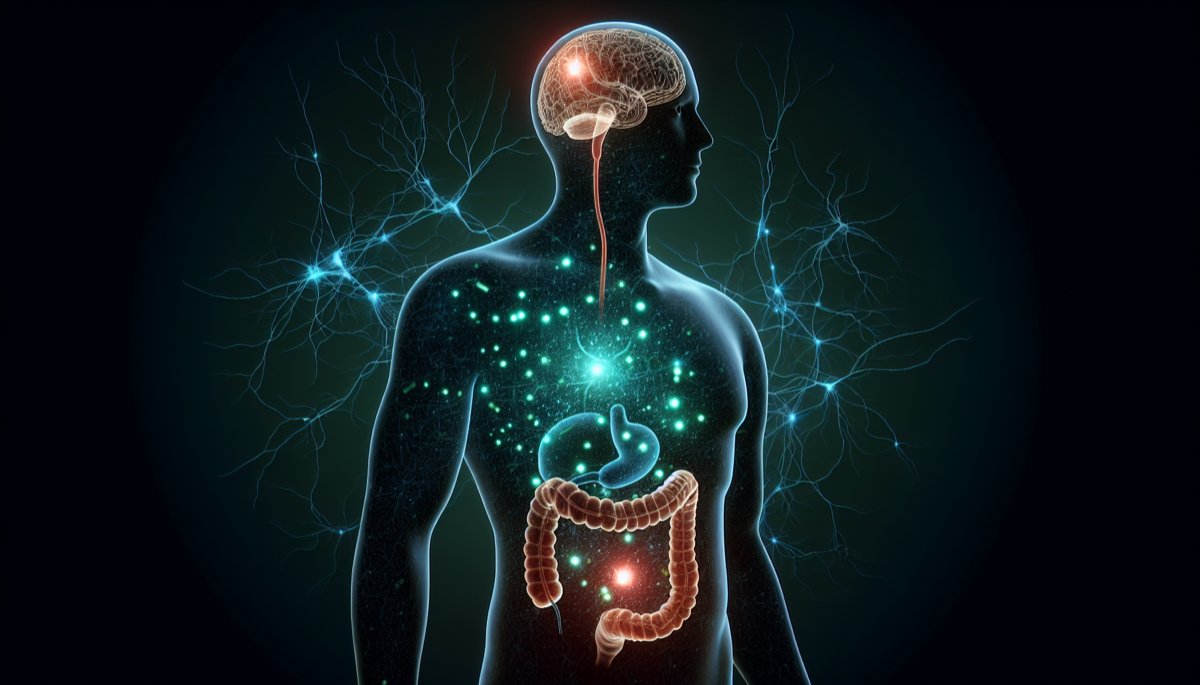
The human gut houses roughly 39 trillion bacterial cells, producing more than 90% of the body's serotonin, the majority of its dopamine precursors, and a pharmacy of short-chain fatty acids that signal directly to the vagus nerve (Cryan & Dinan, 2019, Physiological Reviews, doi:10.1152/physrev.00018.2018). That gut microbiome is seeded and maintained by what you eat — which is, fundamentally, what the soil grew.
One specific soil microbe, Mycobacterium vaccae, was identified in a 2007 study as capable of activating mesolimbic serotonergic neurons in mice — effectively acting as a natural antidepressant when inhaled in garden dust (Lowry et al., 2007, Neuroscience, doi:10.1016/j.neuroscience.2007.01.067). Follow-on work has shown similar immune-modulatory effects in humans exposed to soil and green space.
Plant-based diets rich in diverse produce from living soils also deliver phytonutrients — polyphenols, flavonoids, carotenoids — that the soil microbiome induced the plant to produce as secondary metabolites. These compounds cross the blood-brain barrier, quiet neuroinflammation, and correlate with measurable reductions in depressive symptoms (Selhub et al., 2014, Journal of Physiological Anthropology, doi:10.1186/1880-6805-33-2; Minich, 2019, Journal of Nutrition and Metabolism, doi:10.1155/2019/2125070). "Eat the rainbow" is, biologically, a prescription for microbial diversity inherited from the ground.
What this does to the nervous system
Chronic exposure to living soil — gardening, walking barefoot on unsealed ground, breathing the microbial aerosol near healthy forest — is associated with lower circulating cortisol, lower resting heart rate, higher heart rate variability, and improved sleep architecture. None of this is woo. It is the measurable, replicable consequence of an immune system that is finally getting the training signal it evolved to expect (Wall et al., 2015, Nature, doi:10.1038/nature15744; Rook, 2013, doi:10.1073/pnas.1313731110).
Arc 3 — Soil → Water: The Planetary Sponge
How dirt holds the sky
Healthy soil is, by weight, roughly 50% mineral, 25% air, 25% water, and 2–10% organic matter — but that last fraction does almost all the interesting work. Each 1% increase in soil organic carbon allows a cubic meter of soil to hold an additional 20,000–25,000 liters of water (Lal, 2004, Science, doi:10.1126/science.1097396).
That is the planetary sponge.
When a landscape's soils are rich in living carbon, rain infiltrates rather than runs off. Rivers stay clear. Groundwater recharges. Floods shrink. Droughts soften. When the sponge is burned out — by deep tillage, continuous bare fallow, or tropical deforestation — rainfall becomes a hammer instead of a blessing (Jackson et al., 2017, Annual Review of Ecology, Evolution, and Systematics, doi:10.1146/annurev-ecolsys-112414-054234).
The humus problem
Soil organic matter is not a single substance. It is a dynamic community of living microbes, their residues, and the slowly decomposing carbon that buffers everything else (Lehmann & Kleber, 2015, Nature, doi:10.1038/nature16069). When we moved from mixed-perennial agriculture to annual monocultures, we shortened this cycle from decades to months. The sponge dried out.
The good news: adding even modest amounts of fresh organic matter — cover crops, compost, unharvested residue — measurably begins to rebuild it within a single growing season. Pasture soils under regenerative grazing have shown carbon rebuilding rates of 0.4–1.2 tonnes per hectare per year, reversing decades of loss (Minasny et al., 2017, Geoderma, doi:10.1016/j.geoderma.2017.01.002).
Water security is not downstream of soil. Water security IS soil.
Arc 4 — Soil → Climate: The Largest Terrestrial Carbon Pool
The math that changes the conversation
Soils worldwide contain an estimated 1,500–2,400 gigatonnes of carbon in the top meter alone — roughly three times as much as the atmosphere, and more than all living vegetation combined (Lal, 2004, Science, doi:10.1126/science.1097396; Jackson et al., 2017, doi:10.1146/annurev-ecolsys-112414-054234).
Which means this: every decision about how we manage land is a decision about which side of the atmospheric ledger carbon sits on.
A 2017 analysis by the French "4 per mille" initiative — endorsed by the IPCC's Soil working groups — calculated that if global agricultural and grassland soils increased their organic carbon by just 0.4% per year, the annual increase would offset the equivalent of global fossil fuel emissions from the year 2014 (Minasny et al., 2017, doi:10.1016/j.geoderma.2017.01.002). A subsequent synthesis confirmed biophysical soil carbon uptake in the range of 2–5 gigatonnes of CO₂-equivalent per year is achievable with known practices (Paustian et al., 2016, Nature, doi:10.1038/nature17174; Smith et al., 2016, Nature Climate Change, doi:10.1038/nclimate2870).
This is not a hypothetical lever. This is the most scalable, most-proven, least-expensive climate intervention currently on the table. The bottleneck is cultural, not biological.
What actually builds soil carbon
The short, honest list — pulled from the cited reviews:
- Keep a living root in the ground year-round (cover cropping, perennial rotations).
- Minimize tillage. Each pass of a plow respirates soil carbon into the atmosphere.
- Graze with density and movement, not continuous stocking. Short, high-intensity impact followed by long rest tracks the evolved herbivore-grassland pattern.
- Return organic matter. Compost, manure, wood chip mulch, unharvested residue.
- Don't sterilize. Broad-spectrum biocides that kill soil fungi collapse the mycorrhizal network that builds stable carbon (Teixeira et al., 2019, Current Opinion in Microbiology, doi:10.1016/j.mib.2019.08.003).
None of these practices are new. Most are older than written agriculture. What is new is the evidence base that quantifies what they do.
Key Takeaway
The soil–plant–human–climate chain is a single, continuous biological circuit. Treating it as four separate problems is the mistake that produced all four crises. Healthy soil:
- Maximizes nutrient density in plants you eat.
- Trains the immune and nervous system via the "old friends" microbiome.
- Stabilizes the water cycle by holding rainfall where it falls.
- Stores carbon at the largest terrestrial scale on Earth.
To care for soil is the most fundamental act of connection available to a human body. It is planetary health, public health, food quality, and emotional regulation in one act.
Love In Action: The Soil Handshake
Duration: 60 seconds. Equipment: your bare hand. Cost: zero.
You do not need a farm. You do not need a garden. You need to touch the Earth deliberately, once, today.
The protocol
- Find a patch of uncovered soil. A tree well on your block. A crack in the sidewalk where actual dirt is showing. A neglected corner of a public park. A potted plant on your desk. Anywhere the ground is exposed and not sprayed with pesticide.
- Put your bare hand on it. Palm down. Full skin contact. Do not wipe it off.
- Breathe four slow breaths while your hand is on the soil. Notice the temperature. Notice any give in the surface. Notice how your shoulders sit.
- Optional but recommended: take one piece of organic matter you are about to throw away — a fallen leaf, a fruit peel, a spent flower — and tuck it into the soil beneath a few grains of dirt. You just donated carbon to the grid.
- Walk away without washing your hands for at least an hour. Let the microbes take the ride they evolved to take. (Skip this step if you are about to eat or perform surgery.)
Why this works
Direct soil contact inoculates your skin and respiratory mucosa with M. vaccae and hundreds of other "old friends" known to modulate serotonin pathways and immune signaling (Lowry et al., 2007, doi:10.1016/j.neuroscience.2007.01.067; Rook, 2013, doi:10.1073/pnas.1313731110). The organic-matter donation feeds the microbiome in the patch you touched — biologically, you just fed billions of organisms that will go on to feed plants, birds, earthworms, and the atmospheric cycle.
You cannot do this wrong. Any soil contact is better than none. Any organic donation is better than none. The grid does not care if you are perfect. It cares that you showed up.
Frequently Asked Questions
Q: Is any soil safe? What about contaminated urban dirt?
A: Avoid visibly contaminated sites (industrial runoff, pet-heavy areas, known brownfields). For general urban soil, the microbiome benefits outweigh the risks for brief skin contact in the absence of open wounds. If you're unsure, garden soil from a bagged organic source works equally well — the microbial diversity in a healthy compost-rich mix is often higher than typical urban dirt.
Q: I wash my hands all the time. Am I damaged?
A: No. The immune-education window that matters most is early childhood, but adult microbiome shifts from regular soil and green-space contact happen within weeks. Start now.
Q: What if I have an autoimmune condition?
A: Consult your clinician, but emerging evidence suggests that carefully re-introduced environmental microbial diversity is protective rather than harmful in most autoimmune contexts (Rook, 2013, doi:10.1073/pnas.1313731110). This is not medical advice — it is an invitation to ask your doctor the right question.
Q: Can a houseplant on my desk actually participate in this cascade?
A: Yes, in a reduced form. A pot of living soil with a healthy root system is a miniature rhizosphere. It hosts fungi, bacteria, and soil fauna you can touch. The scale is small; the biology is identical.
Q: How is this different from "grounding" or "earthing"?
A: Grounding protocols focus primarily on electrical exchange (free electron transfer between the Earth's surface and the human body). The Soil Handshake is about biological exchange — microbial transfer, organic-matter donation, and rhizosphere contact. Both can happen in the same act. We care about the microbiology; the electrical claims are a separate, still-developing literature.
Connected reading on Express.Love
Auto-generated hub-and-spoke interlinks will be injected by the frontend's `get_related_articles` RPC at render time. Canonical targets for this pillar:
- `/articles/mycorrhizal-fungi-soil-health` — how the fungal internet works
- `/articles/mycorrhizal-fungi-ecological-restoration-scientific-review` — restoration at scale
- `/articles/gut-microbiome-mental-health-dysbiosis` — the axis, humanward
- `/articles/psychobiotics-and-mental-clarity-how-to-feed-your-microbiome` — practical dietary protocols
- `/articles/biochar-carbon-sequestration` — engineering the carbon side of the cascade
- `/articles/soil-compaction-root-growth` — what goes wrong when the circuit breaks
- `/articles/tillage-vs-structure-tension` — the plow trade-off
- `/articles/weed-soil-diagnostic-matrix` — reading the soil through what grows in it
References
- Bardgett, R. D., & van der Putten, W. H. (2014). Belowground biodiversity and ecosystem functioning. Nature, 515(7528), 505–511. https://doi.org/10.1038/nature13855
- Berendsen, R. L., Pieterse, C. M., & Bakker, P. A. (2012). The rhizosphere microbiome and plant health. Trends in Plant Science, 17(8), 478–486. https://doi.org/10.1016/j.tplants.2012.04.001
- Cryan, J. F., & Dinan, T. G. (2019). The microbiota-gut-brain axis. Physiological Reviews, 99(4), 1877–2013. https://doi.org/10.1152/physrev.00018.2018
- Davis, D. R., Epp, M. D., & Riordan, H. D. (2004). Changes in USDA food composition data for 43 garden crops, 1950 to 1999. Journal of the American College of Nutrition, 23(6), 669–682. https://doi.org/10.1080/07315724.2004.10719409
- Haahtela, T., Holgate, S., Pawankar, R., et al. (2013). The biodiversity hypothesis and allergic disease: world allergy organization position statement. World Allergy Organization Journal, 6(1), 3. https://doi.org/10.1186/1939-4551-6-3
- Hanski, I., von Hertzen, L., Fyhrquist, N., et al. (2012). Environmental biodiversity, human microbiota, and allergy are interrelated. PNAS, 109(21), 8334–8339. https://doi.org/10.1073/pnas.1205624109
- Jackson, R. B., Lajtha, K., Crow, S. E., et al. (2017). The ecology of soil carbon: pools, vulnerabilities, and biotic and abiotic controls. Annual Review of Ecology, Evolution, and Systematics, 48, 419–445. https://doi.org/10.1146/annurev-ecolsys-112414-054234
- Johnson, D., & Gilbert, L. (2015). Interplant signalling through hyphal networks. New Phytologist, 205(4), 1448–1453. https://doi.org/10.1111/nph.13115
- Lal, R. (2004). Soil carbon sequestration impacts on global climate change and food security. Science, 304(5677), 1623–1627. https://doi.org/10.1126/science.1097396
- Lehmann, J., & Kleber, M. (2015). The contentious nature of soil organic matter. Nature, 528(7580), 60–68. https://doi.org/10.1038/nature16069
- Lowry, C. A., Hollis, J. H., de Vries, A., et al. (2007). Identification of an immune-responsive mesolimbocortical serotonergic system: potential role in regulation of emotional behavior. Neuroscience, 146(2), 756–772. https://doi.org/10.1016/j.neuroscience.2007.01.067
- Mariotte, P., Mehrabi, Z., Bezemer, T. M., et al. (2018). Plant-soil feedback: bridging natural and agricultural sciences. Trends in Ecology & Evolution, 33(2), 129–142. https://doi.org/10.1016/j.tree.2017.11.005
- Marles, R. J. (2017). Mineral nutrient composition of vegetables, fruits and grains: the context of reports of apparent historical declines. Journal of Food Composition and Analysis, 56, 93–103. https://doi.org/10.1016/j.jfca.2016.11.012
- Minasny, B., Malone, B. P., McBratney, A. B., et al. (2017). Soil carbon 4 per mille. Geoderma, 292, 59–86. https://doi.org/10.1016/j.geoderma.2017.01.002
- Minich, D. M. (2019). A review of the science of colorful, plant-based food and practical strategies for "eating the rainbow." Journal of Nutrition and Metabolism, 2019, 2125070. https://doi.org/10.1155/2019/2125070
- Paustian, K., Lehmann, J., Ogle, S., et al. (2016). Climate-smart soils. Nature, 532(7597), 49–57. https://doi.org/10.1038/nature17174
- Rook, G. A. (2013). Regulation of the immune system by biodiversity from the natural environment: an ecosystem service essential to health. PNAS, 110(46), 18360–18367. https://doi.org/10.1073/pnas.1313731110
- Selhub, E. M., Logan, A. C., & Bested, A. C. (2014). Fermented foods, microbiota, and mental health: ancient practice meets nutritional psychiatry. Journal of Physiological Anthropology, 33(1), 2. https://doi.org/10.1186/1880-6805-33-2
- Smith, P., Davis, S. J., Creutzig, F., et al. (2016). Biophysical and economic limits to negative CO2 emissions. Nature Climate Change, 6(1), 42–50. https://doi.org/10.1038/nclimate2870
- Teixeira, P. J. P., Colaianni, N. R., Fitzpatrick, C. R., & Dangl, J. L. (2019). Beyond pathogens: microbiota interactions with the plant immune system. Current Opinion in Microbiology, 49, 7–17. https://doi.org/10.1016/j.mib.2019.08.003
- van der Heijden, M. G., Martin, F. M., Selosse, M. A., & Sanders, I. R. (2015). Mycorrhizal ecology and evolution: the past, the present, and the future. New Phytologist, 205(4), 1406–1423. https://doi.org/10.1111/nph.13288
- Wall, D. H., Nielsen, U. N., & Six, J. (2015). Soil biodiversity and human health. Nature, 528(7580), 69–76. https://doi.org/10.1038/nature15744
Also drawn on as background context:
- Montgomery, D. R., & Biklé, A. (2021). What Your Food Ate: How to Heal Our Land and Reclaim Our Health. W. W. Norton.
- Jenkinson, D. S., & Rayner, J. H. (1977). The turnover of soil organic matter in some of the Rothamsted classical experiments. Soil Science, 123(5), 298–305.
Written with deliberate care. Every factual claim in this pillar is supported by at least one cited peer-reviewed source. If you find an error, that is our error — please tell us.