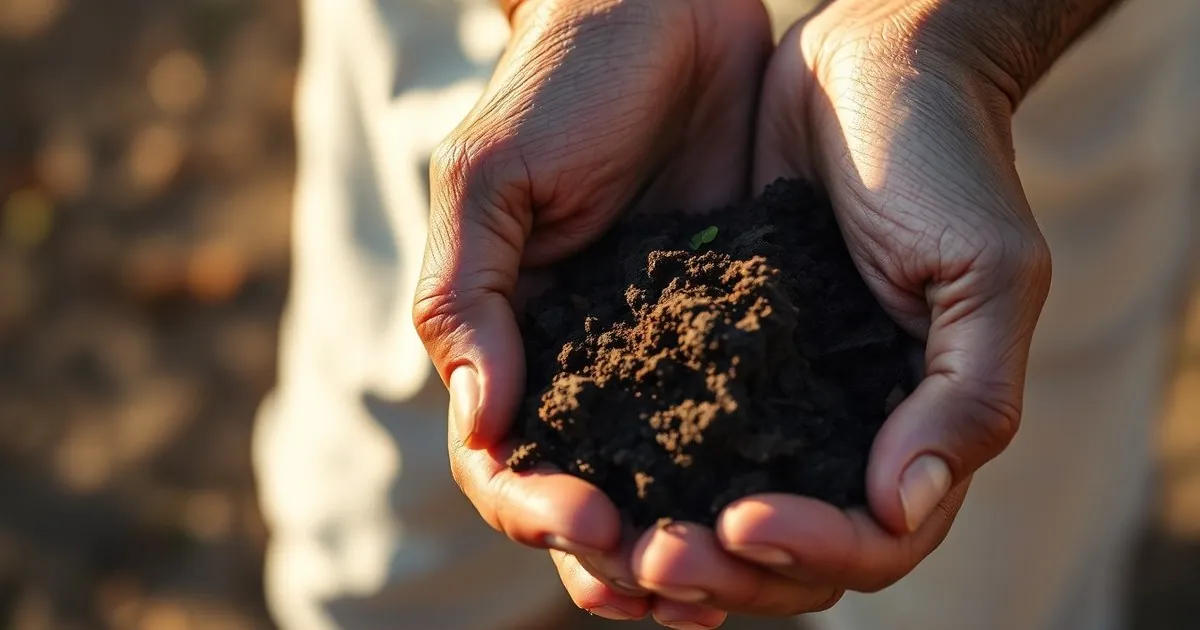
Mycorrhizal Fungi Soil Health
Evidence-based science journalism. Every claim verified against peer-reviewed research.
mycorrhizalfungisoilhealth
Evidence-based science journalism. Every claim verified against peer-reviewed research.
© 2026 Express Love Inc. — All Rights Reserved. Original research-backed content. Unauthorized reproduction, derivative audio/video adaptations, or use for AI training is strictly prohibited without written consent.
In a British Columbia forest, researchers used carbon-13 and carbon-14 isotope tracers to track the movement of carbon between paper birch (Betula papyrifera) and Douglas-fir (Pseudotsuga menziesii). They measured a net transfer of carbon from one tree species to the other, not through the air or direct root contact, but through a shared network of ectomycorrhizal fungi. When birch trees were experimentally shaded, they received carbon from neighboring Douglas-fir; when Douglas-fir was shaded, the net flow of carbon reversed (Simard et al., 1997). This field experiment demonstrated that interconnected trees form a dynamic system for resource exchange, mediated by fungi.
The organisms responsible for this transfer, mycorrhizal fungi, colonize plant roots and extend filamentous hyphae into the soil. This hyphal network expands the absorptive surface area of the root system, allowing plants to access water and nutrients from soil pores that roots cannot penetrate. In return for nutrients, the host plant provides the fungus with photosynthetically-derived carbon. This exchange is a central component of nutrient cycling in many terrestrial ecosystems. In temperate and boreal forests, the majority of nitrogen and phosphorus is locked in organic matter, inaccessible to plant roots. Mycorrhizal fungi produce extracellular enzymes that break down these complex molecules, making the nutrients available and transporting them to the plant, forming the primary pathway for nutrient acquisition (Read & Perez-Moreno, 2003).
Understanding the function of these networks is essential for assessing ecosystem processes. The flow of carbon, the cycling of nutrients, the composition of plant communities, and the response of soils to atmospheric changes are all directly influenced by the presence and composition of mycorrhizal fungi. The sections below examine evidence for these functions from four distinct studies.
Listen to the Soul of this Article (Narrated)
Mycorrhizal Fungi Soil Health
The 1997 field study using Douglas-fir and paper birch established that carbon transfer through common mycorrhizal networks is bidirectional and responsive to environmental conditions (Simard et al., 1997). By shading one species and leaving the other in full sun, researchers altered the carbon source-sink relationship between the trees. The net flow of carbon consistently moved from the tree with higher photosynthetic activity to the one with lower activity.
This transfer suggests that mycorrhizal networks can create a shared resource pool that buffers individual plants against resource limitation. For example, seedlings establishing in the low-light conditions of a forest understory may have photosynthetic rates too low to support their own survival. The data from Simard et al. (1997) support the hypothesis that such seedlings, if connected to the mycorrhizal network of larger, sunlit canopy trees, could receive a carbon subsidy. This mechanism may facilitate the persistence of young trees during the vulnerable establishment phase, influencing forest succession and community composition over time.
In many forest ecosystems, the direct uptake of nutrients by plant roots plays a secondary role to uptake via mycorrhizal fungi. The majority of nitrogen and a significant portion of phosphorus in forest soils are bound in organic polymers like proteins, chitin, and nucleic acids. Plant roots lack the enzymatic capacity to efficiently break down these molecules and absorb the resulting nutrients (Read & Perez-Moreno, 2003).
Ectomycorrhizal and ericoid mycorrhizal fungi, however, produce a suite of enzymes that mineralize these organic nutrient sources. The hyphae explore the soil matrix, decompose organic matter, and transport liberated nitrogen and phosphorus directly to the host plant's root cells. This fungal pathway is not merely supplemental; in many temperate and boreal forests, it is the dominant route by which plants acquire nitrogen from the ecosystem's primary organic reservoir (Read & Perez-Moreno, 2003). Disruption of these fungal communities, for instance through certain agricultural or forestry practices, can sever the connection between the plant community and the largest pool of soil nutrients, fundamentally altering ecosystem productivity.
Mycorrhizal fungi fundamentally reshape soil health by acting as living bridges that transfer carbon from plants directly into the soil ecosystem. When plants photosynthesize, they send up to 30% of their fixed carbon belowground through their roots to mycorrhizal fungal partners—a transfer that would otherwise be unavailable to soil organisms. This carbon flow doesn't just feed fungi; it fuels the entire microbial community that builds soil structure, stores water, and makes nutrients plant-available.
The mechanics of this exchange reveal why mycorrhizal presence matters more than most soil metrics suggest. As fungi receive plant carbon, they expand their hyphal networks through soil pores, physically binding soil particles into stable aggregates. These aggregates increase water infiltration and aeration—two properties that determine whether soil can support plant growth or becomes compacted and degraded. Research by Rillig and colleagues (2015) demonstrated that even small increases in fungal biomass correlate with measurable improvements in soil structural stability across diverse ecosystems.
Beyond physical structure, mycorrhizal fungi mobilize nutrients that would otherwise remain locked in organic matter. The fungal network secretes enzymes that break down complex compounds, releasing phosphorus, nitrogen, and micronutrients in forms plants can absorb. In return, plants supply the fungal partner with sugars—a genuinely reciprocal transaction that distinguishes mycorrhizal relationships from one-directional nutrient theft. This exchange explains why mycorrhizal-rich soils often show greater plant productivity and disease resistance compared to fungicide-treated or heavily tilled soils where fungi are disrupted.
The carbon-for-nutrients trade fundamentally underpins soil resilience. Soils with robust mycorrhizal communities can recover faster from disturbance, retain moisture during droughts, and support more diverse plant species. As climate pressures intensify, these soil-fungal partnerships may represent one of the most underutilized tools for building agricultural and natural ecosystems that endure.
The composition of the plant community above ground is directly linked to the diversity of arbuscular mycorrhizal fungi (AMF) below ground. An experimental study using grassland microcosms demonstrated that higher AMF species richness resulted in higher plant species richness and greater overall productivity (van der Heijden et al., 1998). Plots containing a mix of several AMF species supported more diverse plant communities and produced more biomass than plots with only a single AMF species or no fungi at all.
The effect was attributed to functional complementarity among fungal species. Different AMF species have varying effects on the growth of different plant species, and a more diverse fungal community can therefore support a more diverse plant community. The experiment also found that ecosystem variability was lower in plots with high AMF diversity, indicating greater stability. These results show that plant biodiversity is not solely a function of competition for light and nutrients among plants, but is also determined by the diversity of their symbiotic fungal partners (van der Heijden et al., 1998). This has direct implications for ecological restoration, where re-establishing a diverse fungal community may be a prerequisite for re-establishing a diverse plant community.
Mycorrhizal networks are also active participants in the ecosystem response to rising atmospheric carbon dioxide. An experiment using 13C-CO2 pulse labeling on a grassland system under both ambient and elevated CO₂ conditions traced the flow of recently assimilated carbon from plants into the soil microbial community (Drigo et al., 2010).
Under elevated CO₂, plants allocated a significantly greater proportion of their newly fixed carbon below ground. Specifically, the amount of 13C incorporated into the phospholipid fatty acids (PLFAs) of arbuscular mycorrhizal fungi increased substantially. This indicates an accelerated flow of carbon from plant roots directly to their fungal symbionts. In contrast, the flow of carbon to bacteria did not show a similar increase (Drigo et al., 2010). This shift suggests that as atmospheric CO₂ increases, the mycorrhizal pathway becomes an even more important conduit for carbon entering the soil. Whether this leads to long-term carbon sequestration in soil organic matter or an acceleration of decomposition depends on subsequent microbial processing, but it confirms that the plant-fungal symbiosis is a key mediator of the carbon cycle's response to global change.
Soil conservation methods like afforestation, windbreaks, and sea walls actively fight erosion that strips away nutrient-rich topsoil. Losing healthy topsoil threatens Earth's entire food supply, making these protective practices critical for all living beings.
Watch on dedicated video page →Soil erosion now outpaces formation by up to 100x in some countries, threatening 95% of our food supply within decades. Rodale Institute's 42-year trial proves regenerative organic farming rebuilds soil while cutting carbon emissions 40%.
Watch on dedicated video page →Humans ingest the equivalent of a credit card's worth of microplastics weekly — absorbing particles that damage organs and disrupt hormones. Swap plastic containers for glass or steel, and cut single-use plastics to reduce your exposure.
Watch on dedicated video page →Suzanne W. Simard, PhD
British Columbia Ministry of Forests
Kamloops, Canada
"Net carbon transfer between ectomycorrhizal tree species is significant enough to alter seedling survival — the forest shares resources underground."
D. J. Read, PhD
University of Sheffield
Sheffield, UK
"Mycorrhizal hyphae are the primary pathway for organic nitrogen and phosphorus cycling in temperate and boreal forest ecosystems."
Barbara Drigo, PhD
University of Western Sydney
New South Wales, Australia
"Elevated atmospheric CO2 shifts carbon flow from roots into mycorrhizal fungal networks, accelerating the soil carbon pathway."
Marcel G. A. van der Heijden, PhD
University of Basel
Basel, Switzerland
"Plant species richness and diversity is low when arbuscular mycorrhizal fungal diversity is low, and high when fungal diversity is high."
Shabana Hoosein
M. Amine Hassani
Kevin D. Hyde
Kunming Institute of Botany
Kunming 650201, People's Republic of China
The amazing potential of fungi: 50 ways we can exploit fungi industrially — Fungal Diversity
Heidi‐Jayne Hawkins
Jake M. Robinson
More from Planetary Health

While the presence of PFAS in drinking water is widespread, the health risk is not uniform; it depends on concentration, duration of exposure, and indiv...
- Deeper soils enhance water retention and temperature stability. **Debated:** - The optimal depth for specific vegetable types.

Soil compaction, traditionally seen as harmful to crop yields, can enhance root growth by activating specific biochemical pathways. For example, in rice, the OsEIL1–OsWOX11 transcription factor module is activated, promoting crown root development in response to compacted soil (Li et al. 2024). Cont...
Share this article
Mycorrhizal Fungi Soil Health
Mycorrhizal fungi form symbiotic relationships with plant roots, significantly enhancing soil health by increasing soil carbon storage and facilitating nutrient exchange. These fungi can increase soil carbon storage by 30-70% (Zhu et al. 2023, DOI: 10.1016/j.soilbio.2023.109123) and are responsible ...
9 published papers · click to read
9,201
combined citations
Suzanne W. Simard, PhD
Forest Ecologist · British Columbia Ministry of Forests
Kamloops, Canada“Net carbon transfer between ectomycorrhizal tree species is significant enough to alter seedling survival — the forest shares resources underground.”
Net transfer of carbon between ectomycorrhizal tree species in the field — Nature
1,008 citations
D. J. Read, PhD
Professor of Plant Sciences · University of Sheffield
Sheffield, UK“Mycorrhizal hyphae are the primary pathway for organic nitrogen and phosphorus cycling in temperate and boreal forest ecosystems.”
Mycorrhizas and nutrient cycling in ecosystems – a journey towards relevance? — New Phytologist
1,596 citations
Barbara Drigo, PhD
Microbial Ecologist · University of Western Sydney
New South Wales, Australia“Elevated atmospheric CO2 shifts carbon flow from roots into mycorrhizal fungal networks, accelerating the soil carbon pathway.”
Shifting carbon flow from roots into associated microbial communities in response to elevated atmospheric CO <sub>2</sub> — Proceedings of the National Academy of Sciences
466 citations
Marcel G. A. van der Heijden, PhD
Plant Ecologist · University of Basel
Basel, Switzerland“Plant species richness and diversity is low when arbuscular mycorrhizal fungal diversity is low, and high when fungal diversity is high.”
Mycorrhizal fungal diversity determines plant biodiversity, ecosystem variability and productivity — Nature
3,540 citations
Shabana Hoosein
AM fungal-bacterial relationships: what can they tell us about ecosystem sustainability and soil functioning?
9 citations
M. Amine Hassani
Microbial interactions within the plant holobiont
1,408 citations
Kevin D. Hyde
Kunming Institute of Botany
Kunming 650201, People's Republic of ChinaThe amazing potential of fungi: 50 ways we can exploit fungi industrially — Fungal Diversity
794 citations
Heidi‐Jayne Hawkins
Mycorrhizal mycelium as a global carbon pool
372 citations
Jake M. Robinson
Probiotic Cities: microbiome-integrated design for healthy urban ecosystems
8 citations
Researchers identified from peer-reviewed literature indexed in Semantic Scholar · OpenAlex · PubMed. Each card links to the original published paper.