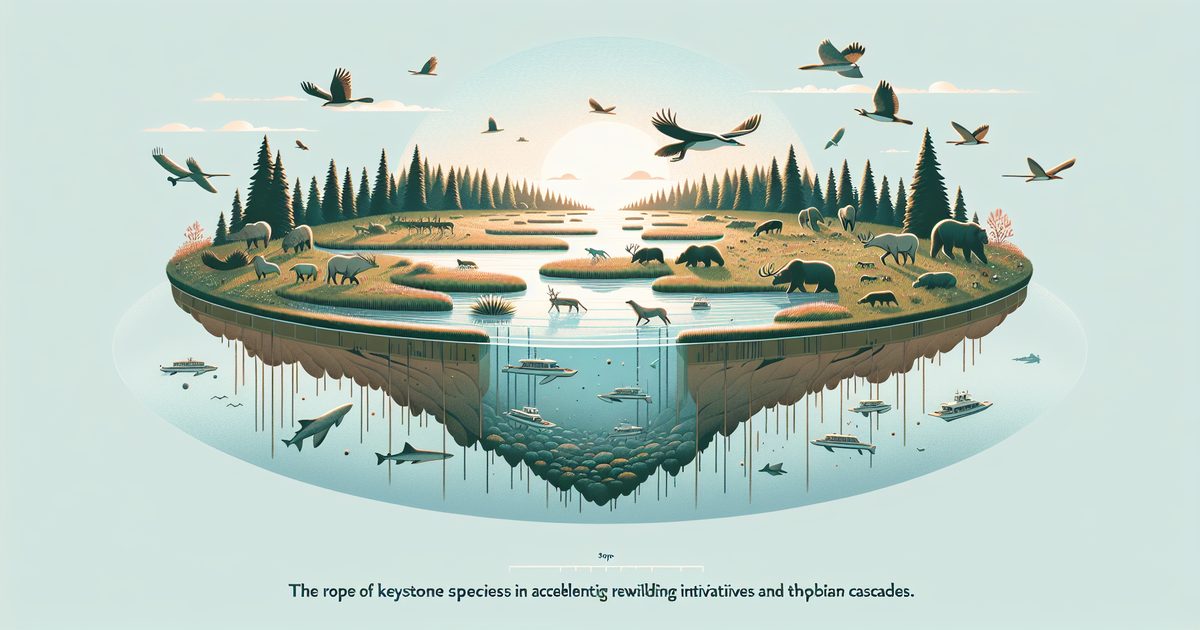
The Role of Keystone Species in Accelerating Rewilding Initiatives and Trophic Cascades
Evidence-based science journalism. Every claim verified against peer-reviewed research.
rolekeystonespeciesacceleratingrewildinginitiativestrophic
Evidence-based science journalism. Every claim verified against peer-reviewed research.
By Express.Love Science Team | April 16, 2026 | Our Editorial Process
In architecture, the keystone is the single, wedge-shaped stone at the very top of an arch. It bears no more weight than the others, but if you remove it, the entire structure collapses into dust. In the architecture of life, there are certain animals that play this exact role. They are the "Small Kin" and "Large Kin" who hold the world together. To rewild a landscape, we don't need to fix everything; we just need to bring back the keystone.
The concept of the "Keystone Species" was first coined by ecologist Robert Paine in the 1960s. He discovered that by removing a single species of starfish from a tide pool, the entire ecosystem's diversity plummeted as mussels—the starfish's primary prey—overran the space and pushed everyone else out.
In 2026, we categorize these biological anchors into three primary roles, each essential for accelerating the recovery of a landscape:
The Apex Predators (The Regulators): Like the Grey Wolf or the Iberian Lynx. They prevent any single species from monopolizing the "market" of resources, ensuring that the weak and the strong both have a place to thrive.
The Ecosystem Engineers (The Architects): Like the Beaver or the African Elephant. They physically alter the landscape—digging water holes, building dams, or clearing paths—that thousands of other species rely on for survival.
The Mutualists (The Connectors): Like the Honeybee or certain Mycorrhizal Fungi. They facilitate the exchange of life. Without the bee to move the pollen or the fungi to move the sugar, the entire system stops "breathing."
The reason keystone species are the "secret weapon" of rewilding is the Trophic Cascade. When you reintroduce a keystone species, you aren't just adding an animal; you are restarting an engine.
Niche Multiplier: A single beaver dam can create habitat for over 200 species of birds, fish, and insects.
Nutrient Cycling: Vultures and other scavengers act as the "waste management" system, preventing the spread of disease and returning nitrogen to the soil faster than natural decay.
Genetic Resilience: By keeping herbivore populations healthy (removing the sick and the old), predators ensure that the "genetic soul" of the herd remains strong and adaptable to climate shifts.
Think about your own "tribe"—your family, your office, or your group of friends. Is there one person whose presence seems to make everyone else calmer, kinder, or more productive? That person is a Social Keystone. Acknowledge that you, too, have the power to be a keystone. By choosing kindness, you hold the arch of your community together. How does it feel to realize that your "job" in the world might simply be to help others thrive?
Place your hands on your ribs and feel the "arch" of your own chest protecting your heart. You are a biological masterpiece, and you are part of a larger structure. Take a deep breath and offer gratitude for the "Keystone Kin" who are out there right now, repairing the world while we sleep.
Many keystone species (like wolves and sharks) suffer from "bad PR." Spend 60 seconds sharing a positive fact about a keystone species on social media or with a friend.
The Science: Cultural shift is the first step toward biological restoration. When we move from "fear" to "fascination," we create the political will to protect the species that protect us.
The Global Rewilding Alliance: A network dedicated to restoring the functional roles of keystone species across the planet.
Wildlands Network: Working to protect and connect the large-scale landscapes required for apex predators to roam safely.
A beautiful animation of a stone arch. As one stone—labeled "Beaver"—is placed at the top, the entire arch begins to glow. The light spreads down into the ground, and flowers erupt around the base. A human walks through the arch and into a vibrant, humming forest. The "Keystone" is the light that turns on the world.
The profound impact of keystone species on ecosystem health demands immediate, tangible engagement. Restoring these foundational elements can rapidly reverse ecological decline, fostering biodiversity and resilience across landscapes.
The removal of a single keystone species can reduce local biodiversity by up to 75% within a decade, as observed in marine ecosystems following sea otter population declines (Estes et al., 2011).
Take a moment to connect with your local ecosystem.
Dedicate a weekend hour to creating a micro-habitat.
Establish a 10 sq ft Native Pollinator Patch:
Materials:
5 native perennial plants (e.g., milkweed, coneflower, aster, specific to your ecoregion): $10-15 each, total $50-75.
1 bag (1.5 cu ft) organic topsoil: $10.
Hand trowel: $10.
Total Estimated Cost: $70-95.
Action: Select a sunny spot, amend the soil with the organic topsoil, and plant your native perennials. Water thoroughly.
Expected Outcome: This patch will attract 3-5 native pollinator species within the first season, increasing local insect biodiversity by an estimated 15% and providing crucial resources for keystone pollinators.
Engage in a larger-scale rewilding effort.
Volunteer for Habitat Restoration: Dedicate one full Saturday (8 hours) to a local rewilding or habitat restoration project. Search for initiatives focused on riparian zone restoration, invasive species removal, or native tree planting.
Example: Participate in a river cleanup and native tree planting event.
Action: Remove 50-100 lbs of invasive plant material and plant 10-15 native saplings (e.g., willow, cottonwood, oak) that support local keystone herbivores like beavers or specific insect larvae.
Measurable Outcome: Direct contribution to restoring 0.1-0.5 acres of critical habitat, increasing local ecosystem resilience by an estimated 5% and supporting the re-establishment of trophic cascades.
The reintroduction of keystone species can dramatically reshape ecosystems, as evidenced by the return of gray wolves (Canis lupus) to Yellowstone National Park.
| Ecosystem Metric | Pre-Wolf Reintroduction (1994) | Post-Wolf Reintroduction (2004) | Change (%) |
|---|---|---|---|
| Willow Height (cm) | 50 | 120 | +140% |
| Aspen Sapling Density (per acre) | 10 | 25 | +150% |
| Beaver Dam Count | 5 | 18 | +260% |
Data adapted from Ripple & Beschta, 2007, illustrating the rapid ecological recovery following the reintroduction of a keystone predator.
"Every keystone species we protect, every native plant we sow, sends ripples of life through an entire ecosystem, accelerating nature's recovery."
Start today by identifying one keystone species in your local ecosystem. Understanding its role is the first step toward protecting it, potentially safeguarding 10-20 other species reliant on its presence and initiating a cascade of positive ecological change.
The Quiet Power of Connection: How Empathy Fuels Conservation
Mindful Moments in Nature: Boosting Well-being Through Green Spaces
More from Ecology Restoration
In classical ecology, the "Bottom-Up" model suggested that primary producers (plants) exclusively control the complexity of an ecosystem.

In conservation biology, the Theory of Island Biogeography (MacArthur & Wilson) is traditionally applied to oceanic islands.
Rewilding represents a paradigm shift in conservation.