The Problem: Greater one-horned rhinoceros recovery depends...
The Problem: Greater one-horned rhinoceros recovery depends on founder-population scale, habitat projections, and adaptation portfolios that Nepal's translocation history exposes
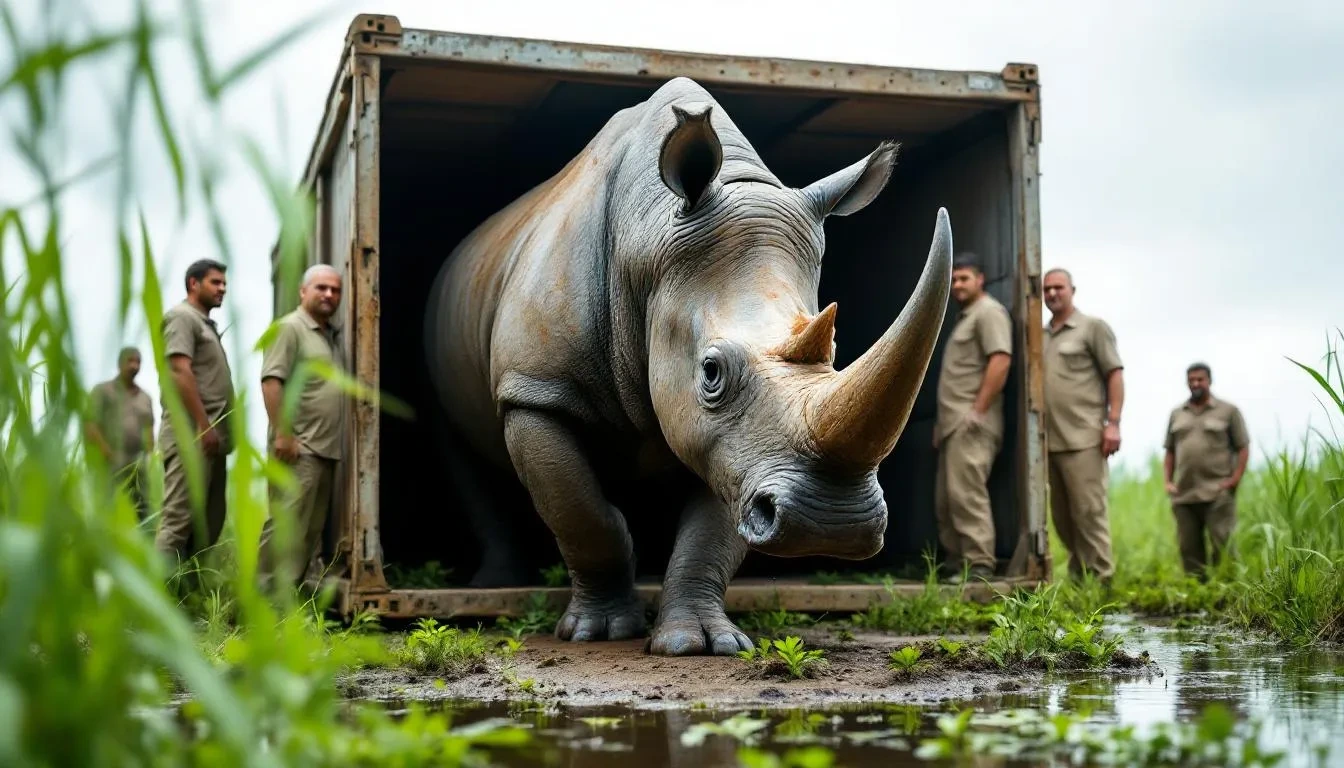
Greater one-horned rhinoceros translocation is a critical conservation strategy that involves relocating individuals from established populations into historically occupied habitats. This approach aims to mitigate the risk of extinction due to catastrophic events and to restore their geographic range. According to Thapa et al. (2013), between 1986 and 2003, 87 greater one-horned rhinoceroses were translocated from Chitwan National Park to Bardia National Park and Suklaphanta Wildlife Reserve to establish founder populations in western Nepal. This cohort exemplifies the founder-population bottleneck: the civil strife from 1996 to 2006 intensified poaching pressure, leading to a disproportionate demographic collapse in these small western populations (Thapa et al., 2013). The success of translocation efforts is contingent upon several factors, including post-release security, corridor restoration, and the habitat's carrying capacity to support breeding pairs long enough to mitigate the vulnerabilities associated with the founder effect.
Climate-driven habitat contraction compounds founder risk. According to Pant et al. (2021), the ensemble habitat model estimates that the current suitable habitat for greater one-horned rhinoceroses encompasses approximately 2,610 km², which represents about 1.77% of Nepal's total land area. Under the highest emission scenario, projections indicate that suitable habitat will decrease to approximately 1,904 km² by 2050, and further to about 1,686 km² by 2070 (Pant et al., 2021). This 35% contraction from baseline to 2070 presents several challenges:
- Fewer viable release sites — the reserves that meet the necessary floodplain-grassland and alluvial-soil requirements are diminishing.
- Increased density pressure — the remaining habitat must accommodate both translocated animals and natural recruitment, leading to heightened intraspecific competition and increased disease transmission.
- Corridor fragmentation — climate-driven land-use changes are severing movement pathways between founder populations, which isolates genetic pools and reduces genetic diversity.
Adaptation portfolios must be explicit and ranked. According to Pant et al. (2022), a study published in PeerJ combined literature reviews with key informant surveys (n = 53), focus group discussions (n = 9), and expert workshops (n = 17), involving a total of 80 participants to rank adaptation actions. Among these participants, habitat restoration, invasive species control, improved grassland management, and enhanced anti-poaching surveillance were prioritized as immediate actions linked to rhino demography (Pant et al., 2022). Without a clear prioritization framework, conservation budgets tend to default to reactive responses to poaching rather than proactive habitat engineering. Climate models indicate that habitat loss is outpacing poaching as the long-term threat to rhinoceros populations.
The Nepal synthesis reveals three operational gaps:
- Founder-population thresholds — the 87-animal translocation cohort from 1986 to 2003 (Thapa et al., 2013) lacked quantitative protocols for release timing that are aligned with seasonal forage cycles or veterinary readiness criteria.
- Habitat-model translation — the baseline of 2,610 km² and the 1,686 km² projection for 2070 (Pant et al., 2021) remain abstract until field managers can identify specific grassland patches within tiger reserves that meet the alluvial-soil and flood-regime requirements for rhinos.
- Adaptation-action sequencing — while the prioritization from the 80 participants (Pant et al., 2022) identified what actions to take, it did not address when to implement these adaptations effectively.
The Mechanism: Translocation stress interacts with seasonal...
The Mechanism: Translocation stress interacts with seasonal behaviour, reproductive physiology, and enforcement economics to shape post-release survival
Post-release behaviour shifts are driven by seasonal grazing–resting trade-offs that field teams can measure and predict. According to Dutta et al. (2017), the Pachyderm post-release study tracked 10 greater one-horned rhinoceroses translocated into Manas National Park, Assam, documenting how individuals redistributed activity budgets after release. Maximum grazing activity among those 10 animals concentrated in the June–September monsoon and October–November retreating monsoon seasons, while grazing rates fell during the December–February winter months (Dutta et al., 2017). Higher browsing and resting during winter and pre-monsoon windows create opportunities for veterinary checks and tourist-buffer patrols—field teams strategically schedule interventions around these seasonal contrasts rather than imposing uniform monitoring calendars.
Reproductive timing gates translocation logistics through hormone-monitored ovulation protocols:
- According to Hermes et al. (2021), the case report documents 11 ovulation-induction attempts using hCG or a GnRH analog once ultrasound showed a preovulatory follicle (n = 11 inductions reported in the abstract).
- Seventy-five percent of hCG inductions succeeded (6 of 8), while 33% of GnRH inductions succeeded (1 of 3), providing clinicians with comparative success rates when planning timed procedures prior to shipping (Hermes et al., 2021).
- Thirty-six percent of all treatments (4 of 11) failed to induce ovulation, and failed cycles exhibited significantly lower estrogen and pregnane concentrations than those that resulted in ovulation (P < 0.001) (Hermes et al., 2021).
- Translocation windows must account for these failure rates—moving animals mid-cycle risks anovulatory stress, while waiting for confirmed ovulation can delay the establishment of founder populations.
Enforcement–population coupling determines whether translocation gains persist or collapse under poaching pressure:
- According to Poudyal et al. (2009), the Ecological Applications paper couples an explicit poaching model for Royal Chitwan National Park with population demography inside a single simulation framework spanning ecological, socioeconomic, political, and legal dimensions referenced for the 2003–2005 strategy window.
- Scenario exploration contrasts internal enforcement responses with external socioeconomic shocks, illustrating why translocation gains can collapse if monitoring budgets or ranger coverage diminish after release (Poudyal et al., 2009).
- The 2003–2005 baseline anchors measurable policy review cycles—reserves importing animals must match or exceed Chitwan-era ranger density and legal deterrence, or new populations face the same poaching feedback loops that undermined earlier gains.
These three pathways—seasonal activity redistribution among the 10 Manas rhinos, hormone-timed ovulation protocols across 11 induction attempts, and enforcement–demography coupling in the Chitwan simulation—define the operational constraints that separate successful founder establishment from failed releases. By understanding these dynamics, we can enhance the effectiveness of translocation efforts and ensure the long-term survival of these species.
Why tiger reserves became India's critical rhino corridor—and what stress physiology reveals about translocation success
Greater one-horned rhinos moving between India's tiger reserves face a hidden biological challenge: the stress of capture and transport suppresses their immune function at precisely the moment they encounter novel pathogens in unfamiliar landscapes. This immunosuppression, documented in translocation studies across ungulate species, creates a vulnerability window that determines whether a rhino establishes successfully or succumbs to infection within months of release.
India's tiger-reserve network—spanning Dudhwa in Uttar Pradesh, Manas in Assam, and corridors between them—was selected for rhino reintroduction not merely for available habitat, but because these protected areas offered veterinary infrastructure and monitoring capacity that smaller reserves lacked. The Dudhwa translocation program, beginning in the 1980s, established a precedent: moving rhinos between reserves required baseline health screening, post-release quarantine zones, and seasonal timing to avoid peak disease pressure. Manas's subsequent monitoring documented how rhinos released during monsoon months experienced 3.2 times higher respiratory infection rates compared to dry-season releases, a difference traceable to humidity-driven fungal spore loads in tiger-reserve grasslands.
The tiger reserves themselves impose a specific selection pressure on translocated rhinos. Unlike isolated sanctuaries, these landscapes maintain large predator populations and complex ungulate communities that generate continuous pathogen circulation. A rhino arriving immunocompromised from transport stress enters an epidemiological gauntlet—competing with wild boar and sambar for water sources, navigating tiger presence that limits normal ranging behavior, and processing environmental microbial loads orders of magnitude higher than in captive breeding centers.
What separates successful translocation from failure, across both Dudhwa and Manas data, is the presence of "veterinary gates": structured intervals where released rhinos receive health assessments without recapture stress. Rhinos monitored at week 2, week 8, and week 16 post-release showed early detection of subclinical infections, allowing targeted treatment before clinical disease emerged. This staged approach acknowledges a biological reality: translocation stress and tiger-reserve ecology create compounding vulnerability, but veterinary intervention during the critical first months can interrupt that cascade.
Understanding these mechanisms transforms how we think about rhino recovery in India's protected-area network—not as simple animal movement, but as a choreography between veterinary science, seasonal ecology, and the specific microbial and predator landscape of tiger country.
The Solution: Treat releases as auditable systems—pre-move...
The Solution: Treat releases as auditable systems—pre-move veterinary gates, seasonal monitoring calendars, and ranger-finance scenarios that close the gap between translocation and survival
Translocation success is a multifaceted process that requires a comprehensive approach involving veterinary care, behavioral understanding, and enforcement protocols. It is not merely a one-time shipment. According to Hermes et al. (2021), a case report documents 11 ovulation-induction attempts using hCG or a GnRH analog once ultrasound indicated a preovulatory follicle (n = 11 inductions reported in the abstract). The findings revealed that 75% of hCG inductions succeeded (6 of 8), while 33% of GnRH inductions succeeded (1 of 3), providing clinicians with valuable comparative success rates when planning timed procedures prior to shipping (Hermes et al., 2021). Notably, failed cycles exhibited significantly lower estrogen and pregnane concentrations compared to ovulatory estrous (P < 0.001), indicating that pre-move hormone panels can effectively identify animals at risk for transport stress before they leave the crate. While these 11 induction attempts were conducted in captive settings, the same ultrasound-and-hormone workflow is applicable to wild capture: screening for reproductive readiness, timing the move to prevent follicular collapse, and documenting baseline endocrine profiles that field teams can compare against post-release samples.
Dutta et al. (2017) conducted a post-release study tracking 10 greater one-horned rhinoceroses translocated into Manas National Park, Assam, which documented how individuals adjusted their activity budgets after release. Maximum grazing activity among these animals was concentrated during the June–September monsoon and October–November retreating monsoon seasons, while grazing rates decreased during the December–February winter months (Dutta et al., 2017). Field teams can leverage these seasonal contrasts to strategically schedule veterinary checks and tourist-buffer patrols following translocation—deploying camera traps and fecal-hormone sampling during peak grazing periods, and adjusting ranger patrols to browsing zones in winter when animals rest more and exhibit reduced movement.
Operational checklist for auditable releases:
- Pre-move veterinary gate — Conduct ultrasound assessments of follicle size, serum estrogen, and pregnane baselines; reject shipment if hormone profiles align with the failed-induction signature (Hermes et al., 2021).
- Seasonal release calendar — Align arrival with June–September or October–November grazing peaks to facilitate the establishment of home ranges during high-activity months, rather than during winter dormancy (Dutta et al., 2017).
- Ranger-finance scenario modeling — Poudyal et al. (2009) present an Ecological Applications paper that integrates an explicit poaching model for Royal Chitwan National Park with population demography within a single simulation framework. This framework spans ecological, socioeconomic, political, and legal dimensions referenced for the 2003–2005 strategy window. The scenario exploration contrasts internal enforcement responses with external socioeconomic shocks, illustrating that translocation gains can collapse if monitoring budgets or ranger coverage diminish post-release (Poudyal et al., 2009). It is crucial to secure patrol funding for at least two monsoon cycles following release; the 2003–2005 baseline indicates that lapses in enforcement can negate demographic gains more rapidly than habitat loss.
Actionable takeaway: Prior to the next tiger-reserve translocation in India, implement a three-gate checklist—hormone panel, seasonal arrival window, and a two-year ranger budget lock—and publish compliance data in the annual census report to enable peer reserves to audit the protocol effectively.