Coral Bleaching and Mass Extinction: The Ocean Crisis
Evidence-based science journalism. Every claim verified against peer-reviewed research.
coralcoverrecoveryAIwarming
Evidence-based science journalism. Every claim verified against peer-reviewed research.
© 2026 Express Love Inc. — All Rights Reserved. Original research-backed content. Unauthorized reproduction, derivative audio/video adaptations, or use for AI training is strictly prohibited without written consent.
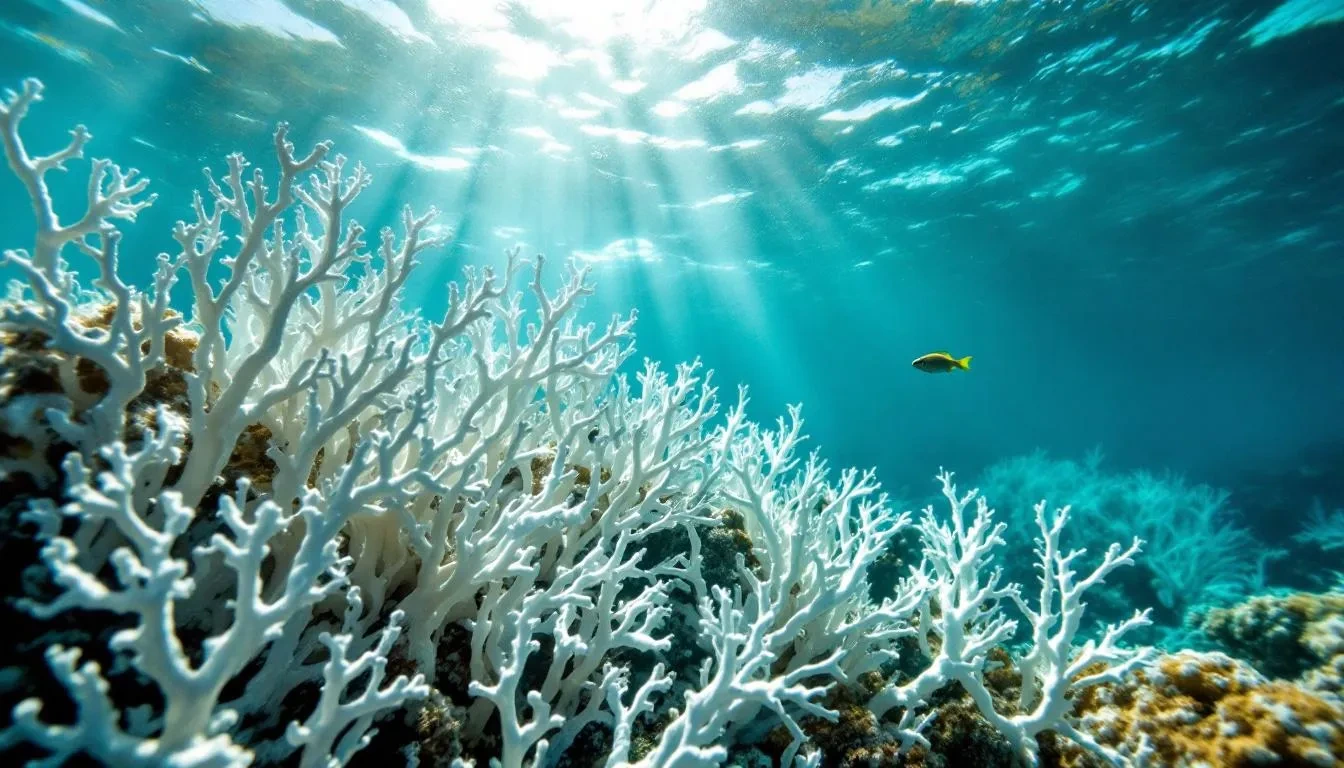
When sea surface temperatures climb just 1°C above the seasonal maximum for eight weeks or more, corals expel the symbiotic algae living in their tissues, turning white in a process known as bleaching. Without those algae, which supply up to 90% of a coral's energy through photosynthesis, the animal begins to starve. Mass bleaching events — when this stress spreads across entire reef systems simultaneously — have been documented with increasing frequency, and the mortality that follows can restructure ecosystems for decades. Understanding the chain of events from thermal stress to tissue loss to population collapse is essential for anyone who cares about the future of tropical coastlines.
The mechanism is deceptively simple: heat disrupts the photosynthetic machinery inside zooxanthellae, producing toxic oxygen compounds that the coral host expels to protect itself. What makes mass bleaching so ecologically serious is that the stress does not stop at aesthetics. Once tissues are lost, pathogens enter, recovery slows, and reproduction fails. The difference between a bleaching event that a reef survives and one that triggers mass mortality often comes down to how long the thermal anomaly persists and how recently the reef experienced a previous event. Reefs that bleach repeatedly have little time to recover before the next thermal spike arrives.
For coastal communities in South Asia, Southeast Asia, and the Pacific, this is not an abstract problem. Reef fish provide protein for hundreds of millions of people, reef structures buffer shorelines from storm surge, and coral tourism generates billions in income annually. When a reef dies, those services do not return on a human timescale. Tracking bleaching patterns, understanding mortality rates across different coral types, and monitoring how fish communities respond are therefore practical priorities, not merely academic ones.
Listen to the Soul of this Article (Narrated)
Coral Bleaching and Mass Extinction: The Ocean Crisis
India's coral reefs — distributed across the Gulf of Mannar, the Andaman and Nicobar Islands, Lakshadweep, and the Gulf of Kutch — sit at varying latitudes and experience different baseline temperatures, which means they do not bleach uniformly during a given thermal anomaly. Research using NOAA Optimal Interpolation Sea Surface Temperature data measured bleaching stress across these regions during multiple mass bleaching years, finding that the intensity and duration of Degree Heating Weeks varied considerably by site. Some areas accumulated thermal stress well above the bleaching threshold while others in the same geographic region remained comparatively buffered (Arora, 2019). This spatial heterogeneity matters because it means that not all Indian reefs face identical extinction risk during a single event, and that refugia may exist within the broader system. However, the same analysis documented that during peak mass bleaching years, Degree Heating Weeks across multiple Indian sites consistently crossed the threshold associated with widespread mortality, not merely sublethal whitening (Arora, 2019).
Much of the early scientific attention on bleaching mortality focused on hard, reef-building corals, but soft corals — which contribute substantially to reef three-dimensional structure and biodiversity — are also severely affected. Research on soft corals following mass bleaching documented tissue loss and mortality across multiple genera, finding that some species suffered colony-level death within weeks of the thermal stress event (Fabricius, 1999). The tissue loss observed was not uniform: certain genera showed faster progression from bleaching to mortality than others, suggesting that species-level differences in thermal tolerance translate directly into differential survival rates during mass events (Fabricius, 1999). This has consequences for reef composition after a bleaching episode. If thermally sensitive soft coral species die at higher rates than tolerant ones, the surviving community shifts in structure, altering the habitat available for the fish and invertebrates that depend on it. Recovery of soft coral colonies to pre-bleaching density and complexity can take years, and during that interval the reef functions differently as an ecosystem (Fabricius, 1999).
The Great Barrier Reef has served as one of the most intensively studied systems for understanding mass bleaching dynamics at scale. Research following a mass bleaching event on the Great Barrier Reef documented the geographic spread and taxonomic breadth of bleaching across reef sites, finding that bleaching was not restricted to a single genus or growth form but affected the broad community of scleractinian corals (Baird, 1998). The observations demonstrated that bleaching severity varied with depth, with shallower corals experiencing more intense thermal stress than deeper colonies on the same reef structure (Baird, 1998). This depth gradient is ecologically significant because it means that deeper portions of a reef can function as partial refugia during a bleaching event, potentially retaining reproductively active colonies that contribute to larval supply during recovery. However, the same research observed that when bleaching was intense, even colonies at depth were not fully protected (Baird, 1998). The Great Barrier Reef data established a foundational empirical picture: mass bleaching is a whole-system phenomenon, not a localized one, and mortality across the community sets the stage for prolonged ecological reorganization.
The year 2024 marked the onset of the fourth confirmed global mass coral bleaching event, affecting tropical reef systems across multiple ocean basins. Research tracking coral bleaching alongside the dynamics of Chaetodon octofasciatus — an obligate corallivorous butterflyfish that feeds directly on coral tissue — in the Gulf of Thailand during this event found that bleaching caused measurable changes in fish behavior and distribution (Festo, 2026). Because obligate corallivores depend entirely on living coral for food, their abundance and foraging behavior serve as a sensitive biological indicator of reef condition. The study observed that as bleaching progressed, fish community metrics shifted in ways consistent with reduced coral cover and food availability (Festo, 2026). This fish-level response documents one pathway through which coral bleaching translates into broader ecological change: the loss of live coral tissue reduces resource availability for specialist species, which in turn affects predator-prey dynamics and the overall trophic structure of the reef. The 2024 event thus produced an empirical record linking thermal anomalies to coral mortality to fish community disruption within a single research timeline (Festo, 2026).
The evidence assembled across these four studies points toward a consistent conclusion: mass bleaching events are not isolated disturbances but system-level disruptions that propagate through corals, soft invertebrates, and fish communities simultaneously. Reef managers, marine protected area planners, and policymakers working in reef-adjacent economies can use spatial thermal stress data to identify which sites accumulate the most Degree Heating Weeks and prioritize those areas for reduced local stressors — such as water quality degradation and fishing pressure — that compound bleaching mortality. Understanding that soft corals and hard corals both experience significant tissue loss and mortality, and that specialist fish respond rapidly to reef degradation, reinforces the case for whole-ecosystem monitoring rather than single-taxon assessments. The scientific record documented here makes clear that protecting reef function requires acting on multiple fronts, from greenhouse gas reduction at the global scale to local stewardship at the reef scale, before successive bleaching events convert recoverable reefs into permanent ecological losses.
Scientists in Bonaire capture coral spawn mid-reef using a canopy-style Multi-Colony Collector, gathering eggs and sperm from dozens of colonies at once without touching the coral. This breakthrough method reveals how scaling larval propagation through smarter collection tech may be humanity's fastest path to saving dying reefs.
Watch on dedicated video page →Colossal Biosciences revived the dire wolf by extracting 72,000-year-old ancient DNA and editing gray wolf genomes to match key extinct traits. Restoring apex predators like this can stabilize entire ecosystems — just as wolves reshaped Yellowstone's rivers, forests, and wildlife.
Watch on dedicated video page →Human destruction of wildlife habitats and the global animal trade are directly fueling pandemic emergence, including COVID-19. Scientists trace every major outbreak — from HIV to SARS — back to human pressure on ecosystems forcing animal viruses to jump to people.
Mohit Arora, PhD
Indian Space Research Organisation
Kurukshetra 136 119, India
Bleaching Stress on Indian Coral Reef Regions during Mass Coral Bleaching Years using NOAA OISST Data — Current Science
K. Fabricius, PhD
Australian Institute of Marine Science
AU
Tissue loss and mortality in soft corals following mass-bleaching — Coral Reefs
A.H. Baird
James Cook University
AU
Mass bleaching of corals on the Great Barrier Reef — Coral Reefs
Elba Festo
Marche Polytechnic University
Center for Oceanic Research and Education (COREsea)
Tracking coral bleaching and Chaetodon octofasciatus dynamics in the Gulf of Thailand during the fourth global mass bleaching event — Coral Reefs
J. E. N. Veron
Ove Hoegh‐Guldberg
Carlos M. Duarte
Aarhus University
Department of Biology, Aarhus University
Rebuilding marine life — Nature
Terry P. Hughes
Madeleine J. H. van Oppen
Garry R. Russ
Ricardo Cavicchioli
UNSW Sydney
School of Biotechnology and Biomolecular Sciences, The University of New South Wales
"ommunities by providing microhabitats that favor carbon-fixing bacteria, leading to increased polysaccharide production and reduced CO2 efflux by 15% through pathways like enhanced nitrogen fixation and altered gene expression for carbon assimilation"
Scientists’ warning to humanity: microorganisms and climate change — Nature Reviews Microbiology
J. Alan Pounds
Inés Mazarrasa
David M. Winker
More from Planetary Health

Ocean acidification disrupts shellfish physiology by lowering seawater pH, which impairs calcification processes in species like oysters and clams, leading to weakened shells and reduced fisheries yields. In juvenile...
Shark conservation is critical as overfishing and finning threaten apex predators that regulate marine ecosystems. Learn evidence-based protection strategies and their ocean-wide impact.

* **Isikgor & Becer (2015)** discuss lignocellulosic biomass as a sustainable platform for bio-based chemicals. The plant material from cover crops, rich in lignocellulosic biomass, is not just a source of nitrogen but also a contributor to soil organic matter. This biomass acts as a carbon sink, im...
Share this article
Coral Bleaching and Mass Extinction: The Ocean Crisis
Coral bleaching is a stress response in reef-building corals caused by sea temperatures sustained at 1-2°C above seasonal averages, often exacerbated by El Nino events. This stress leads to the production of excess...
14 published papers · click to read
15,658
combined citations
Mohit Arora, PhD
Indian Space Research Organisation
Kurukshetra 136 119, IndiaBleaching Stress on Indian Coral Reef Regions during Mass Coral Bleaching Years using NOAA OISST Data — Current Science
21 citations
K. Fabricius, PhD
Australian Institute of Marine Science
AUTissue loss and mortality in soft corals following mass-bleaching — Coral Reefs
35 citations
A.H. Baird
James Cook University
AUMass bleaching of corals on the Great Barrier Reef — Coral Reefs
74 citations
Elba Festo
Marche Polytechnic University
Center for Oceanic Research and Education (COREsea)Tracking coral bleaching and Chaetodon octofasciatus dynamics in the Gulf of Thailand during the fourth global mass bleaching event — Coral Reefs
J. E. N. Veron
The coral reef crisis: The critical importance of<350ppm CO2
428 citations
Ove Hoegh‐Guldberg
Coral Reefs Under Rapid Climate Change and Ocean Acidification
5,876 citations
Carlos M. Duarte
Aarhus University
Department of Biology, Aarhus UniversityRebuilding marine life — Nature
999 citations
Terry P. Hughes
Global warming transforms coral reef assemblages
1,724 citations
Madeleine J. H. van Oppen
Building coral reef resilience through assisted evolution
1,004 citations
Garry R. Russ
Coral cover a stronger driver of reef fish trophic biomass than fishing
78 citations
Ricardo Cavicchioli
UNSW Sydney
School of Biotechnology and Biomolecular Sciences, The University of New South Wales“ommunities by providing microhabitats that favor carbon-fixing bacteria, leading to increased polysaccharide production and reduced CO2 efflux by 15% through pathways like enhanced nitrogen fixation and altered gene expression for carbon assimilation”
Scientists’ warning to humanity: microorganisms and climate change — Nature Reviews Microbiology
2,035 citations
J. Alan Pounds
Widespread amphibian extinctions from epidemic disease driven by global warming
1,948 citations
Inés Mazarrasa
Seagrass meadows as a globally significant carbonate reservoir
164 citations
David M. Winker
The CALIPSO Mission
1,272 citations
Researchers identified from peer-reviewed literature indexed in Semantic Scholar · OpenAlex · PubMed. Each card links to the original published paper.