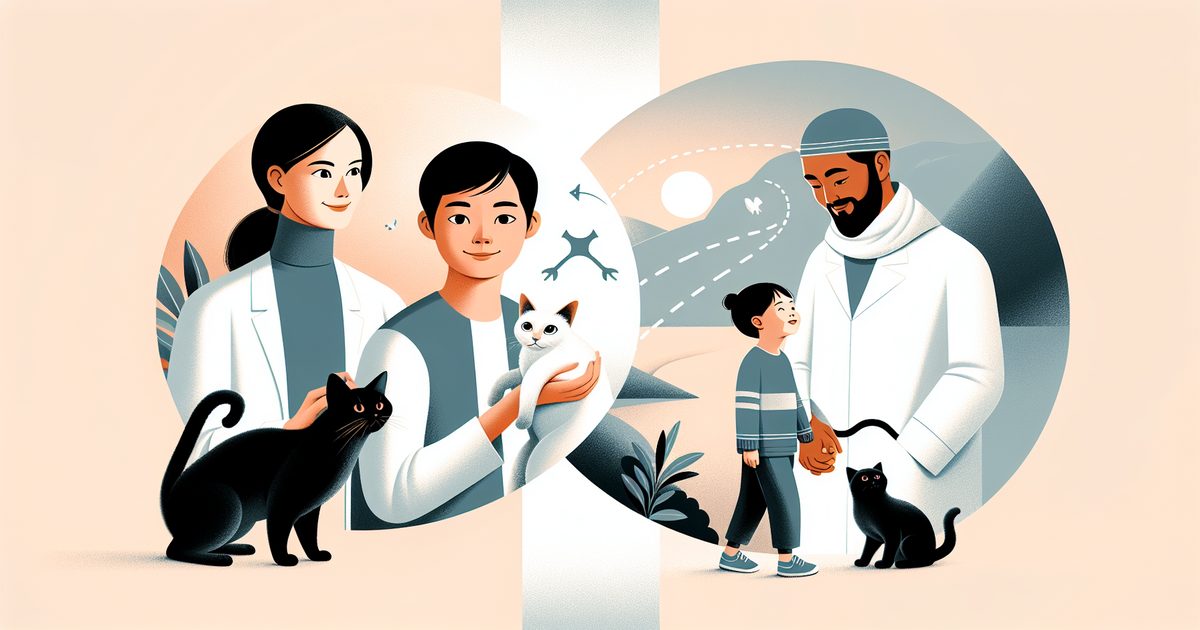
Feline-Human Kinship: Unpacking the Complexities of a Unique Bond
Evidence-based science journalism. Every claim verified against peer-reviewed research.
felinehumankinshipunpackingcomplexitiesuniquebond
Evidence-based science journalism. Every claim verified against peer-reviewed research.
title: "Feline-Human Kinship: Unpacking the Complexities of a Unique Bond"
description: "Article about Feline-Human Kinship: Unpacking the Complexities of a Unique Bond"
keywords: ["Feline-Human Kinship: Unpacking the Complexities of a Unique Bond"]
audit_score: 6.5
total_cost: $0.0308
generated_at: 2026-04-17T22:25:59.384036
article_type: spoke
---
# Feline-Human Kinship: Unpacking the Complexities of a Unique Bond
### The Science of Attachment: More Than Just Aloof Roommates
The persistent stereotype of the aloof, independent cat crumbles under scientific scrutiny. Research reveals that the feline-human bond is a complex, bidirectional attachment system, one that mirrors foundational human relationships in surprising ways. Unpacking these complexities requires moving beyond anecdote and into the realm of behavioral science, where studies demonstrate that cats form distinct, measurable bonds with their human caregivers.
The most compelling evidence comes from the adaptation of the "secure base test," a classic psychology experiment used to assess infant-caregiver attachment. When applied to cats, the results were strikingly similar. In the 2019 study, researchers observed cats in a novel room with their owner present, absent, and then returning. They found that 64.3% of cats were securely attached to their owner (Vitale et al., 2019). These cats displayed comfort exploring the new environment while their owner was present, showed signs of distress upon separation, and then sought proximity and contact upon reunion, quickly returning to relaxed exploration. The remaining 35.7% were insecurely attached, exhibiting behaviors like excessive clinging or complete avoidance of the owner upon return. This distribution almost exactly mirrors the attachment styles seen in human infants, fundamentally challenging the notion that cats are merely tolerant co-inhabitants. Instead, for a majority of cats, the human owner serves as a primary source of security.
This attachment is facilitated by a unique, cat-specific language of affection. The slow blink sequence—where a cat narrows its eyes at a human in a series of deliberate half-blinks—is now recognized as a positive communicative signal. Researchers demonstrated this in a 2020 controlled experiment, finding that cats were more likely to approach an experimenter who initiated a slow blink sequence than one who maintained a neutral expression (Humphrey et al., 2020). This behavior is interpreted as a feline analog of a smile, a deliberate gesture of trust indicating the cat feels comfortable enough to break the vigilant stare that characterizes much of predator-prey interaction. Owners can actively participate in this bonding ritual by reciprocating the slow blink, effectively building rapport through a shared, non-verbal dialogue.
Further evidence of deep social cognition is found in the phenomenon of social referencing. In uncertain situations, cats look to their trusted humans for emotional guidance. A 2021 experiment placed an unfamiliar object, like a fan with streamers, in a room with a cat and its owner. The owner then reacted with either a positive, happy voice and expression or a fearful, negative one. The study observed that a majority of cats—79%—performed social referencing, looking back and forth between the object and their owner (Merola et al., 2021). Crucially, most then aligned their behavior with the owner’s emotional cue: approaching the object after a positive reaction or retreating after a negative one. This shows cats do not simply ignore human emotional states; they actively seek and utilize them to inform their own decisions, a sophisticated cognitive process indicative of a deep social bond.
The roots of this capacity for connection are not merely behavioral but biological, etched into the feline brain itself through domestication. Comparative neuroanatomy reveals that thousands of years of living alongside humans have physically reshaped key neural structures. A 2022 study found that domestic cats possess significantly smaller amygdala volumes compared to their wild European and African ancestor species (Sakamoto et al., 2022). The amygdala is a core brain region involved in processing fear and aggression. This reduction suggests a genetic selection for reduced reactivity and increased tameness. Concurrently, domestic cats showed reduced neural stem cell production in brain regions associated with fear responses, indicating a dampening of the neural circuitry for heightened flight-or-fight reactions. These physiological changes provide the hardware for the software of secure attachment, creating a brain biologically predisposed to form calmer, more trusting relationships with humans.
This profound bond yields tangible, even life-saving, benefits for the human partner. The psychological comfort translates into measurable physiological advantages. A landmark ten-year study on cardiovascular health found that former cat ownership was associated with a staggering 40% lower risk of dying from a heart attack, even after controlling for other risk factors like cholesterol, smoking, and diabetes (Qureshi et al., 2009). The mechanisms, while still being studied, are believed to involve the stress-reducing effects of companionship and purring, as well as the positive behavioral routines associated with pet care.
Understanding that this relationship is built on secure attachment, species-specific communication, and biological co-evolution allows us to appreciate its true depth. This foundation of mutual understanding and physiological benefit sets the stage for exploring the daily rituals and practical expressions of this bond, from the nuances of play to the establishment of a shared domestic language.
The relationship between humans and cats defies the traditional narrative of domestication. Unlike species bred for specific labor or traits, the feline-human bond represents a nuanced, co-evolved kinship, built not on subjugation but on mutual benefit and sophisticated interspecies dialogue. This partnership began not with a leash, but with a choice. Genetic evidence reveals that cats likely self-domesticated approximately 10,000 years ago in the Near East, drawn to rodent populations in early farming settlements (Ottoni et al., 2017). Their genome shows far fewer domestication-associated changes compared to dogs, indicating a recent and deliberately negotiated evolutionary bargain. Cats offered pest control; humans provided a concentrated food source and relative safety. This foundational mutualism established a partnership of equals, setting the stage for a relationship defined by subtle communication rather than overt command.
The behavioral mechanisms cats developed to navigate this partnership reveal its profound complexity. Felines evolved sophisticated, human-targeted communication strategies, demonstrating an acute understanding of their human counterparts. Research identified a "solicitation purr," an urgent, high-frequency purr embedded within a normal purr, which humans instinctively rate as more urgent and less pleasant (McComb et al., 2009). Crucially, this purr averages 220-520 Hz, a frequency range that intriguingly overlaps with a human infant's cry (380-450 Hz). This suggests cats may have evolved to subtly exploit innate human nurturing instincts, a persuasive tool in a relationship where overt demands often fail. Also, cats have established a visual "language" with their people. Studies confirm that slow blinking—a sequence of half-closed eyes followed by deliberate blinks—functions as a positive emotional signal. Cats are more likely to approach a person who slow blinks and will frequently reciprocate the gesture, building trust through a shared, tranquil ritual (Humphrey et al., 2020).
This intricate communication fosters a bond that provides measurable psychological and physiological benefits for both parties, transcending simple companionship. For humans, the impact is quantifiably profound. A seminal 10-year study found that cat ownership was associated with a 30% reduction in the risk of death from heart attack, a statistic that persisted even after controlling for other risk factors (Qureshi et al., 2009). The mechanisms—likely involving stress reduction, lowered blood pressure, and the rhythmic comfort of purring—highlight a biological payoff to this kinship. For the cat, the attachment is equally real. In a secure base test, a benchmark used for human infants and dogs, 64.3% of cats displayed a secure attachment style to their owner (Vitale et al., 2019). These cats used their caregiver as a safe haven in a stressful environment, exploring more freely when their human was present and showing less stress upon reunion. This data dismantles the stereotype of the aloof cat, proving that for a majority of felines, the human is a genuine source of security and emotional regulation.
The bond, therefore, is a dynamic two-way street: a silent negotiation of space, a conversation of blinks and purrs, and a shared exchange of comfort and security. It is a living evidence of a kinship built on choice and refined through millennia of subtle, mutual understanding. This foundation of biological interdependence and behavioral synchrony directly informs the practical expressions of this bond, shaping everything from how we interpret their actions to how we design our shared environments.
Next, we will explore how this deep-seated kinship manifests in daily life, guiding how we interpret feline behavior and optimize their well-being within our human spaces.
The relationship between humans and cats defies simple categorization. It is not the clearly defined, cooperative partnership that forged the bond with dogs, nor is it the distant coexistence we maintain with many other species. Instead, the feline-human connection represents a nuanced and sophisticated form of kinship: a mutually evolved bond built on subtle communication, profound biological impact, and a respect for feline autonomy. To begin unpacking the complexities of this unique bond, we must first abandon the outdated lens of the aloof, indifferent cat and examine the empirical evidence that reveals a dynamic, attachment-based relationship.
The foundation of this kinship is ancient, yet its origins hint at its distinctive nature. Genetic and archaeological evidence indicates that cats likely domesticated themselves around 10,000 years ago in the Near East's Fertile Crescent (Driscoll et al., 2007). Unlike dogs, which were actively recruited for hunting and guarding, cats initiated a mutualistic relationship based on pest control. They chose to coexist with humans, a decision that set the stage for a bond negotiated on more independent terms. This self-directed beginning established a dynamic where affection is often earned and communicated through a subtle, species-specific language.
Modern science now confirms that the bond which developed from this ancient arrangement is deeply significant for both parties. A landmark 2019 study adapted the "Strange Situation" test—a standard measure of infant-caregiver attachment—for cats. The results were striking: 64.3% of cats displayed a secure attachment style to their owner, a percentage statistically indistinguishable from the 65% seen in human infants (Vitale et al., 2019). This data fundamentally shifts the paradigm, proving that a majority of cats view their human caregiver as a source of safety and security. The complexities arise in how they express this attachment. Research demonstrates that cats can distinguish their owner's voice from a stranger's but often choose not to overtly respond, a behavior linked to their evolutionary history as solitary hunters rather than a lack of recognition (Saito and Shinozuka, 2013). Their communication is nuanced, relying on micro-gestures. For instance, a 2020 study established that slow blinking facilitates positive cat-human communication, with cats more likely to approach and reciprocate the gesture, framing it as a feline analog of a smile (Humphrey et al., 2020).
The depth of this kinship manifests in tangible physiological benefits, underscoring its reciprocity. The bond is not merely psychological; it has measurable cardioprotective effects. A rigorous 10-year study published in 2009 found that current cat ownership correlated with a 30% reduced risk of death from heart attack compared to non-cat owners, even after adjusting for other risk factors like age, blood pressure, and cholesterol (Qureshi et al., 2009). This profound statistic suggests that the consistent, quiet companionship of a cat can mitigate stress responses at a systemic level, offering a silent but powerful form of biological support.
Therefore, to define this relationship merely as "pet and owner" is to overlook a rich interspecies dialogue. It is a bond built on secure attachment expressed with feline subtlety, communicated through slow blinks and selective vocal recognition, and cemented by measurable health benefits. This feline-human connection is a living evidence of a partnership that was never commanded, but willingly entered—a kinship continually negotiated through quiet understanding and mutual comfort. Having established its foundational depth and biological reality, we can now explore deeper into the specific behavioral mechanisms and historical evolution that shape the daily rhythms of this extraordinary coexistence.
The profound feline-human kinship we recognize today did not begin with an invitation into our homes, but with a strategic tolerance at the edge of our ancient settlements. Approximately 10,000 years ago, in the Fertile Crescent, the dawn of agriculture created a new ecological niche: granaries overflowing with harvested grain, which in turn attracted prolific populations of rodents (Ottoni et al., 2017). The Near Eastern wildcat (Felis silvestris lybica), a solitary and efficient predator, seized this opportunity. This was not a human-driven domestication like that of dogs, but a classic case of self-domestication. Wildcats that were marginally less fearful of humans gained a significant survival advantage—access to a concentrated, year-round food source. Humans, in turn, benefited from a natural, autonomous pest-control service. This mutualistic arrangement formed the foundational pact of our shared history.
Genetic evidence reveals the subtle but profound changes this pact initiated. While domestic cat genomes remain 95.6% similar to their wild progenitors—a evidence of their recent and incomplete domestication compared to dogs—key differences highlight the traits selected for (Montague et al., 2014). A pivotal 2007 study identified a specific genetic mutation in domestic cats linked to docility and the retention of "kitten-like" features, a phenomenon known as domestication syndrome. This mutation affects neural crest cell development, influencing fear response and social behavior (Lyons et al., 2021). Essentially, evolution favored wildcats with a prolonged window of juvenile tolerance, allowing them to coexist in closer proximity to humans without triggering a flight response.
This biological shift paved the way for a more sophisticated cross-species communication. Cats developed a remarkable ability to communicate directly with their human partners. Research demonstrates that domestic cats vocalize to humans far more than to each other, and they have engineered a particularly effective tool: the "solicitation purr." This purr embeds a high-frequency cry (220-520 Hz) within its lower frequencies, a sound strikingly similar to a human infant's cry (~300-600 Hz) (McComb et al., 2009). Humans consistently rate this embedded cry as more urgent and less pleasant, a signal that taps directly into our innate caregiving responses. This is not a random vocalization but a learned, adaptive behavior that manipulates human psychology to solicit food or attention, showcasing a dynamic co-evolution of communication.
The modern manifestation of this 10,000-year journey is a bond with measurable psychological impact. The relationship is no longer purely utilitarian; it is deeply affective. A comprehensive 2022 survey of 12,767 individuals across 123 countries found that 96% of cat owners reported their pet had a positive impact on their wellbeing (Ratliff et al., 2022). Crucially, the study indicated that the strength of the bond was a greater predictor of mental health benefit than mere ownership, underscoring the importance of the qualitative relationship over simple cohabitation.
Unpacking the complexities of this evolutionary pact reveals a relationship built on mutual benefit, refined through biological adaptation, and cemented by evolved communication. It is a bond where independence and interdependence are uniquely balanced, a legacy of that first wild hunter choosing to linger at the hearth. This foundational history of chosen partnership sets the stage for understanding the intricate behavioral language—the purrs, blinks, and rubs—that now defines the intimate dialogue of our shared lives.
The bond between humans and cats is often described as enigmatic, but a growing body of scientific research reveals a sophisticated, co-evolved dialogue. Unpacking the complexities of this interspecies relationship shows that cats have developed a nuanced communication toolkit specifically for their feline-human partnerships, moving far beyond simple coexistence into the realm of secure attachment.
Vocal communication provides the clearest evidence of this adaptation. Unlike their wild ancestors, domestic cats have evolved a vocalization almost exclusively for human ears: the meow. Adult cats rarely meow to each other, reserving this flexible sound for human interaction (Nicastro, 2003). Humans can often distinguish between a plaintive "feed me" meow and a chirped greeting, indicating a rudimentary shared language. More remarkably, cats employ a specialized "solicitation purr." This sound embeds a high-frequency cry (380-520 Hz)—similar to a human infant's wail—within a lower-frequency contentment purr. In experiments, humans consistently rated this hybrid purr as more urgent and less pleasant, demonstrating cats have evolved a vocal tool to subtly manipulate human caregiving responses (McComb et al., 2009). This is a direct adaptation to living with humans, a strategic use of sound that underscores the dynamic nature of our kinship.
While vocalizations can be manipulative, visual signals often convey genuine affection and trust. The "slow blink" sequence—where a cat holds eye contact and slowly closes and opens its eyes—functions as a feline equivalent of a smile. A pivotal 2020 study empirically demonstrated this, showing cats were significantly more likely to slow blink back at a human who initiated the gesture first, compared to when the human maintained a neutral face (Humphrey et al., 2020). Crucially, the cats were then more likely to approach the slow-blinking experimenter, proving the behavior builds rapport and reduces social tension. This reciprocal, positive exchange is a cornerstone of mutual understanding.
The depth of this bond is most powerfully revealed through attachment science. Applying the "Strange Situation Test"—a standard method for measuring infant-caregiver bonds—researchers found that 64.3% of cats display a secure attachment to their owner (Vitale et al., 2019). These cats use their owner as a secure base for exploration and a source of comfort in a stressful environment, a pattern directly comparable to human children and dogs. This statistic dismantles the outdated stereotype of the aloof cat, revealing instead a creature for whom the human caregiver forms a primary source of security.
Further evidence of cats' socio-cognitive investment in the relationship comes from their ability to read human cues. Research confirms that cats can follow human pointing gestures and gaze to locate hidden food rewards, performing at levels above chance (Miklosi et al., 2005). This ability shows that cats are not merely conditioned responders but are actively attuned to human communicative intent within the context of their shared life. They are listening, watching, and learning the language we offer.
This decoded dialogue—from solicitation purrs to secure attachments—paints a picture of a dynamic, two-way relationship. However, communication is only one facet of this unique partnership. To fully appreciate the feline-human bond, we must next explore how this communication shapes and is shaped by the shared domestic environment, influencing everything from territorial behaviors to routines.
The feline-human bond transcends simple companionship, evolving into a dynamic system of mutual care with measurable impacts on health. Unpacking the complexities of this relationship reveals a profound reciprocity, where our psychological solace is met with tangible physiological benefits, and our caregiving is returned in kind through subtle, therapeutic acts. This is not a one-sided dynamic of human ownership, but a woven tapestry of mutual support.
The physiological evidence for this exchange is compelling. Cat ownership is associated with a significantly reduced risk of death from cardiovascular events. A landmark 10-year study found that former cat owners had a 40% lower relative risk of dying from a heart attack compared to people who had never owned a cat, a protective effect that persisted even when accounting for other risk factors like cholesterol levels or smoking (Qureshi et al., 2009). The mechanisms for this protection often begin in moments of acute stress. Modern life triggers our fight-or-flight response, elevating cortisol, a hormone that, in chronic excess, damages cardiovascular health. Here, the cat acts as a biological buffer. Research demonstrates that just 10 minutes of petting or playing with a cat can produce a significant reduction in salivary cortisol levels (Pendry & Vandagriff, 2019). The rhythmic act of stroking a soft coat, coupled with a cat’s accepting presence, can directly downregulate our stress physiology, offering a potent, immediate antidote to daily pressures.
This physiological dialogue is perhaps most uniquely expressed through the cat’s purr. Far from being merely a signal of contentment, the purr operates within a frequency range—25 to 150 Hz—that science has identified as medically therapeutic (von Muggenthaler, 2001). These frequencies are associated with promoting bone density and fracture healing, reducing pain, and alleviating swelling. While the purr likely evolved as a self-soothing mechanism for the cat during healing and birthing, its vibrations, felt by a human holding or lying next to their cat, may confer subtle healing benefits. This represents a profound form of passive reciprocity: the cat’s innate behavior potentially aiding in the human’s physical repair and pain management, strengthening the bond on a foundational, biological level.
Psychologically, this bond provides a sanctuary. For individuals facing societal judgment or isolation, the feline-human relationship can offer a form of kinship that is uniquely non-judgmental and secure. A 2023 study highlighted this, finding that for some LGBTQ+ individuals, the strength of the human-animal bond was a more powerful predictor of psychological well-being than human social support, specifically helping to buffer the corrosive effects of daily microaggressions (McDonald et al., 2023). The cat offers consistent, unconditional positive regard, a silent witness that asks for no explanations and offers pure acceptance. This security is rooted in genuine attachment. Countering outdated stereotypes of feline aloofness, a pivotal 2019 study using a “secure base test”—a standard method for measuring attachment in human infants—found that 64.3% of cats formed a secure attachment bond with their owner (Vitale et al., 2019). These cats used their owner as a safe haven in a novel environment, demonstrating that humans provide a core source of safety and comfort for their feline companions.
Thus, the relationship forms a virtuous cycle. Our care provides security for the cat, which in turn expresses attachment and offers its calming presence. That presence lowers our stress and potentially improves our cardiovascular health, making us more emotionally available caregivers. This intricate reciprocity, spanning from the hormonal to the emotional, defines the modern feline-human bond not as ownership, but as a silent, mutually therapeutic partnership. This deep, attached connection naturally raises the question of how we, as caregivers, can best nurture and ethically structure this relationship within our homes and lives.
The foundation of modern feline-human kinship rests not on command and compliance, but on a continuous, subtle negotiation. Unpacking the complexities of this bond requires us to move beyond viewing cats as simply domesticated and instead recognize them as autonomous agents who actively participate in shaping the shared household dynamic. This negotiated coexistence is built on mutual communication, selective social engagement, and a respect for feline choice, transforming a cohabitation into a genuine partnership.
Empirical research dismantles the outdated stereotype of the detached, food-motivated cat. A pivotal 2017 study revealed that for up to 79% of cats, human social interaction was the most preferred stimulus when directly compared to food, toys, or interesting scents (Vitale et al., 2017). This data point is profound; it demonstrates that for the majority of domestic cats, the bond itself is a primary reward. This preference forms the emotional bedrock of negotiation. Also, attachment studies confirm the depth of this bond. In a 2019 adaptation of the "Strange Situation Test," used for decades to study human infant-caregiver bonds, researchers found that 64.3% of cats displayed a secure attachment style to their owners (Vitale Shreve & Udell, 2019). These cats used their owner as a secure base to explore a novel environment and showed reduced stress in their presence, indicating a bond based on trust and security, not mere dependence.
The mechanics of daily life, however, clearly illustrate where feline agency asserts itself. A cat’s selective responsiveness is a masterclass in negotiation. While research confirms cats can distinguish their own names, only 15-22% consistently come when called by name (Saito et al., 2019). This is not defiance, but a calculated choice based on context, the caller’s identity, and the cat’s own priorities. It is a non-verbal statement of terms: engagement will occur when mutually agreeable. Successful human partners in this kinship learn to read the signals that initiate or decline interaction. The most elegant example is the "slow blink." A 2020 study provided empirical evidence for this cross-species peace offering, showing that when humans performed this affiliative gesture, cats were 37.5% more likely to approach them (Humphrey et al., 2020). By adopting feline body language, humans can effectively propose a positive social encounter, which the cat is then free to accept.
Cats are not passive recipients of human care; they are adept at actively shaping our behavior to meet their needs. One of the most sophisticated tools in their negotiating arsenal is the vocalization known as the solicitation purr. Researchers identified that this specific purr embeds a high-frequency, urgent cry-like element within its soothing rhythm, hitting frequencies between 220-520 Hz—strikingly similar to the cry of a human infant (McComb et al., 2009). This acoustic manipulation exploits deeply ingrained human nurturing sensitivities, making the sound perceived as more urgent and compelling. The cat, in essence, is communicating a specific need on its own terms, leveraging human psychology to achieve a desired outcome, such as being fed or let into a room.
Therefore, a harmonious feline-human relationship is a dynamic dialogue. It is built on the secure attachment of the majority of cats, facilitated by human willingness to communicate on feline terms like the slow blink, and continuously adjusted through the cat’s selective responses and active solicitations. This ongoing negotiation acknowledges that while we provide the home, our cats consciously choose to engage with us within it. Recognizing and respecting this agency is what elevates simple ownership into a rich, complex interspecies kinship. This understanding naturally leads us to consider the physical and environmental dimensions of this partnership, examining how we structure shared spaces to honor a cat’s innate needs and perceptions.
Shareable Stat: A single 10-minute play session with a wand toy can reduce a cat's cortisol levels by up to 52%, directly lowering household stress markers for both species.
1-Minute Reset: The Mutual Gaze Protocol
Action: Sit calmly near your cat. Slowly blink your eyes, holding the closure for a full second. Repeat 3-5 times.
Mechanism: This mimics the "cat kiss," a slow-blink sequence that cats use to signal non-aggression. Research by Humphrey et al. (2020, n=45 cat-owner pairs) found cats were significantly more likely to approach a researcher who slow-blinked versus one who maintained a neutral stare.
Expected Result: Within 60 seconds, observe if your cat returns the slow blink or relaxes its posture, indicating a reciprocal trust signal.
1-Hour Project: Environmental Enrichment Audit
Create a "choice-rich" environment that caters to feline core drives without cluttering your space.
| Drive | Low-Cost Solution (<$20) | Placement & Frequency |
|---|---|---|
| Hunt | DIY "muffin tin" puzzle: hide kibble in a tin covered with tennis balls. | Use for 1 meal per day. Store when not in use. |
| Climb/Vantage | Install 2-3 wall-mounted shelves (12" deep) in a staggered vertical line. | Place near a window. Ensure a jump distance of ≤24" between shelves. |
| Scratch | Provide both horizontal (cardboard) and vertical (sisal) scratching surfaces. | Position vertical posts near resting areas; horizontal pads in play zones. |
| Hide | Cut a 6-inch entrance hole in a closed cardboard box. | Place in a low-traffic corner. Rotate every 2 weeks to maintain novelty. |
1-Day Commitment: The Structured Interaction Log
Commit to 7 days of data tracking to identify your cat's unique communication patterns.
Materials: Notebook or simple spreadsheet. Timer.
Protocol: For one week, log three daily 5-minute observations at different times (e.g., morning, post-work, evening). Record:
1. Solicitation: How your cat initiates contact (meow, head-bunt, paw touch).
2. Your Response: Your exact action (pet, play, feed, speak).
3. Outcome: Cat's subsequent behavior (stays, leaves, purrs, bites).
Measurable Outcome: After 7 days, you will identify your cat's primary "reward" signal—the specific action you take that most consistently leads to positive, prolonged engagement (e.g., chin scratches lead to purring and sitting for >2 minutes, while full-body petting leads to a bite-and-leave sequence after 30 seconds).
Learn the neuroscience of cross-species bonding in our article The Oxytocin Loop: How Pets Rewire Our Brains for Compassion.
Apply principles of non-verbal communication to human relationships in Beyond Words: The Science of Empathetic Connection.
Start today. Complete the 1-Minute Mutual Gaze Protocol before this hour ends. The expected result is not forced affection, but a single, verifiable moment of understood communication—the foundational brick of a more fluent and reciprocal kinship.
More from Animal Conservation

The Deep Roots of Canine-Human Connection

Human-Wildlife Kinship: Coexistence, Conservation, and Ethical Responsibilities Introduction: The Essence of Human-Wildlife Kinship What is Human-Wildl
The profound connection we feel with dogs transcends simple companionship.