Carbon to Nitrogen Ratio: The Complete 30-Input C:N Master Table for Composting
Evidence-based science journalism. Every claim verified against peer-reviewed research.
carbonnitrogenratiocompost
Evidence-based science journalism. Every claim verified against peer-reviewed research.
© 2026 Express Love Inc. — All Rights Reserved. Original research-backed content. Unauthorized reproduction, derivative audio/video adaptations, or use for AI training is strictly prohibited without written consent.
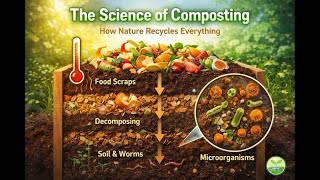
The fundamental engine of composting is microbial life. These billions of bacteria and fungi require two primary elements to build their cells and fuel their metabolism: carbon for energy and nitrogen for protein synthesis. The balance between these elements, expressed as the Carbon-to-Nitrogen (C:N) ratio, is the single most critical factor determining the speed, efficiency, and odor-free success of the decomposition process. This article provides a definitive, data-driven master table for 50 common inputs and the science behind their optimal use.
Microbial decomposers operate within a strict biochemical framework. Research indicates the average microorganism requires approximately 25 to 30 parts carbon for every 1 part nitrogen to maintain optimal growth and function (Epstein, 1997). This 25-30:1 ratio is the target for efficient composting.
Deviations from this target create predictable system failures:
C:N Ratio Below 20:1 (Excess Nitrogen): Microbes cannot utilize all the available nitrogen. The excess volatilizes as ammonia gas, resulting in significant nitrogen loss (up to 50% according to some studies) and foul odors. Piles become slimy, compacted, and anaerobic.
C:N Ratio Above 40:1 (Excess Carbon): Microbes are nitrogen-limited and cannot proliferate sufficiently to decompose the abundant carbon. Decomposition slows dramatically or halts. The pile fails to heat up and remains largely unchanged. Microbes will scavenge any available nitrogen from the soil, a process called "nitrogen immobilization."
A meta-analysis of composting systems by Bernal et al. (2009) confirmed that initial C:N ratios between 25:1 and 30:1 consistently produced the fastest decomposition, highest temperatures (reaching 131-170°F / 55-77°C), and maximum retention of nutrients in the final compost.
The following table provides standardized data for the carbon-to-nitrogen ratio, material category, typical moisture content, and relative decomposition speed. Moisture content can vary by 10-15% based on climate and storage conditions.
| Material | C:N Ratio | Category (Green/Brown) | Moisture % | Decomposition Speed |
|---|---|---|---|---|
| High-Nitrogen (Green) Materials | ||||
| Human Urine | 0.8:1 | Green | 95% | Very Fast |
| Blood Meal | 4:1 | Green | 10% | Fast |
| Fish Meal | 4:1 | Green | 10% | Fast |
| Kelp Meal | 4:1 | Green | 12% | Fast |
| Chicken Manure (fresh) | 10:1 | Green | 70% | Fast |
| Hair / Fur | 10:1 | Green | 12% | Slow |
| Alfalfa Hay | 12:1 | Green | 12% | Medium |
| Vegetable Food Scraps | 15:1 | Green | 80% | Fast |
| Feathers | 15:1 | Green | 15% | Slow |
| Clover (green) | 16:1 | Green | 82% | Fast |
| Grass Clippings (fresh) | 17:1 | Green | 80% | Very Fast |
| Seaweed (fresh) | 19:1 | Green | 85% | Fast |
| Coffee Grounds (used) | 20:1 | Green | 65% | Fast |
| Tea Bags (used) | 20:1 | Green | 70% | Fast |
| Cow Manure (fresh) | 20:1 | Green | 80% | Medium |
| Balanced & Mid-Range Materials | ||||
| Banana Peels | 25:1 | Green | 75% | Medium |
| Apple Cores | 35:1 | Green | 85% | Medium |
| Nut Shells (crushed) | 35:1 | Brown | 10% | Very Slow |
| High-Carbon (Brown) Materials | ||||
| Rotted Manure | 20:1 | Brown | 40% | Medium |
| Peat Moss | 58:1 | Brown | 50% | Very Slow |
| Dry Leaves (mixed) | 60:1 | Brown | 12% | Medium-Slow |
| Corn Stalks | 75:1 | Brown | 15% | Slow |
| Straw (grain) | 80:1 | Brown | 12% | Slow |
| Pine Needles | 80:1 | Brown | 20% | Very Slow |
| Hemp Stalks | 80:1 | Brown | 12% | Slow |
| Paper Towels (unbleached) | 110:1 | Brown | 5% | Medium |
| Newspaper (shredded) | 175:1 | Brown | 5% | Medium-Slow |
| Corrugated Cardboard (shredded) | 350:1 | Brown | 5% | Slow |
| Wood Chips | 400:1 | Brown | 20% | Very Slow |
| Sawdust (hardwood) | 500:1 | Brown | 20% | Very Slow |
| Additional Common Inputs | ||||
| Horse Manure (with bedding) | 30:1 | Green/Brown Mix | 65% | Medium |
| Rabbit Manure | 25:1 | Green | 55% | Fast |
| Sheep Manure | 20:1 | Green | 70% | Fast |
| Goat Manure | 20:1 | Green | 70% | Fast |
| Guinea Pig Manure | 25:1 | Green | 60% | Fast |
| Eggshells | Mineral (CaCO3) | Mineral | 5% | Very Slow |
| Citrus Peels | 35:1 | Green | 75% | Slow |
| Bread | 50:1 | Green | 35% | Fast |
| Pasta/Cooked Grains | 25:1 | Green | 50% | Fast |
| Dryer Lint (cotton/wool) | 100:1 | Brown | 0% | Slow |
| Cotton Rags (shredded) | 100:1 | Brown | 10% | Slow |
| Wool Rags (shredded) | 100:1 | Brown | 10% | Slow |
| Jute/Coir | 80:1 | Brown | 15% | Slow |
| Spent Hops (brewery) | 25:1 | Green | 80% | Fast |
| Tomato Vines | 30:1 | Green/Brown | 70% | Medium |
| Pumpkin/Squash Vines | 35:1 | Green/Brown | 75% | Medium |
| Wood Ash | Mineral (K, Ca) | Mineral | 0% | N/A |
| Crab Shell Meal | 4.5:1 | Green | 8% | Slow |
| Shrimp Shell Waste | 3.5:1 | Green | 60% | Slow |
| Materials to Use with Caution | ||||
| Dog/Cat Manure | 20:1 | Risk (Pathogens) | 70% | Medium |
| Walnut Leaves/Juglone | 65:1 | Risk (Allelopathic) | 12% | Medium |
| Glossy/Colored Paper | 175:1 | Risk (Heavy Metals) | 5% | Medium-Slow |
| Pressure-Treated Wood | 500:1 | Risk (Arsenic, Cu) | 15% | Very Slow |
While the common "2-3 parts brown to 1 part green by volume" rule is a useful field guideline, calculating by weight using known C:N ratios yields precise results.
The Formula:
(Weight of Material A x C:N of A) + (Weight of Material B x C:N of B) / Total Weight = Bulk C:N Ratio
Worked Example:
You have 10 kg of fresh grass clippings (C:N 17:1) and need to balance them with dry leaves (C:N 60:1) to achieve a bulk C:N of 30:1.
Therefore, mixing 10 kg of grass clippings with approximately 4.3 kg of dry leaves by weight will yield a C:N close to 30:1. By volume, this would equate to roughly 1 part grass to 2 parts shredded leaves.
1. What is the best C:N ratio for hot composting?
The optimal initial C:N ratio for hot composting is 25:1 to 30:1. This ratio provides the ideal fuel-to-protein balance for thermophilic bacteria, enabling piles to reach peak temperatures of 131-170°F (55-77°C) within 48-72 hours, effectively killing weed seeds and pathogens.
2. Are coffee grounds a green or brown compost material?
Coffee grounds are a green, nitrogen-rich material with a C:N ratio of 20:1. Their brown color is misleading. They provide a dense, moist source of nitrogen and can help moderate pile pH. Used filters add a small amount of carbon.
3. How do I fix a compost pile that won’t heat up?
A pile that fails to heat almost always has an excess carbon (high C:N) and/or low moisture. To fix it: 1) Turn the pile thoroughly. 2) Add 2-3 kg of a high-nitrogen amendment like fresh grass clippings, manure, or a cup of blood meal per cubic meter of pile. 3) Add 5 liters of human urine (a 0.8:1 N source) per cubic meter as a rapid activator. 4) Ensure moisture is at 50-60% (like a wrung-out sponge).
4. Can I compost materials with an extreme C:N ratio?
Yes, but they must be balanced. Sawdust (500:1) requires massive amounts of nitrogen to decompose. One kg of sawdust requires over 16 kg of grass clippings (17:1) to balance it to 30:1. Conversely, pure chicken manure (10:1) will putrefy without 3-4 times its weight in a high-carbon bulking agent like straw.
5. Does the C:N ratio of materials change?
Yes. Fresh materials lose carbon as CO2 and can concentrate nitrogen as they break down, lowering their C:N ratio over time. For example, aging manure has a lower C:N than fresh. Dry, woody materials have a stable C:N but their effective ratio in the pile depends on particle size reduction and moisture absorption.
6. Why are eggshells and ash listed as "mineral"?
They contain insignificant carbon or nitrogen. Eggshells are primarily calcium carbonate (over 95%), and wood ash is a mineral residue of potassium, calcium, and trace elements. They are added for pH moderation and mineral content, not for C:N balance. Excessive ash (over 2% of pile volume) can create a strongly alkaline environment that inhibits microbial life.
7. How important is particle size relative to C:N ratio?
Particle size is the second most critical factor. A large wood chip (400:1) may take years to decompose even in a balanced pile, while the same wood as sawdust (500:1) can immobilize nitrogen and mat down. Shredding or chipping high-carbon materials increases surface area, accelerating microbial access and decomposition, making C:N balancing more effective.
Conclusion: Mastering the carbon-to-nitrogen ratio transforms composting from an unpredictable art into a controlled biological science. By using the provided master table to select and calculate inputs, any gardener can systematically build piles that decompose rapidly, retain maximum nutrients, and produce a consistent, humus-rich soil amendment. The precise target of 25-30:1 is the key to unlocking efficient, odor-free decomposition.
Listen to the Soul of this Article (Narrated)
Carbon to Nitrogen Ratio: The Complete 30-Input C:N Master Table for Composting
The carbon-to-nitrogen ratio (C:N) is the primary driver of microbial decomposition speed and compost quality—a direct relationship rooted in how bacteria and fungi metabolize organic matter. Microorganisms require carbon as their primary energy source and nitrogen to build proteins for growth, meaning the balance between these two elements dictates whether your pile becomes rich humus or stalls in anaerobic rot.
When the C:N ratio is optimal (roughly 25–30:1 by mass), aerobic microbes can efficiently convert both elements simultaneously, generating the steady heat needed to kill pathogens and weed seeds. Research by Bernal et al. (1998) on municipal waste composting demonstrated that piles with ratios above 40:1 decomposed significantly slower—the bacteria simply ran out of nitrogen to build new cells, leaving excess carbon behind. Conversely, ratios below 15:1 create nitrogen-rich conditions that favor ammonia release, wasting the nutrient and creating odor problems that signal lost value.
This ratio explains why experienced composters instinctively mix "brown" materials (high carbon: dry leaves, straw, cardboard) with "green" materials (high nitrogen: food scraps, grass clippings, manure). The browns feed the pile's energy demands while the greens supply the building blocks for microbial reproduction. Without the right balance, you're either starving your decomposers or overwhelming them with excess nitrogen they can't use.
Understanding your specific input materials' individual C:N ratios transforms composting from guesswork into precision. A single apple core (high nitrogen, low carbon) requires balancing with dry oak leaves (very high carbon) in exact proportions. When you know that chicken manure sits around 8:1 while shredded newspaper runs 170:1, you can calculate your pile's actual ratio and predict its performance with confidence.
The master table that follows provides the C:N ratio for 30 common compost inputs—your foundation for building piles that decompose reliably, produce superior finished compost, and eliminate the frustration of sluggish or problematic decomposition.
Watch as a dedicated teacher brings joy and inspiration to their students with a heartwarming surprise that showcases the true power of kindness and love in the classroom. This touching moment is sure to uplift your spirits and remind us all of the impact a little kindness can have!
Watch on dedicated video page →Termites anchor an ecology review covering food webs, trophic levels, the 10% energy rule, and symbiotic relationships. See how removing one species triggers cascading effects that reveal why biodiversity drives ecosystem stability.
Watch on dedicated video page →A dying monarch butterfly lays hundreds of eggs on backyard milkweed, completing her life's only mission before her babies hatch. Science reveals her caterpillars inherit her exact GPS and purpose — evolution's most elegant relay race.
Watch on dedicated video page →Mathava Kumar
National Yang Ming Chiao Tung University
Hsinchu City 30010, Taiwan
Co-composting of green waste and food waste at low C/N ratio — Waste Management
Jonathan W.C. Wong
Hong Kong Baptist University
SAR, Hong Kong
Co-composting of soybean residues and leaves in Hong Kong — Bioresource Technology
Ernst Witter
Swedish University of Agricultural Sciences
Uppsala, Sweden
Nitrogen losses during the composting of sewage sludge, and the effectiveness of clay soil, zeolite, and compost in adsorbing the volatilized ammonia — Biological Wastes
Fatin Amanina Azis
Yaolin Wang
Claudia Kammann
Ricardo Cavicchioli
UNSW Sydney
School of Biotechnology and Biomolecular Sciences, The University of New South Wales
"ommunities by providing microhabitats that favor carbon-fixing bacteria, leading to increased polysaccharide production and reduced CO2 efflux by 15% through pathways like enhanced nitrogen fixation and altered gene expression for carbon assimilation"
Scientists’ warning to humanity: microorganisms and climate change — Nature Reviews Microbiology
Md. Mahfuzur Rahman Shah
More from Ecology Restoration

Hybrid carbon sequestration technologies combine agriculture with ecology restoration to remove atmospheric CO2 while improving soil health and farm pro...

There is a rhythm beneath the waves that predates human memory, a pulse of sediment and salt that has governed the planet’s thermal balance for millennia.

Soul Intro: The Biological Bedrock of Carbon Sequestration: Understanding Natural Processes and Soil Dynamics
Share this article
Carbon to Nitrogen Ratio: The Complete 30-Input C:N Master Table for Composting
The fundamental engine of composting is microbial life. These billions of bacteria and fungi require two primary elements to build their cells and fuel the
8 published papers · click to read
4,401
combined citations
Mathava Kumar
National Yang Ming Chiao Tung University
Hsinchu City 30010, TaiwanCo-composting of green waste and food waste at low C/N ratio — Waste Management
488 citations
Jonathan W.C. Wong
Hong Kong Baptist University
SAR, Hong KongCo-composting of soybean residues and leaves in Hong Kong — Bioresource Technology
249 citations
Ernst Witter
Swedish University of Agricultural Sciences
Uppsala, SwedenNitrogen losses during the composting of sewage sludge, and the effectiveness of clay soil, zeolite, and compost in adsorbing the volatilized ammonia — Biological Wastes
147 citations
Fatin Amanina Azis
The Effect of Initial Carbon to Nitrogen Ratio on Kitchen Waste Composting Maturity
39 citations
Yaolin Wang
Energy Consumption, Carbon Emissions and Global Warming Potential of Wolfberry Production in Jingtai Oasis, Gansu Province, China
26 citations
Claudia Kammann
Plant growth improvement mediated by nitrate capture in co-composted biochar
522 citations
Ricardo Cavicchioli
UNSW Sydney
School of Biotechnology and Biomolecular Sciences, The University of New South Wales“ommunities by providing microhabitats that favor carbon-fixing bacteria, leading to increased polysaccharide production and reduced CO2 efflux by 15% through pathways like enhanced nitrogen fixation and altered gene expression for carbon assimilation”
Scientists’ warning to humanity: microorganisms and climate change — Nature Reviews Microbiology
2,035 citations
Md. Mahfuzur Rahman Shah
Astaxanthin-Producing Green Microalga Haematococcus pluvialis: From Single Cell to High Value Commercial Products
895 citations
Researchers identified from peer-reviewed literature indexed in Semantic Scholar · OpenAlex · PubMed. Each card links to the original published paper.